

The reasons
On March 6, 1975, the Algiers Agreement between the Iranian monarchy and the Iraqi Ba'athist government ended The September Revolution As a result of this agreement and the cessation of the revolution, most of the revolutionary leadership and members of the Kurdistan Democratic Party (KDP) fled to Iran and neighboring countries with their families Europe continued their activities.
The Algiers Agreement that led to his collapse The September Revolution The displacement of more than 180,000 Kurds to Iran created a sense of complete victory over the Kurds among the Iraqi Ba'athist authorities and even the Iranian monarchy He had led the Kurdish movements in Iraq since the beginning of the formation of the country, so he began to implement the conspiracy to destroy Kurdistan and the policy of deportation and Arabization, after the collapse of the revolution by the Ba'ath regime began to change Kurdistan was demographized and soon a large area of Kurdistan was subjected to deportation and a large number of Kurdish citizens were settled in forced communities. The Iranian monarchy, like Iraq, considered itself successful against the Kurds It seemed that they were taking revenge on the March 11, 1970 agreement or on the president Mustafa Barzani Iran closed its borders to refugees at the request of the Iraqi government and opened camps to Iraqi officials to encourage them to return to Iraq The most remote border areas in eastern and southern Iran have been moved
This unfavorable and dangerous situation had put the struggle of the Kurdistan Democratic Party in South Kurdistan in danger of disappearing and nearing its end Massoud Barzani In consultation with his elder brother Idris Barzani, a proposal was made to reorganize the organs of the PKK and the revolution by Massoud Barzaniwas presented to the President Mustafa Barzani, he agreed, as early as April 1975 by Massoud BarzaniPreparations for the revolution began.
Preparations for the revival of the revolution
After the Naghdeh meeting on April 2, 1975, President Mustafa Barzani ordered him to reorganize the party and revolutionary organs Massoud Barzani He was deported to Tehran by the Iranian authorities Massoud Barzani After consultations and discussions, they agreed that Idris Barzani should supervise the affairs of Iranian refugees Massoud BarzaniAt the same time, contacts were made in Naghdeh, East Kurdistan, with the old leadership and prominent cadres They were closely monitored by the Savak intelligence agency, relying more on young cadres, especially those with whom they had previously worked Massoud Barzani They had worked and could be more reliable in such a situation.
On April 15, 1975, the first secret meeting of the party was held on a spring near Naghdeh called Hawt Cheshma Massoud Barzani, Jawhar Namiq Saleem, Karim Sinjar, Azad Barwari and Mohammad Reza The meeting was attended by Jawhar Namiq Salim, Karim Sinjar, Azad Barwari, Arif Taifur, Dr. Kamal Kirkuk and Sherko Ali should be sent back to South Kurdistan Sami Abdulrahman and Mohammad Reza to be sent to Europe, and to supervise the work of refugees Idris Barzani, Ali Abdullah, Mohsen Dzeyi, Falakeddin Kakeyi and Franco Hariri It was also decided to rejoin the cadres and Peshmergas who had remained in Iraq and Syria as soon as possible Massoud BarzaniTwo letters to Mohammed Khalid Bosali and Jalal Talabani who was then in Syria were sent.
In June 1975, Tariq Akreyi, head of the sixth European branch and president of the Kurdish Students Association, and his wife Shirin Katani secretly returned to Iran and met the president in Tehran Mustafa Barzani fell, then to see him Massoud Barzani Other comrades went to Naghdeh in June in his presence Massoud Barzani, Idris Barzani, Tarq Akreyi, Sami Abdulrahman, Ali Abdullah and Dr. A.SMahmoud Osman A secret meeting was held and the first draft of the party's statement after the collapse of the revolution was prepared on behalf of the European branch. It was also decided to hold the conference of the sixth European branch and the congress of the Kurdish Students Association in Europe The draft statement was later submitted to the president Mustafa Barzani In Tehran, it was taken to Europe and published there.
In response to the efforts of the Kurdistan Democratic Party (KDP) leadership to reorganize and quickly revive the revolution, by Jalal TalabaniOn May 25, 1975, the formation of a semi-front called the Kurdistan National Union (KNU) was announced in Syria.
September 1975 President Mustafa Barzani He was sent to the United States for treatment under the intensive supervision of the Iranian intelligence agency SAVAK. Massoud Barzani He visited the United States and returned to Iran on October 10, 1975, after receiving treatment.
After the return of the president Mustafa Barzani, Massoud Barzani, a large number of refugees in different parts of Iran in order to learn about the president's illness Mustafa Barzani On the same occasion, the PKK cadres who had been assigned to revive the PKK's secret organizations surrounded him again Massoud Barzani and the PKK leadership met.
on request Massoud Barzani After the reunion of the comrades, in mid-November 1975, a secret meeting was held at his home Massoud Barzani and in his presence Jawhar Namiq, Karim Sinjar, Arif Tayfoor and Mohammad Reza in Azimiyah, Karaj, the meeting took several important decisions, including the establishment of a joint leadership between the old and new leadership of the PKK. Returning to South Kurdistan and re-establishing armed detachments and secret organizations of the party and revolution. For this purpose, it was decided to divide the regions of South Kurdistan into two regions, Region One and Region Two, later known as Badinan and Soran Both regions were freed to carry out their own activities in other Iraqi cities. For this purpose, Jawhar Namiq and Karim Sinjar As the leadership of the first region (Badinan) and Arif TayfoorSherko Sheikh Ali Sargalo and Sheikh Aziz Sheikh Yousef have been appointed as the leaders of the second region (Soran).
It was also decided to issue a statement at the meeting. Massoud Barzani He instructed his comrades to write the statement. Karim SinjarAfter returning to Tehran, Arif Tayfour and Hama Reza rewrote the statement. The next day, the comrades went back to him in Karaj Massoud Barzani There, the statement was re-evaluated and submitted to the president after minor amendments Mustafa Barzani He agreed to publish the statement. It was decided to publish the statement in Naghdeh. It was not yet clear under what name the statement would be published. It was there that the name of the interim leadership of the Democratic Party was decided for the first time Kurdistan was given the interim leadership, and later published on December 10, 1975 under the same name and entitled Kurdistan is the real arena of struggle.
Interim leadership
In mid-November 1975, a secret meeting in Karaj decided to establish an interim leadership for the party, as the central committee of the Kurdistan Democratic Party (KDP) had brought about the situation that had brought about the Kurdish revolution and people Especially after leaving the country, their displacement and the disruption of the internal organizations of the Kurdistan Democratic Party (KDP) had practically collapsed.
According to the party's internal program and rules, the members of the central committee must be elected at the congress by the vote of the congress delegates, but the post-NSC situation on the one hand and on the other hand the intense surveillance by the Iranian intelligence agency The activities of party members were controlled by the SAWAK, and holding a congress seemed impossible. That was at the mid-November meeting in Karaj and then in consultation with the president Mustafa Barzani It was decided to appoint a new leadership for the party, but because the new members were not elected through the congress, it was decided to add a temporary suffix to the leadership until the opportunity to hold a party congress They remained members of the party's interim leadership, thus establishing the party's interim leadership, known as the interim leadership.
In the first step, the number of members of the PKK's interim leadership was only seven Massoud Barzani, Idris Barzani, Jawhar Namiq, Karim Sinjar, Arif Tayfoor, Hama Rezai and Azad BarwariThus, the members of the new interim leadership were generally young, except Idris Barzani and Massoud Barzani Members of the PKK Central Committee before NSK The September Revolution The others were appointed to the interim leadership after the dissolution of the central committee at the Karaj meeting. In order to further develop the collective work and reorganize the political and military organs of the party, it was decided to contact the members of the old central committee who had remained in Iran and were present within the framework of the Kurdistan Democratic Party Give their political struggle and benefit from their political experience, especially among themselves Sami Abdulrahman and Dr. Mahmoud Osman . . . . After visiting and discussing each of the Sami Abdulrahman, Nuri Shawes and Ali Abdullah They were added to the party's interim leadership Kamal Kirkuk After that Arif Tayfoor He was arrested by the Iranian government and sent back to South Kurdistan as the head of the second region. His name was also included in the list of members of the interim leadership, thus bringing the number of members of the interim leadership to eleven Berlin, August 11, 1976: Four more members were added to the provisional leadership Warya Saati, Dilshad Miran, Brave Khafaf and Abdul Rahman gave it to you, bringing the number of members to fifteen and fever 9th Congress of the Kurdistan Democratic Party In 1979, the names remained the same.
The revival of the revolution
After the election of the interim leadership of the Kurdistan Democratic Party (KDP), the division of South Kurdistan into two regions, Soran and Badinan, the rebuilding of the party and Peshmerga organizations in these two regions and abroad The Kurdish people have been displaced and destroyed in Kurdistan's villages Kurdistan Democratic Party He arrived in southern Kurdistan on April 28, 1976 against the Iraqi Ba'athist regime Massoud BarzaniA secret meeting was held in which Mohammad Reza, Arif Taifur and Azad Barwari participated. In this meeting, the final decision was made on the redistribution of duties and preparations for the armed revolution.
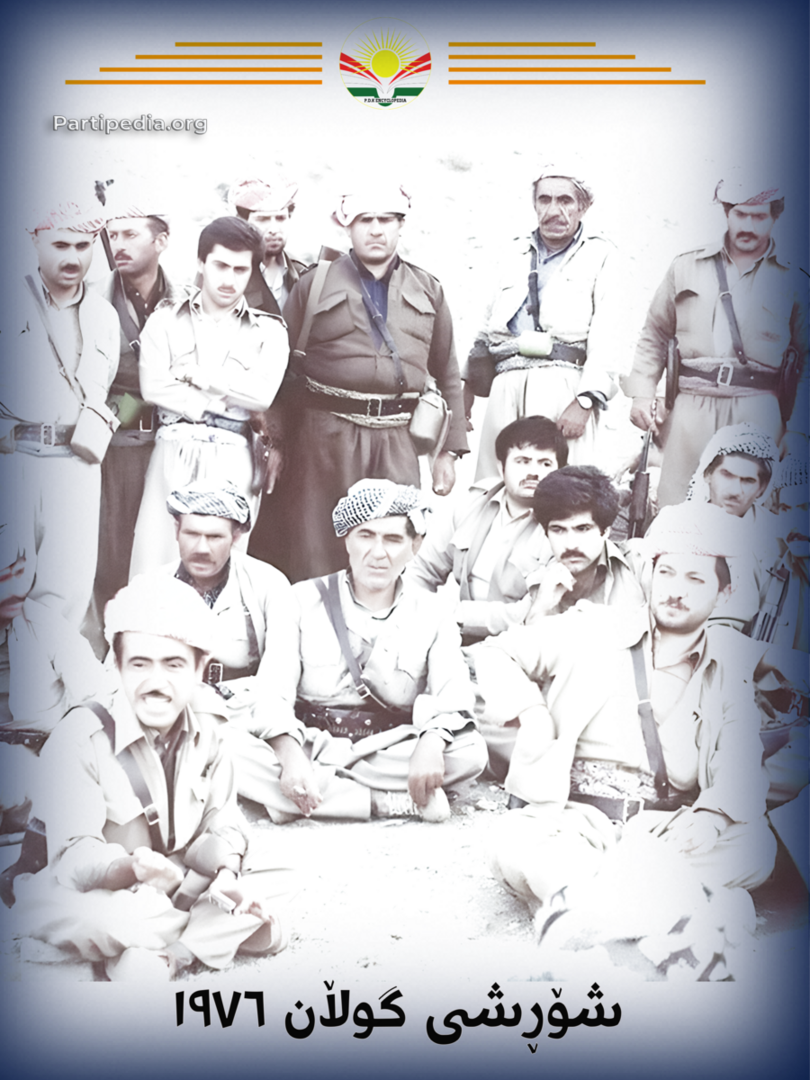
In general, May 1976 was the month of the resumption of guerrilla and armed activities against the regime army. Initially, a Peshmerga detachment under the interim leadership clashed with the regime army in the areas of Amedi and Zakho A number of regime soldiers were killed, and regime forces were forced to use air force after the clashes and bombed the areas of Nerwa and Rekani on the Iraqi-Turkish border, after a reassessment of the situation by the party leadership on May The first bullet of the revolution was fired on May 26, 1976 at 4 am against the army of the Ba'athist regime.
On May 26, a PKK Peshmerga detachment was ambushed by the regime army in Zeno near Haji Omeran, after fighting broke out between the two sides, killing eight Iraqi soldiers and wounding 12 others Sayyid Abdullah The commander of the PKK battalion was martyred and became the first martyr of the revolution after the collapse of the September Revolution. On the same day, another armed detachment of the PKK's interim leadership attacked a regime army position in the village of Kashani in Badinan region under the command of Abu Nawal Clashes have resumed on the Turkish-Iraqi border.
In general, during the years (1976-1979), which is considered the first phase of the May Revolution and is supervised by the interim leadership, despite all the difficulties and ups and downs, despite its formation Several other armed political organizations in southern Kurdistan moved to the mountains of Kurdistan in the name of revolution, where they put their opposition to the Kurdistan Democratic Party (KDP) ahead of their opposition to the Ba'athist regime According to the military statements of the interim leadership, the fighting between the Peshmerga forces and the regime army continued despite the heavy casualties At that time, most of the border areas were controlled by the Peshmerga forces of the revolution and the government had no authority over them. Battle of Bangird October 11, 1976, The Battle of Sharsten December 26, 1976, Battle of Govke and The Battle of Belmbir May 25, 1977 and the Battle of Qasrok in 1978 were recorded as the basis for the continuation of the revolution in later years.
Ninth Congress and dissolution of the interim leadership
On June 19, 1976, the President Mustafa Barzani He was sent back to the United States for the second time under intensive surveillance by the Iranian intelligence agency SAVAK. Massoud Barzani He accompanied President Mustafa Barzani on the trip, which was scheduled to last six weeks and then return to Iran, but their return was delayed until 1979 and the death of the President Mustafa Barzani It took a long time.
During this period, the party's organizations inside the country were controlled by the interim leadership, most of whom had returned to South Kurdistan Sami Abdulrahman Especially after the Berlin Conference, the party was given a completely Marxist face that was far from the original policy of the PKK and Barzani's path Berlin Conference by the Sami Abdulrahman In order to consolidate its position, it added four of its supporters to the interim leadership, amended the party's program and internal rules, and published a critical pamphlet entitled The Path of the Kurdish Liberation Movement It defined the leadership of the revolution and the line on which the PKK would fight from now on.
Although these actions of some members of the interim leadership, especially Sami Abdulrahman, were not to the liking of the PKK leadership, but in order not to damage the unity of the PKK and the revolutionary organizations, the solution for a convenient time postponed.
In February 1979, the monarchy collapsed and was replaced by the Islamic Republic Mustafa Barzani On March 1, 1979, the new Iranian authorities agreed to return Mustafa Barzani's body to Iran for a temporary burial In March 1979, his body was brought back to Iran and buried in Shino, East Kurdistan.
Participation in the funeral of President Mustafa Barzani in East Kurdistan was a reason for all members, cadres, Peshmergas and party leadership to meet again and decide on the fate of the party after the president The meeting decided to hold the ninth congress of the Kurdistan Democratic Party (KDP).
He was born on November 10, 1979 in Zeveh camp, west of Urmia, East Kurdistan Ninth Congress of the Kurdistan Democratic Party was held unanimously as a result of this congress Massoud Barzani He was elected party leader and a new central committee was appointed to replace the interim party leadership. The party and military organs of the revolution were reorganized and the party was brought back on track to some extent already.
Regional situation after 1979 and The May Revolution
After the change of regime in Iran, political power in Iraq also changed. President Ahmad Hassan Bakri resigned and was replaced by Saddam Hussein on July 17, By Saddam Hussein, the regime's policy towards the Kurds deteriorated. The Ba'ath government deployed five divisions, 50,000 police, border guards, and reserve forces to control the borders where the Peshmerga bases were established After several small battles, the regime was unable to prevent the Peshmerga from expanding their military activities, so in June 1979 the Iraqi air force bombed several villages in East Kurdistan under the pretext of the presence of the Peshmerga. The situation of the Peshmerga forces on the Turkish border also deteriorated when Ali Haider Ozga, the head of the Turkish intelligence agency, visited Baghdad on March 29, 1979, to resolve the border dispute between the two countries Thousands of Kurds from Northern Kurdistan fled to neighboring countries after a military coup by General Kanaan Efrin. The Turkish government deployed thousands of troops in the border areas of Syria, Iraq and Iran They were ordered to attack PKK Peshmergas and other Kurdish forces near the border.
On August 16, 1979, a republican decree was issued in Saddam's name, which called for the release of all political prisoners and a general amnesty for all Kurds who had gone to the mountains or gone abroad and returned. Those who have been amnestied should be allowed to return to their former jobs, and Kurds who were deported to central and southern Iraq, but were settled in forced labor camps after their return, should be allowed to return to Kurdistan.
On September 22, 1980, after the breakdown of relations, war broke out between Iraq and Iran. The Kurdistan Democratic Party (KDP) was the archenemy of the Ba'ath regime and had already launched a revolution against it and used Iranian aid to advance its national goals.
The Jude Front
After the victory of the Islamic Revolution in 1979, the Iraqi opposition forces tried to unite their ranks and strengthen their ties in order to establish a strong national front He advocated the formation of a political front and one of the decisions of the congress was to form a broad front in Kurdistan and Iraq The Kurdistan Socialist Party (HSK) was forced to sever ties with the PKK, thus frustrating attempts to form a joint opposition front.
On November 12, 1980, the Juqad Front, abbreviated as the National Democratic Front, was formed in Syria with the aim of creating a unified Iraqi opposition front against the Ba'ath regime One of the parties is the Ba'athist Arab Socialist Party (Iraqi Regional Leadership), the Arab Socialist Movement, the Iraqi Communist Party, the Iraqi Socialist Party, the Iraqi People's Liberation Army, the Independent Democrats, the Kurdistan National Union and the United Kurdistan Socialist Party Although the representatives of the Communist Party tried hard to get the PUK to participate in this front, the PUK refused and the Ba'ath Party, the leadership of the Iraqi Region, and the Arab Socialist Movement supported the PUK's position.
After several parties refused to allow the PKK to become a member of the Juqad Front, the Kurdistan Socialist Party and the Iraqi Communist Party joined the PKK and on November 28, 1980, a new front called Jude was announced.
On November 28, 1980, a cooperation agreement was signed between the PKK, the HSK and the HSH in the village of Kawpar in Khane, East Kurdistan Massoud Barzani, Ali Abdullah, DrMohammed Saleh Juma, day Nuri Shawes On November 29, 1980, the news of the establishment of the Jude Front was broadcast on Voice of Kurdistan Radio It was the fall of the Ba'ath regime, the establishment of a democratic, national and genuinely autonomous regime for Kurdistan and the end of the war between Iraq and Iran. This front was supported by the Islamic Republic of Iran. On November 10, 1981, PASOK joined the Jud Front, but the formation of the front failed to bring together all the opposition forces instead of party conflict Frontline conflict had emerged, leading to deepening conflicts and civil war between Kurdish parties.
Political and military situation (1980-1986)
After the reorganization of the party organs and the Peshmerga forces of the Kurdistan Democratic Party (KDP), especially after the outbreak of the Iran-Iraq war, the Peshmerga activities against the regime's army resumed in the border areas The PKK's Peshmerga forces dominated the Iraqi army, while the PUK was constantly looking to make up for its 1978 defeat in the Turkish border areas and Hakkari at the hands of the PKK's interim leadership forces On May 14, 1980, with the help of the Ba'ath government, they resumed fighting against PKK forces in Alwatan. The PUK's attacks later spread to the PKK's allies, and the fighting turned into a war with the PKK The Ba'athist authorities brutally destroyed villages, displaced people and cleansed them. In 1980, more than 10,000 Failis were killed They were disappeared. In May 1983, after Ali Hassan Majid was appointed head of the Ba'ath Party's northern affairs, more than 8,000 Barzanis settled in the forced communities went missing.
Tehran Peace Congress 1986
In 1985, relations between the PUK and the Iraqi Ba'ath Party broke down after the failure of negotiations. In October 1986, a political-military agreement was signed between the PUK and the Islamic Republic of Iran, which led to joint military operations against the regime The Revolutionary Guards' invasion of Kurdistan through the Kurdistan National Union (KNU) and the drilling of oil wells in Kirkuk caused a strong reaction from the Ba'athist government and began to destroy Kurdish villages, especially in the Kirkuk border.
In late 1986, the Iranian government tried to unite the Iraqi opposition forces against the Ba'ath regime and hold the Iraqi People's Cooperation Congress in Tehran Tehran, the capital of Iran, Idris Barzani He participated in the congress as the head of the Kurdistan Democratic Party (KDP) delegation and played a major role in bringing peace between the parties, especially the PUK and KDP, and strengthening their alliance with the Islamic Republic of Iran.
The Ba'ath regime's attitude after the Tehran Peace Conference
In early 1987, all the border areas of Kurdistan were liberated by the Peshmerga. On February 12, 1987, Iranian forces, with the help of PUK and KDP forces, attacked Haji Omeran in the east In May 1987, the Ba'ath Party leadership decided to appoint Ali Hassan Majid as the secretary general of the Northern Bureau, replacing Mohammed Hamza Zubeidi He issued several decisions at the beginning of his tenure, such as considering the areas where the Peshmerga are in the restricted areas, shooting and killing in these areas were released without any conditions, on June 1987 According to the decision of the Iraqi Revolutionary Leadership Council No. 457, all agricultural directorates in all Kurdistan cities and towns were abolished and all kinds of agricultural equipment were banned.
In 1988, after the weakening of the Iranian army, the Ba'ath army launched its brutal attacks on Kurdistan, bombing the revolutionary bases and chemical attacks on Kurdistan's cities and villages. He began to continue the campaign of massacre (Anfal) and genocide of the Kurdish people. Throughout 1988 alone, more than 180,000 Kurds were disappeared and Anfal in eight stages from Garmian to Badinan.
Kurdistan Front
The idea of forming a unified Kurdistan front in South Kurdistan began for the November 1986 meetings between the Kurdistan Democratic Party (KDP) and the Kurdistan Democratic Party (KDP). Idris Barzani and the Kurdistan National Union Jalal Talabani After the victory of the Tehran Peace Conference in February 1987, the two sides issued a joint statement on their efforts to form a Kurdish front and pledged to support the Peshmerga forces On July 18, 1987, the Kurdistan Democratic Party (KDP), the Kurdistan National Union (KNU), the Socialist Party, PASOK and the People's Party met at the headquarters of the Kurdistan Democratic Party (KDP) Political Bureau. On July 30, 1987, a joint statement was issued outlining the goals of the Kurdistan Front.
After several meetings between the political parties in South Kurdistan, especially the peace agreement between the PUK and KDP in the autumn of 1987, the Kurdistan Front was established on May 2, 1988 and began its activities on May 12 of the same year It was held in early June 1988 in Khawkurk.
Until 1988, Kurdish forces and parties in South Kurdistan were supported by the Islamic Republic of Iran against the Ba'ath regime He began to attack Kurdistan and the Peshmerga forces with all his might. In response, on July 20, 1988, at a meeting of the central committee of the Kurdistan Democratic Party (KDP) under the chairmanship of the president Massoud Barzani The decision was made to defend and resist and the battle fronts were opened in the areas of Khrna and Khawkurk Massoud BarzaniLater, as a result of the attacks of the regime army on the headquarters of the Peshmerga forces, many battles and heroism were recorded by the Peshmerga forces. Of course, the battle of Khawkurk is one of its pride and sovereignty The Kurdish people at that stage.
The May Revolution It was the result of all the revolutions waged by the Kurdish people against successive Iraqi regimes over the past decades, which resulted in the creation of the Kurdistan Front, the unification of Kurdish forces in South Kurdistan and the 1991 spring uprising He achieved the long-standing dream of the Kurdish people in South Kurdistan by creating an independent protected region.
The most important battles of the second phase of the revolution (1980-1988)
After the end of the first phase of the revolution, which lasted from 1976-1979 and was considered the period of interim leadership, after the death of the president Mustafa Barzani and freezing 9th Congress of the Kurdistan Democratic PartyA new phase of the revolution against the regime began, which coincided with the outbreak of the eight-year war between Iraq and Iran They expanded the battle fronts against the Ba'ath regime and even after the cessation of the war between the two countries, the fighting continued by the Peshmerga forces of the revolution, despite all the internal problems and complications by its forces The Peshmergas of the revolution recorded many battles and heroic stories against the regime army that day by day brightened the horizon for the future of the Kurdish people and gave them the good news of a complete victory The spring uprising of 1991 led to the liberation of South Kurdistan.
- Battle of Kani Sef, 20 October
- Battle of Haji Omeran, 18 October
- Battle of Mount Sorin, early
- Battle of Biara, 3 December
- Battle of Sharazoor, 31 May
- Third Battle of Gara, 10 December
- Battle of Sharman, 29 March
- Battle of Said Sadiq, 16 April
- Battle of Kanyelnja, 21 November
- Battle of Akre,
- Battle of Duhok, August
- Battle of Sarsang, spring
- Battle of Karadag, June
- Battle of Amedi, 8 October
- Battle of Zakho, 12 October
- Battle of Basque, 20 December
- Battle of Ahmadawa, 1 July
- Battle of Atrosh, 4 December
- Battle of Bamerni, 26 May
- Battle of Basra, 27 July
- The story of Kani Mase , 13 September
- 11 December 1987 - Battles between Amedi and Derelok
- Battle of Karadag, 20 April
- Battle of Deir Ezzor, 5 August
- Battle of Hiran, 16 August
- Battle of Diyarbakir, 11 December
- Battle of Balisan, 26 February
- Battles in Zakho to Batufa, 26 February 1988
- Battle of Halabja, March 12,
- Battle of the 143rd Battalion, 13 March
- Battle of Zakho, 8 December
- Battle of Mandil, 10 December
Sources:
- Massoud Barzani, Barzani and the Kurdish Liberation Movement, 1958-1961, Volume II, (2012).
- Massoud Barzani, Barzani and the Kurdish Liberation Movement 1961-1975, Volume III, Part I, (Erbil, Ministry of Education Printing House, 2004).
- Massoud Barzani, Barzani and the Kurdish Liberation Movement 1961-1975, Volume III, Part II, (Erbil, Ministry of Education Printing House, 2004).
- Massoud Barzani, Barzani and the Kurdish Liberation Movement 1961-1975, Volume 4, Part 1, (Erbil - Roxana Printing House - 2021).
- Massoud Barzani, Barzani and the Kurdish Liberation Movement 1961-1975, Volume 4, Part 2, (Erbil - Roxana Printing House - 2021).
- History of Kurdistan Democratic Party (KDP), Congress and Conference (Program and Rules of Procedure). Kurdistan Democratic Party Encyclopedia Board, Volume 1, (Erbil- Rojhelat Printing House- 2021).
- Salah al-Khursan, Political Preparations in Iraqi Kurdistan, Reading in the Files of Kurdish Movements and Parties in Iraq 1946-2001, (Beirut – Al-Bagh Printing House – 2001m).
- Habib Mohammed Karim, History of the Kurdistan Democratic Party - Iraq (in the headquarters) 1946 - 1993, (Duhok - Khabat Printing House - 1998m).
- Dr. Sherko Fathullah Omar, Kurdistan Democratic Party and the Kurdish Nation's Liberation Movement 1946-1957, p. Suwara Qaladzeyi, (Shahid Azad Hawrami Printing House - 2013).
- Archive of the Kurdistan Democratic Party Encyclopedia Board.