

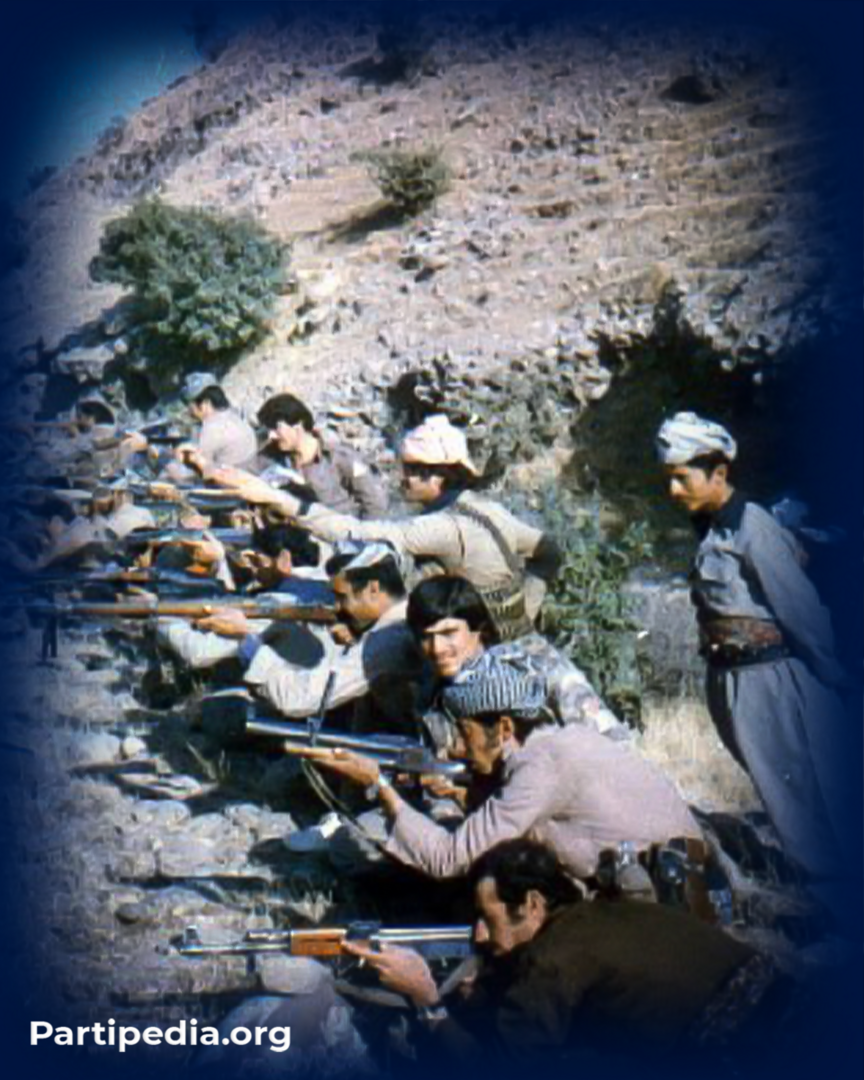
Haji Omaran is located 183 km northeast of Erbil, in the Choman district, on the border of the Kurdistan Region and the Islamic Republic of Iran. The geographical location of the region has been the cause of many important historical events, especially in the Kurdistan revolutions, the most important of which was the start of the September Revolution (1961-1975) was led by Mullah Mustafa Barzani, at the beginning of May Revolution The first martyr of the revolution in that region was Martyr Seyid Abdullah on May 26, 1976. In addition to that, other wars and epics took place there. From 1980 to 1988, Haji Omaran and its villages were completely destroyed for three years due to the eight-year war between Iraq and Iran. Then, in the spring of 1991, due to the great Kurdish uprising, the region was completely rebuilt.
After starting May Revolution, the headquarters of the Political School of the Democratic PartywillThe Kurdistan Democratic Party (KDP) was in the village of Kewper in Khan (Pîranşar) in Eastern Kurdistan. It seems that the Iraqi army artillery was harassing Haji Omaran with indiscriminate artillery. Therefore, the leadership of the revolution decided to do something to remove the artillery. For this purpose, a force of 60 peshmerga under the command of Zikri Yahya Khan, Yasin Beroxî, Ehmed Keshxay Gelalî, Hesen Axa Zewayî and Omar Osman was assigned to carry out the operation. The force climbed from the Haji Ibrahim Valley to Qandil Bicuk and headed towards Mount Kodo. Their position was in the Haji Omaran, Rayat, Çoman and its surroundings. From there, the Iranian artillery was told to start shelling the Iraqi regime's artillery battalion and the Haji Omaran military center. After determining the location, the Iraqi army's base and artillery were heavily shelled for 2-3 days. As a result of the shelling, they could no longer resist and after Having suffered great damage, they retreated and went away.
When the leadership of the revolution was convinced that the war between Iraq and Iran was entering a difficult phase, it should take advantage of this opportunity. For this, they met with the military commanders of the revolution and discussed the war between the two states. It is clear that according to the information obtained, the border regions were not very strong due to the war, so it was considered good to bring these regions under the control of the revolution. To implement this idea, the leadership of the revolution decided to attack Haji Omaran and try to liberate it, but they had a problem: at that time, the heights of the region were in the hands of the Democratic Party of Kurdistan of Iran.
On the night of October 17-18, 1980, the Peshmerga of the Kurdistan Democratic Party of Iran, with the support of Iraqi artillery, attacked the military base of Padgana Khan (Piranshar), shelling it heavily. After the attack, the forces of the Kurdistan Democratic Party of Iran withdrew from Haji Omaran. Later, the leadership of the revolution sent Peshmerga forces to the heights of the region and asked the Iranian government to help them in the attack. Although they agreed, the help was not as expected. After holding a meeting, Masoud Barzani The leader of the Kurdistan Democratic Party (KDP) and Peshmerga officials outlined the objectives of the attack as follows:
• Eli Xelil, Sabri Nerweyi, Eli Shaban and Najmedin Goroni They were tasked with pressing the Çoman-Hajj Omaran road in the Çe and Meran valleys under the command of Ali Xelil, who was in charge of the front.
• Teacher Ali and the Second League forces descended towards Gundejor towards the People's Road.
• Hamid Effendi, Arif Yasin, Liqa Char, Tahsin Narwayi and Abdulrahman Taha for the Seber Valley east of Haji Omaran.
• Hiso Mirxan was appointed to the Council.
• The forces of the second division, Rasul Faqe, Abdullah Qado, Feyzo Salim Khan and Mullah Rasul, were assigned the route of Haji Omaran.
• Haji Beroqi and Rashid Isomeri remained in Qemter as reserve forces.
• Dr. Roj Nouri Shawes, Rais Abdullah, Azad Berwari and Fatah Axa were assigned to command and supervise the fighting in the field.
On November 11, 1980, all the operations of the offensive were completed and each force went to its place. Iran's assistance in supporting the war was to shell Iraqi army bases, provide logistical support, and transport the martyrs and wounded. Helicopters would be used for this purpose. Also, if Iraqi army helicopters came to the war, Iran should support the Peshmerga with fighter jets. Although it had promised, it did not fulfill it as required. Although the situation of the government forces was stronger than the Peshmerga had realized, according to the information they received, the only major obstacle facing them was the snow and cold.
The attack began on November 15, 1980. Initially, Iranian artillery bombarded the positions that were considered acceptable by the Peshmerga, but it did not reach the level that was expected. At one point, the Peshmerga were unable to target the Peshmerga at the top of the Shiwaresh. On the Sibar front, three important positions were captured by the Peshmerga and five soldiers were taken prisoner. However, they found themselves in difficult conditions on the heights due to snow and storms. Initially, the attack was very successful. The Peshmerga took control of Haji Omaran up to the mosque. The bodies of many Iraqi soldiers were left on the battlefield, but with the news of the martyrdom of Fatah Agha and a number of Peshmerga from Haji Baroki's force, the campaign cooled down.
This battle lasted 48 hours, many places fell into the hands of the Peshmerga, but due to the threat of snow that blocked the road, it was decided to withdraw, the Peshmerga found it difficult to resist due to the cold, and a large regime force was ready to attack the Peshmerga in Diyana, the Iraqi army's losses in the battle were more than 70 soldiers killed and wounded and 5 prisoners, and some weapons and ammunition were also captured by the Peshmerga. After the decision to stop the attack, the Peshmerga forces withdrew and the Iraqi army's Maghawir forces returned to their previous positions. The Peshmerga forces remained in the village of Temerçiyan in Eastern Kurdistan for a month, but they went to the heights of the area to guard.
The losses of the Peshmerga forces in the battle were 14 martyrs and 26 wounded, many of whom were due to heavy shelling by the Iraqi army. It is worth noting that, as stated in the book Barzani and the Kurdish Liberation Movement, the situation of the Iraqi government forces was stronger than the Peshmerga had realized based on the information they had received. On the one hand, the cold weather also prevented the Peshmerga from completely capturing and liberating Haji Omar, especially the heights where they would remain permanently.
Source:
- https://www.hawlergov.org/app/ar/node/4٠5
- Omer Osman, The Life of a Kurd, volumes 1 and 2, Mukriyan Publishing House, Second Edition, Hewlêr-2008.
- Masoud Barzani, Barzani and the Kurdish Liberation Movement, vol. 4 1975-1990 May Revolution Part 2 First Edition, Ruksana Publishing House, 2021.
- Ghazi Adil Gerdi, A Peshmerga in the Service of the Barzani Path Haji Beroxi, volume 2, second edition, Turkey, 2021.
Haji Mirxan Dolemeri, The Search for Justice, Volume 2, Second Edition, Kurdistan-2021