

The reasons
After the July 14, 1958 revolution, major changes took place in the political and social situation in Iraq, which was in the interest of all Iraqi people. Their national rights are recognized by the constitution within a unified Iraq. In terms of freedom of political activity and organization, after the return of the PKK leader, after 12 years of exile, the Kurdistan Democratic Party (KDP) was officially licensed to operate as the only Kurdish party in Iraq.
The Kurdish-Arab partnership in Iraq was short-lived and Article 3 of the constitution was never implemented. The political situation became increasingly tense. The government backtracked on its promises to the Kurds and began to dismiss officers Kurdish employees in the army and Kurdish employees in their offices, especially in the Kurdish provinces, Kurdish education was suspended in Kurdish areas, the publication of political and literary books in Kurdistan was banned, and the authorities tried to satisfy the nobles farmers.
The Kurdistan Democratic Party (KDP) opposed the government's policy, especially after the promulgation of the Iraqi provisional constitution and the inclusion of Article 2 of the constitution, which stated that Iraq is part of the Arab Ummah. On this issue and the situation in general, the newspaper Khabat published an article on October 19, 1960, in which, along with presenting Articles 2 and 3 of the Constitution, calling for the end of customary decrees and The transitional period included free and democratic elections, the release of political prisoners, and the end of the expulsion of members of political parties, trade unions, and farmers' organizations. In response, the government closed down Khabati and prosecuted its editor, especially after the publication of issue 462 on March 28, 1961, which published an article on the occasion of Newroz, in which it was widely praised the president Mustafa Barzani The government later began arresting a number of cadres and members of the PKK's central committee, thus returning the party to the situation before the July 14 revolution He resumed his secret activities and struggle.
the president Mustafa Barzani At the invitation of the Soviet government to attend the October celebrations, he visited Moscow on November 5, 1960, and asked for help during meetings with senior Soviet officials Normalize its relations Kurdistan Democratic Party Many of the problems between the PKK and the Iraqi Communist Party were resolved during these meetings.
On December 13, 1961, President Mustafa Barzani He returned to Baghdad and, after a wait, met with Abdul Karim Qasim in February, where President Barzani tried to dispel his doubts and gave him all the evidence of Kurdish goodwill towards the government In early March 1961, President Barzani left Baghdad and returned to Barzan, thus increasing the situation between them Kurdistan Democratic Party As the Iraqi government deteriorated, it began arming tribes that had made jashaat their profession, while President Barzani tried to obtain weapons to prepare for any sudden attack by the government be.
At the end of June 1961, the PKK Central Committee met to investigate the situation and decided to send a memorandum to Abdul Karim Qasim The memorandum called for an end to the conflict between the PKK and Abdul Karim Qasim and to restore peace to the Kurdistan regions and prevent the deterioration of the situation, but Abdul Karim Qasim ignored the memorandum of the PKK Central Committee and the situation further It went from bad to worse. Before the memorandum was sent on July 12, Jalal Talabani He was sent to Barzan by the party's central committee and presented the latest decisions of the central committee to President Mustafa Barzani. Talabani expressed the readiness of the political bureau to face any sudden developments Mustafa Barzani He thought that nothing should be done yet and they should continue to prepare. Later, Jalal Talabani returned to Sulaimani with some advice from President Barzani.
The chauvinist policy of Abdulkarim Qasim's government against the Kurdish people continued. The situation was getting closer to explosion On September 6, 1961, the Kurdistan Democratic Party (KDP) organized a general strike throughout Kurdistan, which covered all regions of Kurdistan In order to send forces to the Kurdistan regions.
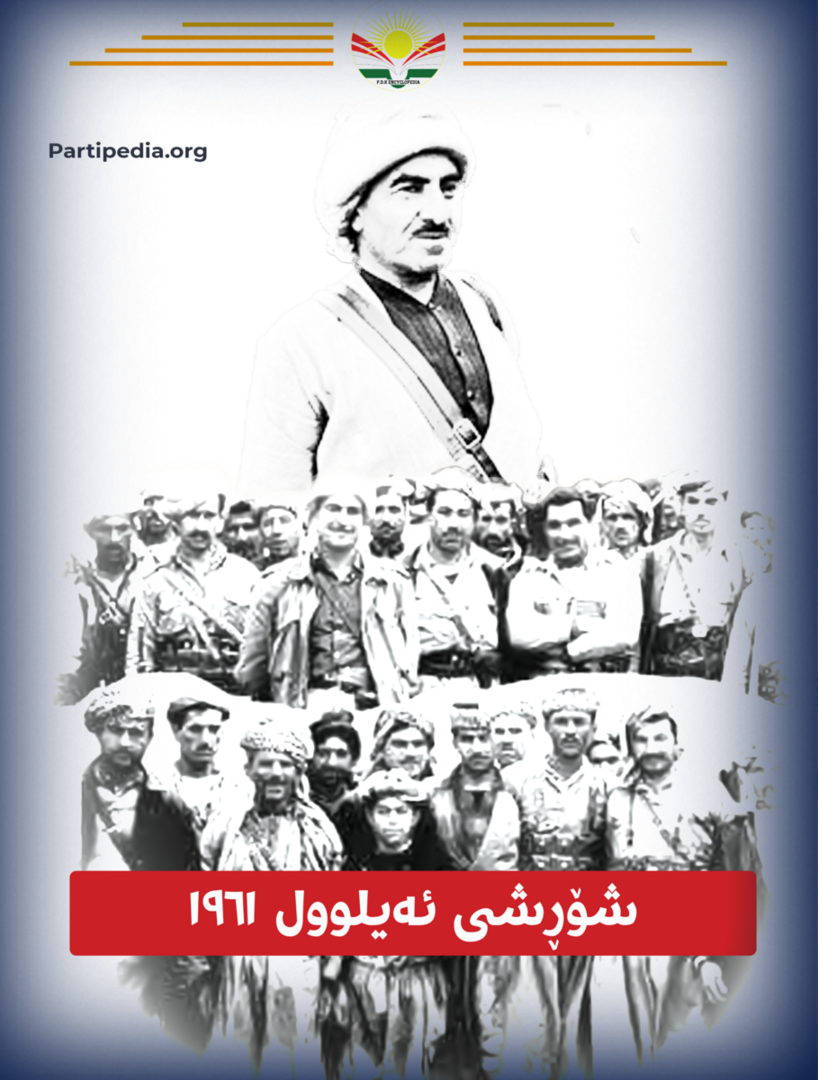
The outbreak of the revolution
Despite all the efforts of the PKK to get closer to the government and prevent war, all these efforts were ignored by Abdul Karim Qasim and on September 11, 1961, the army forces began bombing On September 19, 1961, the PKK Political Bureau decided to confront the government, which once again forced the Kurdish people to resort to armed struggle to defend themselves.
After several battles and confrontations, until September 23, 1961, the government was able to take control of all parts of Kurdistan except some areas of Barzan region Omar is a gun and Ali Abdullah Members of the PKK Political Bureau arrived in Barzan with the president Mustafa Barzani The meeting decided to reorganize and establish coordination between the Barzan forces, the PKK armed forces and the armed forces of the tribes that had not yet left the battlefield.
After the reorganization and several victories over the Iraqi army, in February 1962, a large meeting was held by the members of the central committee of the party in the village of Awdalani in Sulaimani province They sent a memorandum to Abdul Karim Qasim saying that the war they are fighting is a war of defense and defense, not a war of attack. They also chose the name of Peshmerga for their fighters and raised the slogan "Democracy for Iraq and Autonomy for Kurdistan" Some of the participants of the meeting included Ibrahim Ahmad, Ali Askari , Ahmed Abdullah, Omar is a gun, Ali Abdullah, Mullah Abdullah Ismail, Shamsaddin Mufti, Abdulrahman Zabihy, Nuri Ahmad Taha The guards of the meeting were a force of 15 Erbil police, who had just become Peshmerga. The meeting decided to continue the defense.
The Iraqi army's victories were temporary, and the Peshmerga forces soon reorganized and established the Kurdistan Liberation Army, which numbered about 20,000 Peshmergas In early 1963, the government was forced to ceasefire, which was extended several times until the fall of Abdul Karim Qassim's government on February 8, The Kurdistan Democratic Party (KDP) sought a peaceful solution to its problems with the government, and its efforts were welcomed by Iraqi public opinion.
The Ba'athist coup
The September Revolution paved the way for the February 8, 1963 coup against the government of Abdul Karim Qassim, the product of an agreement between the Ba'ath Party and national officers Their preparations for the coup have to do with Kurdistan Democratic PartyThey agreed to implement all the political and national demands of the Kurdish revolution Salih Yousfipromise to the president Mustafa Barzani After the victory of the coup, the Kurdish people were declared autonomous, in exchange for the revolutionary leadership promising to stop the war against the government.
After the victory of the February 8 coup, he received a letter from the Ba'ath Party Ibrahim AhmadThe PKK Secretary was asked to nominate several Kurdish people to be included in the new government, and the Political Bureau after the approval of the president Mustafa BarzaniThe Ba'ath Party replied: “Democracy for Iraq and autonomy for Kurdistan is our party's policy.” Our proposed names are: Baba Ali Sheikh Mahmoud, Fuad Arif, Bakr Abdulkarim, Omar Mustafa, Jalal Talabani and Ali Askari.
On February 18, 1963, a delegation led by the Kurdistan Democratic Party (KDP) arrived in Iraq to negotiate with the new government Jalal Talabani and Salih Yousfi They were sent to Baghdad, where they met with government officials the next day. The Ba'athists were trying to hide from the promises they had made to the Kurds before the coup. The meeting also decided that Jalal Talabani will visit Egypt and Algeria with a government delegation to discuss the Kurdish issue without returning to the PKK leader and political bureau During the visit, Jalal Talabani met with Egyptian President Jamal Abdul Nasser and Algerian President Ahmed Ben Bella, and both countries supported the peaceful solution of the Kurdish issue.
Revolutionary Leadership Council
From 28 to 29 September 1964 in Qaladze township, in the presence of the President Mustafa Barzani and a group of advanced cadres of the Kurdistan Democratic Party (KDP), military commanders and social figures belonging to tribes and families, in order to organize the affairs of the revolution and draft a constitution and how to negotiate with Baghdad. A meeting was held. President Mustafa Barzani opened the congress with a speech in which he spoke about the negotiations and organization of the ranks of the revolution and called for free elections (the Revolutionary Leadership Council in Iraqi Kurdistan) to run the work.
In late September 1964, President Mustafa Barzani and the Political Bureau on the basis of decision Sixth Congress The Qaladze meeting agreed on October 7, 1964 to establish a leadership council to manage the liberated areas. Boskin village was initially designated as the venue for the meeting, but later the meeting was moved to Gardaspi village The meeting was attended by 63 people, including 17 members of the Kurdistan Democratic Party (KDP) leadership, 17 commanders of the forces, 29 Islamic, Christian and Yazidi religious leaders and social figures Tribal chiefs and family personalities.
Earlier, the tribal chiefs had agreed on their candidates and left in large numbers, as well as members of the PKK leadership and force commanders. On October 9, 1964, the constitution of the Revolutionary Leadership Council in Iraqi Kurdistan was signed in Boskin village. On October 10, 1964, the constitution of the Kurdistan Provincial Judicial Committee was signed in 13 articles The administrative laws and regulations were then prepared in 12 articles and the financial laws and regulations were organized into three sections: revolutionary finance, taxes and customs.
The council decided to form an eleven-member executive bureau Mustafa Karadaghi secretary, later changed to Mahmoud OsmanAt the level of ethnic minorities, the Turkmens were not included in the council because of their special circumstances, although President Mustafa Barzani has made great efforts to help them, and someone from Europe is representing them They appointed Dr. Ismet Sharif Wanli, a member of the council, who had participated in the second people's congress and the meetings to establish the council. The council established five committees, namely:
- Constitutional Committee
- The Judicial Committee
- Military Committee
- Executive Committee
- Economic Committee.
Finally, at three levels, led by the president Mustafa BarzaniMembers of the Kurdistan Democratic Party (KDP) Central Committee, commanders of the September Revolution, tribal chiefs and religious and national figures were elected to these committees.
The members of the Central Committee of the Kurdistan Democratic Party (KDP) were Mustafa Barzani, Habib Mohammed Karim, Dr Mahmoud Osman, Salih Yousfi, Aziz Akreyi, Dr. Fuad Jalal, Abdulkarim Murad, Ali Qasim Sinjar, Naaman Jesus, Ismail Arif, Hashim Akrayi , Sheikh Ismail Mullah Aziz, Sheikh Mohammed Harsin, Mustafa Karadaghi, Mohammed Amin Mohammed Ali, Omar Sharif and Ramazan Akrayi . . . .
The commanders of the September Revolution were Colonel Abdul Rahman Qazi, Colonel Nuri Mullah Ma'roof, Colonel Ruken Abdul Kafi Nabawi, Colonel Sheikh Salih Sheikh Mohammed, Lieutenant Nafeez Jalal Hawezi and Lieutenant Nuri Mullah Hakim, Lieutenant Bakr Abdulkarim Hawezi, Lieutenant Yousef Jamil Miran, Lieutenant Sheikh Reza Gulani , employee Rashid Sindhi, police officer Abdul Wahab Atroshi , Assad Khoshaw, Isa Suwar, Huso Mirkhan Dolamari, Ali Khalil, Abdullah Agha Pishdari and Haji Sheikh Qadir.
Tribal chiefs, religious and national figures included Dr. Ismet Sharif Wanli, Dr. Kamal Fuad, Sheikh Latif Hafid, Mr. Ziad Ghafouri, Mohsin Dzeyi, Sheikh Hussein Boskin, Bapir Babakr Agha, Sheikh Mohammed Balisani, Wahab Agha Jundiani, Abbas Mamend Agha, Ismail Suwara Agha, Salih Beg Miran, Sulaiman Haji Badri Sindhi, Ahmad Mohammed Amin Dzaei, Mahmoud Beg Gulaei, Mustafa Beg Jaf, Sheikh Kawkasi Sayyid Tahai Nahri, Kuekha Ismaili Talan, Haji Agha Hiro, Majid Hama Rashid Khan, Mahmoud Abbas Agha, Abdulrahman Agha Norak, Sheikh Rauf Hanjira, Haji Ibrahimi Charmaga, Sheikh Mohidini Sandulan, Matran Mario Wala, Bishop Paul Bedari, Gorgis Malek Cheko and Tahsin Beg Saeed Beg.
The establishment of the Revolutionary Leadership Council was an important step in the organization and management work Distribution of ranks and titles to the various leaderships of the revolutionary army, appointment of the Political Bureau for party work and election of its own secretary, formation of the Executive Bureau, which is responsible for managing and implementing special decisions of internal affairs and supervision of the committee It was entrusted with governmental responsibilities in the liberated areas and was directly headed by President Mustafa Barzani.
The revolutionary army was organized as follows:
- President-General: The President Mustafa Barzani
- Chief of Staff: Nuri Mullah Ma'roof
- First Army in Badinan: Asad Khoshaw, his forces consisted of:
- Zakho Force: Isa Suwar
- Duhok Force: Ali Khalil
- Sheikhan and Akre forces: Huso Mirkhan Dolamari
- Second Army in Erbil: Rashid Sindhi, the forces consisted of:
- Safin Force: Tahir Ali Wali
- Kawa Force in Pishdar: Huso Mirkhan Zhazhuki
- Betwata Force: Ali Shaban
- Third Army in Sulaimani and Kirkuk: Lieutenant Aziz Akreyi, the forces consisted of:
- Struggle Force: Abdul Wahab Atroshi
- Karadag Force: Fazel Talabani
- Salvation Force: Tariq Ahmed.
Resumption of war
In late 1964, under the new cabinet of Tahir Yahya, the Iraqi government and the Revolutionary Leadership Council intensified their efforts to prevent the outbreak of war January 1, 1964 A government delegation visits the President Mustafa BarzaniOn December 10, 1965, the Revolutionary Leadership Council sent a delegation to Baghdad. These efforts continued until March 1965. After the talks stopped, tensions broke out between the two sides and in February 1965, war broke out it started again.
During this period of the war, the government, despite using most of its military forces, used a large number of jashes. The attacks of the government army and jashes began in mid-April 1965 with an attack on Mount Safin in Erbil province. The most important battles of this period were the Battle of Safin (April 1965), the Battle of Piramagrun (28 April 1965), the Battle of Karadag (4 June 1965), the Battle of Azmar and Chawarta (25 June 1965). 1965, the battles of Rawandz Front, August 5, 1965, the battle of Kewarsh, September 6, 1965, the battle of Penjwen, December 23, 1965, etc. As a result of these battles, the Iraqi army was able to advance in several places and in many places they were repulsed by the Peshmerga forces of the revolution and forced to retreat.
During this period and after the president's pardon Mustafa BarzaniOn July 6, 1965, the Political Bureau group was formed Ibrahim Ahmad They returned to southern Kurdistan from Iran and settled in Haji Omeran. After a while, in early 1966, the group joined the government and opposed the revolution.
Plan (Tuklat Ali Allah), New Phase of War 1966
After the death of Abdul Salam Arif on April 13, 1966 and the resignation of Tahir Yahya's cabinet, Abdul Rahman Arif became president of Iraq and the new cabinet was formed by Abdul Rahman Bazaz During this time, the Political Bureau group defected from the revolution and joined the government. These factors made the government feel dominant, so by the Minister of Defense, Lieutenant Colonel Abdul Aziz On May 3, 1966, the Fourth Mountain Brigade, supported by the First Brigade, attacked Mount Hindren and the Third Brigade, supported by the Fourteenth Brigade, attacked Zozk This attack led to the Hindreni Dastan of May 12, 1966, which led to the defeat of the government forces and the jashes and the expulsion of the jashes on the morning of June 1966 and the government's agreement to the demands of the revolutionary leadership and a ceasefire, the statement was read out by Abdul Rahman Bazaz.
New Phase of the Revolution and the Role of the Jashes (1966-1970)
After their failure to implement the plan of “Tuklat Ali Allah”, the government tried to implement its plans against the revolution by opening headquarters and arming the jashes, especially the group of the old Political Bureau. The jashes performed their duty in the worst possible way and became the eyewitnesses and implementers of the government's plans.
In response, the government tried to convey to the people and the outside world that its relations with the revolutionary leadership were at their strongest by sending delegations to Barzani's headquarters and inviting and welcoming the revolutionary delegations in Baghdad. One of the most important visits of this period was the visit of President Abdulrahman Arif to Barzewa to see President Mustafa Barzani on October 28, 1966 and his subsequent visit Idris Barzani and Massoud Barzani One after another to Baghdad in December
During the ceasefire, the revolutionary leadership opened various military courses for the Peshmergas in order to strengthen the revolutionary army Barzani was held and a constitution was adopted to carry out the tasks of the revolution, and the government fulfilled some of the promises made to him on the morning of June 27, especially after the visit of Prime Minister Tahir Yahya to the president Mustafa Barzani In August 1967, he returned the Arab-settled villages of Dubz to their Kurdish owners.
Relations between the revolutionary leadership and the government became tense again when a government delegation visited the revolutionary leadership on October 7, 1967. The delegation announced that the government had withdrawn from the talks Disarm the jashes and the prime minister sent a letter to the president Mustafa Barzani He warned that he had no authority in this regard and that the president was under the influence of army officers, which led the revolutionary leadership to decide to take on this task and send Peshmerga forces to the jash headquarters in Bakrajo, then sent by the president, Abdul Karim Farhan, Minister of Agriculture, to the president Mustafa Barzani In return, the government sent a large number of troops to Sulaimani to support the jashes. After these events, the phenomenon of assassinating cadres and members of the Kurdistan Democratic Party (KDP) occurred The revolutionary leadership tried to respond by sending armed detachments against the jashes. The situation became such that Prime Minister Tahir Yahya He sent a letter to President Mustafa Barzani asking him to stop beating the jashes. In return, he told him to stop assassinating the jashes and close the prison in Bakrajosh, which was run by the jashes.
In early 1968, the situation between the revolution and the government deteriorated again. The government attacked the revolution through jashes and sent troops to Sheikhan under the pretext of calming the situation He asked the ministers and the chief of staff to put a limit on this situation, but the government's withdrawal from the situation led to a response by the revolutionary forces to the attacks of the jash and the army.
On April 15, 1968, fighting broke out between the revolutionary army, the regime army and the jashes in the Erbil plain, which continued until April 18, 1968. As a result, the Iraqi army was defeated and forced to withdraw from the Erbil plain
On July 17, 1968, Abdul Rahman Arif's government was overthrown by the Ba'athists. Ahmad Hassan Bakr was appointed president. Thus, until the end of 1968, there was no fighting between the revolutionary army and the army. In contrast, the attacks of the jashes had intensified The jashes, especially the group of the Political and Field Bureau, tried to attack the revolutionary forces to evacuate them. They tried to take over Karadag with the help of the army On October 12, 1968, the forces of Khabat, Rzgari and Dashti Erbil were sent to Karadag to confront the jashes Kirkuk retreated.
In February 1969, the revolutionary leadership decided to attack the Baba Gurgur oil field in Kirkuk, which was an important source of government revenue and was used against the revolution The government, on the other hand, did not react.
In February 1969, the fighting resumed. The government, with the help of the jashes, attacked the revolutionary forces from everywhere they could.
Shakholan Battle on February 21, 1969, Alan Valley Battle on July 13, 1969, Sharazoor and Halabja Battle on May 25, 1969, Dukan Battle on September 20, 1969, Deccan and Syria Battle in mid-August The government, with the help of the jashes, had intensified its attacks on Garmian and Karadag regions and the fighting continued for three months of the summer. As a result, the Peshmerga They were forced to retreat and gather on Mount Surdash, but the army had little victory in the Erbil plain. After these victories, the government and the jashes planned not to stop the Dilman area where Barzani's headquarters was located, so they resumed their attacks. In mid-October 1969, they launched a comprehensive attack on the Marga area The fields of the Valley of Martyrs were occupied.
After the advance of the army and the jashes, at the end of October 1969, the Peshmerga forces reorganized themselves and launched a counterattack It followed in the wars, such as:
The Battle of Marga on November 6, 1969, the Battle of Piramagrun on November 18, 1969, the Battle of Surdash Mountain in mid-November 1969, etc., these defeats once again forced the government to join the revolutionary leadership The negotiations led to the March 11, 1970 agreement.
Agreement of 11 March
The Ba'athists failed in their military efforts to end the revolution and the revolution achieved great victories. The Ba'athist government had no choice but to waste a lot of human and material resources In September 1969, the Ba'athists made their first attempt to reach an agreement with the revolutionary leadership through a delegation from the Kurdistan Students Union, which continued to negotiate for several months Both sides have been working at the highest levels to reach an agreement between Baghdad and Nawprdan, finally after the visit of Iraqi Vice President Saddam Hussein to Nawprdan and the meeting with the president Mustafa Barzani On March 11, 1970, an agreement was signed between the Iraqi Ba'athist government and the revolutionary leadership, which resulted in recognition of what the Kurds had started the revolution for, namely the political and national rights of the Kurdish people in South Kurdistan.
Reversal of the March 11 agreement and the 1975 Algiers agreement
The March 11, 1970 agreement was never implemented by the Iraqi government as agreed, thus deteriorating the situation between the revolutionary leadership and the Iraqi government. On March 26, 1974, the Ba'ath regime announced a ceasefire with the revolutionary leadership, disbanded all border guard regiments, and fighting resumed between the two sides It shelled the areas under the control of the revolution and took control of most of the areas under the control of the revolution by the end of September 1974. The army's victories did not last long and they were forced to retreat from the areas they had occupied During this time, he was extensively supported by the Iranian government.
In late autumn 1974, Baghdad declared the war to continue in the winter. These defeats were intolerable to the Ba'ath regime and Saddam Hussein, and the government was completely weak against the revolution He had to use even his reserve members, and the government's reserve funds were running out. The Shah of Iran wanted to put pressure on Iraq by helping the revolution until the May Treaty of It was for this purpose that he convinced the United States to secretly support the revolution under his supervision.
On March 6, 1975, the OPEC summit was held in Algiers in the presence of representatives of the organization's 13 member countries, with the assistance of the president A political-military agreement was signed between Iraqi Vice President Saddam Hussein and Iranian King Mohammad Reza Shah Pahlavi to help Iraq blockade the revolution The Kurds should protect their borders with Iraq and no longer interfere in Iraq's internal affairs in exchange for Iraq's ceding some land (Shat al-Arab) to Iran and returning the water borders of the two countries to the agreement Constantinople in 1913 between Iran and the Ottoman Empire.
The collapse of the revolution
When the Algiers Agreement was announced, President Mustafa Barzani A delegation that had visited Tehran at the request of the Shah of Iran was sent by President Barzani to Haji Omeran to hold an urgent meeting with members of the Political Bureau and political leaders On the afternoon of March 8, 1975, Mohsen Dzeyi arrived in Haji Omeran and held a meeting. Barzani's envoy informed the audience that the Iranian regime had decided to hold a meeting on March 1, 1975 President Barzani has asked members of the leadership to decide whether to flee to Iran or continue the revolution.
Most of the members of the Political Bureau were in favor of continuing the revolution through guerrilla warfare and not surrendering to any side. Mohsen Dzeyi returned to Tehran on March 9 and informed President Barzani of the decisions and proposals of the meeting the same day Reply of President Mustafa Barzani through the Bethel Agency of the PKK Office in TehranMustafa Barzani He was sent back to Haji Omeran and supported the PKK leadership's proposal to continue the guerrilla warfare.
After his return from Algeria, on March 11, 1975, he met with a delegation of the revolutionary leadership in Tehran I will put other interests aside, just as you signed the March 11, 1970 agreement with them for your own interests.”
On March 12, the President Mustafa Barzani The accompanying delegation returned to Haji Omeran and held a meeting with members of the party leadership on the same day. At the meeting, it was decided to continue the fighting It was decided to divide the revolutionary regions into several sectors, each with a leader Special fields were to be set up for him, and to ease the burden of the revolution, reduce the number of Peshmergas in the forces, and declare that everyone was free to return to Iraq under a general amnesty or as a refugee Whether he went to Iran or stayed in the revolutionary-controlled areas and continued fighting, most of those present at the meeting decided to stay.
After the decision to continue the revolution, on March 18, General Mansourpour, the representative of Mohammad Reza Shah, came to the area under the control of the revolution and met with President Mustafa Barzani and some members of the Political Bureau He told the revolutionary leadership that if they continued to fight, Iraqi military forces would be allowed to enter Iranian territory to destroy the revolution, and Iranian forces would help them if necessary. On March 18, the revolutionary leadership decided to hold an emergency meeting attended by members of the Political Bureau and Central Committee Mustafa Barzani He expressed his views to the meeting participants that the fighting should be stopped for a while and resumed at a more favorable time, after discussing the whole situation with military leaders and party and political figures, all of them They accepted President Barzani's proposal. By March 25, 1975, most of the revolutionary leadership, Peshmerga and civilians had fled to Iran, and many were granted amnesty and remained in Kurdistan, then to southern and central Iraq Transferred
Sources:
- Massoud Barzani, Barzani and the Kurdish Liberation Movement, 1958-1961, Volume II, (2012).
- Massoud Barzani, Barzani and the Kurdish Liberation Movement 1961-1975, Volume III, Part I, (Erbil, Ministry of Education Printing House, 2004).
- Massoud Barzani, Barzani and the Kurdish Liberation Movement 1961-1975, Volume III, Part II, (Erbil, Ministry of Education Printing House, 2004).
- History of Kurdistan Democratic Party (KDP), Congress and Conference (Program and Rules of Procedure). Kurdistan Democratic Party Encyclopedia Committee, Volume 1, (Erbil- Rojhelat Printing House- 2021).
- Salah al-Khursan, Political Preparations in Iraqi Kurdistan, Reading in the Files of Kurdish Movements and Parties in Iraq 1946-2001, (Beirut – Al-Bagh Printing House – 2001m).
- Habib Mohammed Karim, History of the Kurdistan Democratic Party - Iraq (in the headquarters) 1946 - 1993, (Duhok - Khabat Printing House - 1998m).
- Dr. Sherko Fathullah Omar, Kurdistan Democratic Party and the Kurdish Nation's Liberation Movement 1946-1957, p. Suwara Qaladzeyi, (Shahid Azad Hawrami Printing House - 2013).
- Shawkat Mullah Ismail Hassan, Days in the History of the September Revolution 1961-1975, (Erbil, Tafsir Office for Publication and Media, Ministry of Education Printing House, 2007).
- Esmat Sharif Wanli, Iraqi Kurdistan as a National Identity (Study in the 1961 Revolution), translated by Saad Mohammed Khader, (Sulaimani, Zhin Foundation, Shvan Printing House, 2012).
- Shirzad Zakaria Mohammed, Revolutionary Leadership Council in Kurdistan - Iraq 1964 - 1970 General Political Historical Studies, (Duhok - Kurdish Studies Center and Document Preservation - Duhok University - Duhok University Printing House - 2010m).
- Tribal Revolution Command Council Formed Committee for Defense of Tribal Rights, Information Newspaper, No. 11533, Tehran, Saturday, April 16, 1964 . Sh.
- Badanbal, Iraqi Tribal Information on Autonomy, Information Newspaper, No. 11534, Tehran, Sunday, 17 April 1964 AH. Sh.