

Biography
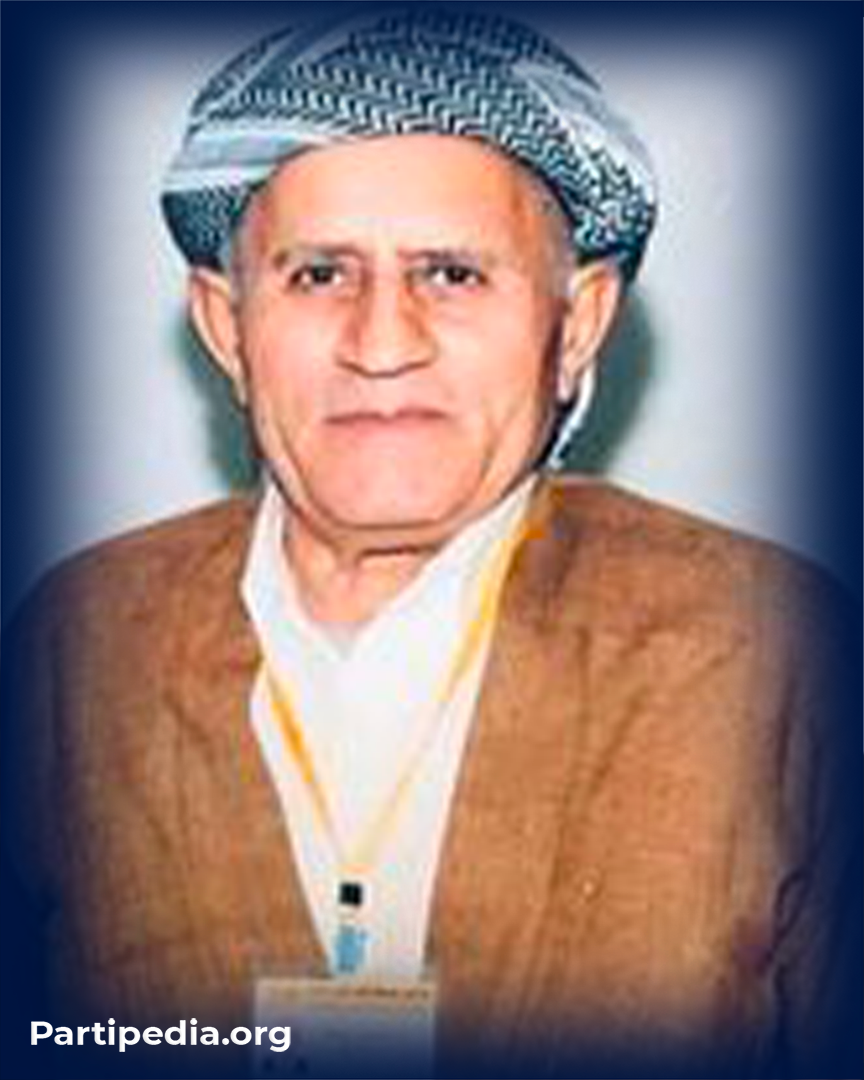
Fatih Muhammad Amin Murtaza was born in Kirkuk province, from the Siyamansuri Fayli tribe whose ancestors migrated from the Kermashan region of Eastern Kurdistan to Southern Kurdistan. In 1959, he entered the Kurdish department of the College of Literature at Baghdad University. On October 9, 1962, his brother Hasib Muhammad Amin (1926-1962) was martyred in the Battle of Ajjalar in Kirkuk province, in an attack by the ground forces of the Iraqi government army. He was the first teacher in September Revolution He is considered a martyr, he received a Bachelor's degree in Kurdish from Baghdad University in 1963, he was the Deputy Director of Education in Kirkuk and responsible for Kurdish education in 1970-1974, and in August 1971 he represented the congress of education directors of the northern provinces of Iraq in the town of Pirmam, in the province of Erbil, to discuss education and employment issues. He was fluent in Kurdish, Arabic, Turkmen, Persian, English and German.
Worksheet
Fatih Mohammed Amin Murtaza joined the KDP in 1957 during the reign of Iraq, working under the pseudonym Birusk, in 1959 he joined the Kurdistan Qutabi (Students) Union, in 1959-1962 he was a member of the Baghdad University Organizing Committee of the Kurdistan Democratic Party (KDP), in 1963 he joined the ranks of the Peshmerga Forces and was a political officer in the Qaradakh force, in 1963 he participated in the Battle of Zanbur against the Iraqi army in Kirkuk province, in 1963 he was the manager of the third division of the Kurdistan Democratic Party (KDP), in 1964 he worked as a commentator in the Turkmen language section of Radio Dengê Kurdistan, in 1964 he became the second manager of the fifth division committee of the Kurdistan Democratic Party (KDP), in 1964 he opposed the decisions of the General Assembly The Mawet movement, which was organized by the Political School wing of the Kurdistan Democratic Party (KDP), came out in support of President Mustafa Barzani.
In 1964, a member of the twelve-member negotiating delegation The sixth congress of the Kurdistan Democratic Party (PDK) who, with the approval of President Mustafa Barzani (1903-1979), had gone to the Political School wing to participate in the sixth congress, but due to the insistence of the Political School wing not to participate, the delegation failed. In 1964, he was elected as a member of the Central Committee of the Kurdistan Democratic Party (PDK) by the representatives of the Sixth Congress. In 1966, he was elected as an alternate member of the Central Committee of the Kurdistan Democratic Party (PDK) by the representatives of the Seventh Congress. In 1966, he was appointed as the head of the third division committee. In 1967, he was arrested by Iraqi government officials and held in Naqliyet, Mawqif General and Ramadi prisons and was severely tortured. He was released at the end of 1969. In 1969, he became the director of Galale Secondary School, which was the only secondary school in the country. September Revolution He was a member of the editorial board of Tişk magazine in 1969. He was a delegate to the third congress of the Kurdistan Teachers' Union in the village of Nawpirdan in the province of Erbil on August 5, 1970. He was a delegate to the 8th congress of the Kurdistan Democratic Party (PDK) in the village of Nawpirdan in the province of Erbil in 1970. He was appointed as the second official of the headquarters of the first league committee of the Kurdistan Democratic Party (PDK) from the eleventh rank in 1970.
In 1970, he became the head of the first league committee, in 1971 he welcomed world-class boxer Adnan Qaysi at the headquarters of the fourth league committee of the Kurdistan Democratic Party (KDP), in 1972 he became a representative of the fourth congress of the Kurdistan Teachers' Union in Erbil, in 1972 he was in charge of the Kirkuk league of the Kurdistan Teachers' Union, in mid-1973 he was a member of the founding committee of the Kurdish Cultural Association in Kirkuk, in 1973 he was elected as a member of the executive committee of the Kurdistan Writers' Union in Kirkuk, from February 1 to 3, 1974, he was a representative of the fifth congress of the Kurdistan Teachers' Union in Sulaymaniyah, in 1974 he was appointed as the head of the Kurdistan Teachers' Union in Kirkuk, in 1974 he became the head of the Sirwan District Committee of the League Committee Thirdly, in 1975, he was wounded by the Iraqi army in the Battle of Tuz Khurmatu in Kirkuk province.
In 1975-1976, after the defeat of September Revolution, took refuge in the town of Nakheda in Iran, in 1976 after returning to southern Kurdistan, he was deported to central Iraq, spent the years (1976-1982) in exile in Diwaniyah, from 1982 to 1991 he spent his life in exile in Baquba, the capital of Diyala province, in 1991 he was transferred to Erbil as a teacher and in 1991 he was appointed as the second in charge of the School of Public Organizations (Communities) of the Kurdistan Democratic Party (PDK), in 1992 he was the first candidate for the Kurdistan Parliament on the list of the Kurdistan Democratic Party (PDK), in 1992 he facilitated the organization of the sixth congress of the Kurdistan Teachers' Union, in 1992-1994 he was the General Director of Education in Sulaymaniyah in the Kurdistan Regional Government.
In 1993, he was a delegate to the Eleventh Congress of the Kurdistan Democratic Party - United in Erbil, in 1993-1994 he was the secretary of the second league committee of the Kurdistan Democratic Party - United in Erbil, in 1995 he moved to the Federal Republic of Germany as a refugee, in 1999-2001 he was the head of the Berlin Organization of the Sixth League Committee of the European League of the Kurdistan Democratic Party (KDP), in 2001-2005 he became a Member of the Kurdistan Parliament, on April 4, 2002 he became a member of the Education and Higher Education Affairs Committee of the Kurdistan Parliament for the first time, in 2005 he was appointed as the head of the Human Rights Office in Kirkuk province, on November 12, 2002 he became a member of the Education and Higher Education Affairs Committee of the Kurdistan Parliament for the first time, in the years He served as a member of the Kirkuk-Garmian Provincial Leadership Council of the Kurdistan Democratic Party (KDP) from 2011 to 2019. He passed away on Monday, November 2, 2020.
Source:
- Archives of the Encyclopedia Committee of the Democratic Party of Kurdistan.
- Condolence Letter, Xebat Newspaper, Issue 6032, Hewlêr, Monday, 02.11.2020, p 6.
- Reza Shwan, the first teacher of the martyr September Revolution Hasîb Mihemed Emin Beg, Sirwan Magazine, 15th Khanaqin Division of the Kurdistan Democratic Party, issue 18, Spring 2014, pages 21, 25.
- Ali Sinhalese, The Kurdish Question and the Arab Socialist Ba'th Party, Part Three, (Duhok - Xanî Press - 2012), p. 382.
- Shwan Mohammed Emin Taha Khosnaw, Hewlêr between 1963-1970: a historical study of the political situation, (Hewlêr - Salaheddin University Press - 2016), pp. 28, 30-31, 198-199.
- Reza Shwan, Hasib Mohammed Beg Siyamensuri 1925-1961, Omar Ali Sharif, 100 Famous People of Kirkuk and Germiyan, (Sulaymaniyah - Karo Press - 2019), pp. 122-127.
- Latif Nadir Rawandzi, The Importance of the Kurdistan Institute of Knowledge in the Great September Revolution, Gulan Magazine, issue 132, Hewlêr, 02.08.1997, pp. 45, 47.
- Brother of Fatih Muhammad Amin, Al-Taxi newspaper, issue 938, Baghdad, Times Press, Monday, January 15, 1972, pages 14, 16.
- Masoud Barzani, Barzani and the Kurdish Liberation Movement, Third volume, (Hewlêr - Ministry of Education Press - 2002), p. 144.