

Biography
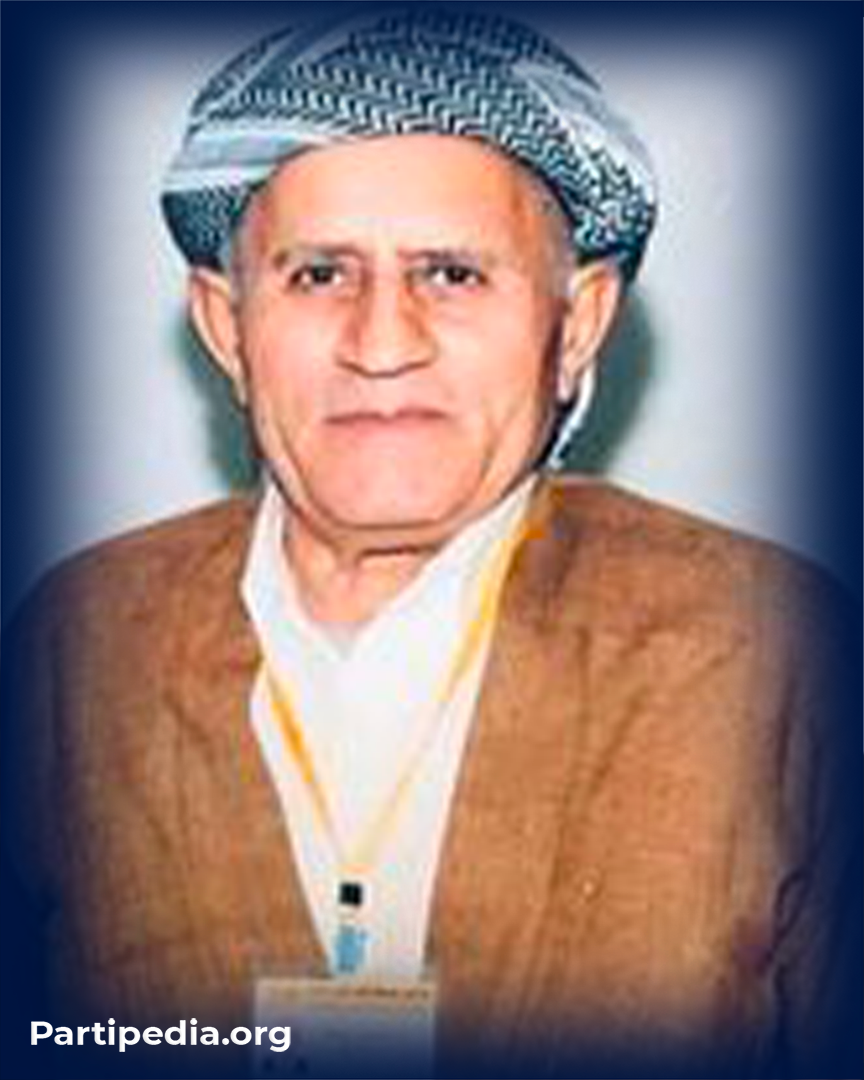
Ali Qasim Khedir Muhammad, also known as Ali Shingali and father of Sardar, was born in Mosul province in 1933, holds a diploma in electricity from the Mosul Technical Institute, works as an art worker in the electricity department of the Mosul railway in 1953, works in the Mosul Railway Office in 1955, became a member of the Kurdistan Democratic Party (KDP) Workers' Union in 1955, in 1956, he was arrested in Mosul and dismissed from his job for participating in demonstrations against the tripartite attack by Britain, France and Israel on the Republic of Egypt, in 1957 he was established in the telephone exchange in the city of Mosul, in 1975, after the defeat of the September Revolution, entered the Iranian Empire, arrived in Damascus as a refugee with his family on September 16, 1975, passed away in Duhok, Syrian Arab Republic, on Saturday, September 5, 2020, he was fluent in Kurdish, Persian and Arabic.
Worksheet
Ali Qasim Khedir Muhammad, known as Ali Shingali, was accepted as a candidate in the Kurdistan Democratic Party - Iraq on March 21, 1954. In 1955, he received the honor of membership in the ranks of the Kurdistan Democratic Party (KDP). In May 1955, he participated in the Mosul demonstrations against the regime of the Kingdom of Iraq. In 1956, he was in charge of the organizing committee of the Mosul District Committee. In 1958, he was a member of the Mosul District Committee of the first league committee of the Kurdistan Democratic Party (KDP). In 1958, he met with President Mustafa Barzani (1903-1979) in Baghdad with a delegation from Mosul upon his return from abroad. In 1959, he was expelled from the party by the left wing of the KDP for six months due to his opposition to the KDP becoming the successor to the Iraqi Communist Party. However, with the success of the second conference of He was returned to Baghdad, in 1959, he became a member of the League and was appointed to the First League Committee, in 1960, he was appointed to the First League Committee in charge of the Inspection and Supervision Committee of the First League, in 1960, he became a member of the First League Committee, in 1960, he was appointed from the sixth group as a member of the First League Committee under the responsibility of Salih Abdullah Najmeddin (1918-1981), also known as Salih Yousfi, in early 1961 he was in charge of the secret line of the Kurdistan Democratic Party (KDP) organizations in the First League Committee, on September 9, 1961, he was arrested and tortured by Iraqi security forces in Mosul, he was sent to the town of Zakho in Mosul province for further investigation and then to the town of Duhok in Mosul province for further investigation and was released on bail, on December 1, 1962, After his release on bail, he was appointed as an artistic employee in the Baghdad Secretariat.
In 1962, he was in charge of the secret line of the Kurdistan Democratic Party (KDP) organizations in the Fifth League Committee and in charge of the relations department of the Fifth League Committee. In April 1963, he was dismissed by the authorities due to his Kurdish activities.
In 1963, after the arrest of most of the staff of the Fifth League Committee by the Iraqi General Security Service, he was appointed as the head of the Fifth League Committee. In July 1963, with the help of the Kurdistan Democratic Party (KDP) military line, they blew up the Dora oil depot along with the railway until the Iraqi army sent its ammunition and soldiers from Til Muhammad near Baghdad to southern Kurdistan. On February 24, 1964, as a representative of President Mustafa Barzani (1903-1979), he visited the great Shiite leader Abdul Mohsen Al-Hakim (1889-1970) in Kufa. On April 4, 1964, he participated in a large-scale meeting in Mawat. On April 10, 1964, he visited President Mustafa Barzani with a delegation to resolve the problems, but they failed in their attempt with the issuance of an initial statement by the Political School. supported the president's wing.
In early June 1964, as a member of the Preparatory Committee of The sixth congress of the Kurdistan Democratic Party was elected, in 1964 he was elected as a member of the Central Committee of the Kurdistan Democratic Party (PDK) at the sixth congress, in 1964 he represented the Second People's Congress (Qaladize Congress), in 1964 he became a member of the Revolutionary Leadership Council in Iraqi Kurdistan, in early 1965 he was appointed as the head of the fourth league committee of the Kurdistan Democratic Party, in February 1965 he participated as a representative of the Kurdistan Democratic Party in the third conference of the Kurdistan Qutab (Student) Union in Qaradax, in August 1965 he became the head of the league committee from the sixth cadre group of the second league committee of the Kurdistan Democratic Party (PDK).
In 1965, he became the commander of the Safin Force of the Second Army. At the end of November 1965, he commanded the Battle of Gerote Peak on Safin Mountain against the Iraqi army and was victorious. On November 27, 1965, he fought against the attack of the first Iraqi army on Mount Shakrok in Erbil province and was able to prevent the attack. On December 1, 1965, he was appointed as a member of the Political School and the Executive School of the Revolutionary Leadership Council in Iraqi Kurdistan.
At the beginning of 1966, he was the first person in charge of managing the Executive Office, the Palace, the Guards of the Executive Office and receiving the post. In November 1966, he was responsible for the preparations for the seventh congress of the Kurdistan Democratic Party (KDP) in the village of Gelale in the province of Erbil. In 1966, he was elected as a member of the Central Committee of the Kurdistan Democratic Party (KDP) at the seventh congress. In 1966, he was responsible for the executive office of the Revolutionary Leadership Council in Iraqi Kurdistan. In 1966, he was elected as a member of the Political School of the Kurdistan Democratic Party (KDP). In November 1966, he resigned from the Political School. In 1966, he was responsible for the organization of the fifth division committee. In March 1967, he was elected for the second time as President. Masoud Barzani He carried a letter from President Mustafa Barzani to Grand Ayatollah Abdul Mohsen Hakim (1889-1970) in Najaf. On April 15, 1967, under the supervision of President Mustafa Barzani, he was a representative of the Military-Political Conference of Kani Simaq in Erbil. In November 1967, an arrest warrant was issued for him by the Iraqi military intelligence service on charges of assassinating Jalal Talabani. In February 1968, he was established as the head of the third league committee of the Kurdistan Democratic Party (KDP). In 1968, he became the commander of the Qaradakh force of the third army. On October 13, 1968, he commanded the counterattack of Ibrahim Ahmed Jalal Talabani's group on Mount Silbatu in Kirkuk province, known as the Six-Hour Battle. In 1970, he participated in the congress of the Kurdistan Democratic Party (KDP). On 8th, he was elected as a member of the Central Committee of the Kurdistan Democratic Party (PDK), in 1970 he was elected as a member of the Political School of the Kurdistan Democratic Party (PDK) at the first meeting of the Central Committee, at the end of 1970 he was in charge of the first league of the Kurdistan Democratic Party (PDK) from the eleventh cadre group, in 1970 he was a teacher of the third course of the secret organization at the cadre school of the Kurdistan Democratic Party (PDK) in Baghdad, on 07.12.1970 he participated in the opening of the center of the Kurdistan Women's Union in Baghdad, in 1971 he was a teacher of the third course of the cadre school in Baghdad, on Monday 01.02.1971 he participated in the graduation ceremony of the third phase of the cadres of the Kurdistan Democratic Party (PDK) at the headquarters of the fifth league committee in Baghdad, on Thursday 3 June In 1971, he received a delegation from the Central Committee of the Bulgarian Communist Party in Mosul province. On August 16, 1971, he delivered a speech on behalf of the party committee at the celebration of the 25th anniversary of the founding of the Kurdistan Democratic Party (KDP). At the end of April 1972, he secretly delivered a special letter from President Mustafa Barzani to Hafez Al-Assad, the President of the Syrian Arab Republic, in which he asked for help and support. On July 13, 1972, he retired by order of the Revolutionary Leadership Council.
In mid-October 1972, on the orders of President Mustafa Barzani, he attended the congress of the Kurdish Democratic Party in Syria (Phase Leadership) in the village of Dawidiyya, Duhok province.
On June 17, 1973, he represented President Mustafa Barzani at the funeral ceremony of Bishop Mario Ale, a member of the Revolutionary Leadership Council in Iraqi Kurdistan. From August 16 to 19, 1973, he attended the opening of the 16th Congress of the Kurdish Students' Association in Europe (K.S.S.E.) in Berlin and read a speech on behalf of the first committee. On August 18, 1973, he presented a memorandum from the leader of the Kurdistan Democratic Party (KDP), General Mustafa Barzani, regarding the Iraqi army's poison gas reserves to the International Red Cross in Geneva (Switzerland). In mid-June 1973, he represented President Mustafa Barzani at the funeral ceremony of Bishop András Tíadors Eyud Barwari (1938-1973) in Baghdad, who was a member of the Revolutionary Leadership Council in Iraqi Kurdistan. On August 1, 1973, he attended the funeral ceremony of Bishop András Tíadors Eyud Barwari (1938-1973), a member of the Revolutionary Leadership Council in Iraqi Kurdistan. On December 2, 1975, he became the head of the fifth division committee. In 1974, at the beginning of the war between the Kurdistan Democratic Party (KDP) and the Arab Socialist Ba'th Party, he joined the ranks of the Peshmerga Forces.
On March 29, 1977, the Founding Committee of the Democratic Union of Kurdistan (YDK) announced, on June 9, 1977, he announced the establishment of the Democratic Union of Kurdistan (YDK) and became its general secretary. In 1978, he attempted to resolve the disputes between the interim leadership of the Kurdistan Democratic Party (KDP) and the Patriotic Union of Kurdistan (PUK), but failed. In 1979, he was expelled from the Kurdistan Democratic Party (KDP) at the ninth congress of the Kurdistan Democratic Party (KDP), and on December 20, 1980, he wrote a letter to the President Masoud Barzani and expressed his dissatisfaction, in 1981 he provided training assistance to Kurdistan Workers' Party (PKK) fighters in the Syrian Arab Republic, in 1981 he visited the Political School of the Kurdistan Democratic Party (PDK) in the village of Rajan in Eastern Kurdistan with the aim of coordinating and exchanging views on the situation in Southern Kurdistan.
On December 14, 1984, he met with the President of the People's Republic of Libya, Muammar Gaddafi, in Tripoli. On December 17, 1986, he met with United Nations officials in New York City. From March 15 to 17, 1991, he participated in the International Congress of the Kurdish Cause in Stockholm (Sweden) as the Secretary General of the Kurdistan Democratic Union. In 1992, he was a member of the advisory board of the Iraqi Opposition Congress (Masif Salaheddin Congress). On May 26, 1992, as the Secretary General of the Kurdistan Democratic Union, he signed a cooperation agreement with the Patriotic Union of Iraq and the Turkmen National Party. In 1992, he became a candidate for the Kurdistan Parliament on the Unity list. On June 9, 1993, at the Duhok conference of the Kurdistan Democratic Union (YDK), he proposed returning to the ranks of the party. He joined the Kurdistan Democratic Party (PDK) and dissolved the Kurdistan Democratic Union (YDK), and was elected as a member of the Central Committee of the Kurdistan Democratic Party - United in the eleventh congress in 1993. In mid-September 1995, he was a member of the Kurdistan Democratic Party (PDK) delegation that visited the Syrian Arab Republic.
On June 29, 1996, with the President Masoud Barzani He attended the first graduation ceremony of the University of Duhok. In 1997, he became an advisor to the President of the Kurdistan Democratic Party (KDP) on Arab relations. On September 1, 1998, he was appointed by a presidential decree. Masoud Barzani was appointed as the Presidential Advisor for Arab Relations, on Sunday, November 29, 1998, he was received by Abdullah Al-Ahmar, Deputy Secretary General of the Syrian Arab Socialist Ba'ath Party, along with Hishyar Mahmud Muhammad, known as Hishyar Zebari, on Wednesday, December 2, 1998, he was received in Damascus by Syrian Vice President Abdul Halim Khadam, on Wednesday, February 24, 1999, he was a member of the Kurdistan Democratic Party (KDP)-United delegation that visited Amman to offer condolences for the passing of Shahisen Hashemi (1999).
In 1999, he was a delegate to the 12th congress of the Kurdistan Democratic Party (KDP) in Erbil. On Wednesday, October 13, 1999, at the 12th congress of the Kurdistan Democratic Party (KDP), he was honored for his struggle in September Revolution, May Revolution, The Southern Kurdistan Uprising and the Sovereignty Phase, by the President Masoud Barzani He was awarded the Barzani Medal of Nemir on 24 March 2000, was elected as a member of the Executive Committee of the Kurdish-Arab Friendship Association in Erbil, and was a representative of the 13th Congress of the Kurdistan Democratic Party (KDP) in Erbil in 2010.
in their products:
- The Kurdish Liberation Movement: Attitudes and Opinions - 1997.
- Papers from the Archives of Kurdistan - 2007.
- The Kurdish Question and the Arab Socialist Ba's Party in Iraq - 2006 - Part One.
- The Kurdish Question and the Arab Socialist Ba'th Party in Iraq - 2009 - Part Two.
- The Kurdish Question and the Arab Socialist Ba'th Party in Iraq - 2012 - Part Three.
- The Truth about the Caravan of September 11 Revolution 1961 - 2013.
- Pages from my memoir source in the Kurdistan Democratic Party - 2015.
- Shedding light on the truth about the Kurdistan Workers' Party (PKK)'s ties with Syria.
- Facts and documents about the Kurdistan National Congress - 1996.
Source:
- Archives of the Encyclopedia Committee of the Democratic Party of Kurdistan.
- Masoud Barzani, Barzani and the Kurdish Liberation Movement, Third Volume, (Hewlêr - Ministry of Education Press - 2002), pp. 144, 253.
- Ali Shingali, Papers from the Archives of Kurdistan, (Duhok - Spirez Publishing House - Xanî Printing House - 2007).
- Ali Shingali, The Kurdish Question and the Arab Socialist Ba'th Party in Iraq - Part One, (Hewlêr - Hacî Hashim Press - 2006).
- Ali Shingali, The Truth of the Caravan of the September 11 Revolution 1961 – 2013, Duhok - Xanî Publishing House - 2013.
- Ali Shingali, The Kurdish Liberation Movement: Attitudes and Opinions, Duhok - Xanî Publishing House - 1997.
- Ali Shingali, Truth and documents about the Kurdistan National Congress – (no place – 2013).
- Ali Shingali, The Kurdish Question and the Arab Socialist Ba'th Party in Iraq - 2012 - Part Three, Duhok - Xanî Press - 2012.
- Ali Shingali, Pages from the source of my memory in the Democratic Party of Kurdistan - Duhok - Xanî Publishing House - 2015.
- Hamid Gawheri, Barzani Medal, the Highest Honorable Award, Book 3, (Hewler - Barzani Charity Organization - 2019), pp. 15-20.
- Ehmed Banîxelani, My Memories, (Stockholm, 1997), pp. 223-224.
- Shwan Husên Şink Balekî, Cewher Namq Salim 1946-2011 Life, Work and Political Role, Soran University, Faculty of Literature, 2016, (Unpublished Master's Thesis), p 55.
- Sulêman Mustafa Hesen, Kurds and the First Adventure, (Hewlêr – Karo Press – 2017), p 280.
- Shaban Said Muhammad, Me and the Rivals and the Waves of Evil, (Duhok - Law College Press - 2000), p 47.
- Shekib Aqrawi, The Years of Trouble in Kurdistan, The Most Important Political and Military Events in Kurdistan and Iraq from 1958 to 1980, second edition, (Hewlêr - Manara Press - 2007), p. 157.
- Ismet Sherif Wanli, Kurdistan of Iraq, a National Identity (A Study on the 1961 Revolution), translated by Suad Mihemed Xidir, (Sulaymaniyah - Jîn Publishing House - Şivan Press - 2012), p. 316.
- Revolutionary Leadership Council Decision No. 1319, Iraqi Al-Waqa Newspaper, Iraqi Ministry of Information, Issue 1933, Baghdad, Wednesday, November 4, 1970, page 2.
- Lia Duyem, The Second League in Half a Century of Struggle, (Hewlêr - Aras Press - 2010), p 39.
- Website of the First League of the Kurdistan Democratic Party (PDK): www.pdk ـ leqa1.com.
- Necmedin El-Yusufî, The Glorious September Revolution, (Duhok - First League of the Democratic Party of Kurdistan - United Law College Press - 1995), pages 20, 26, 32.