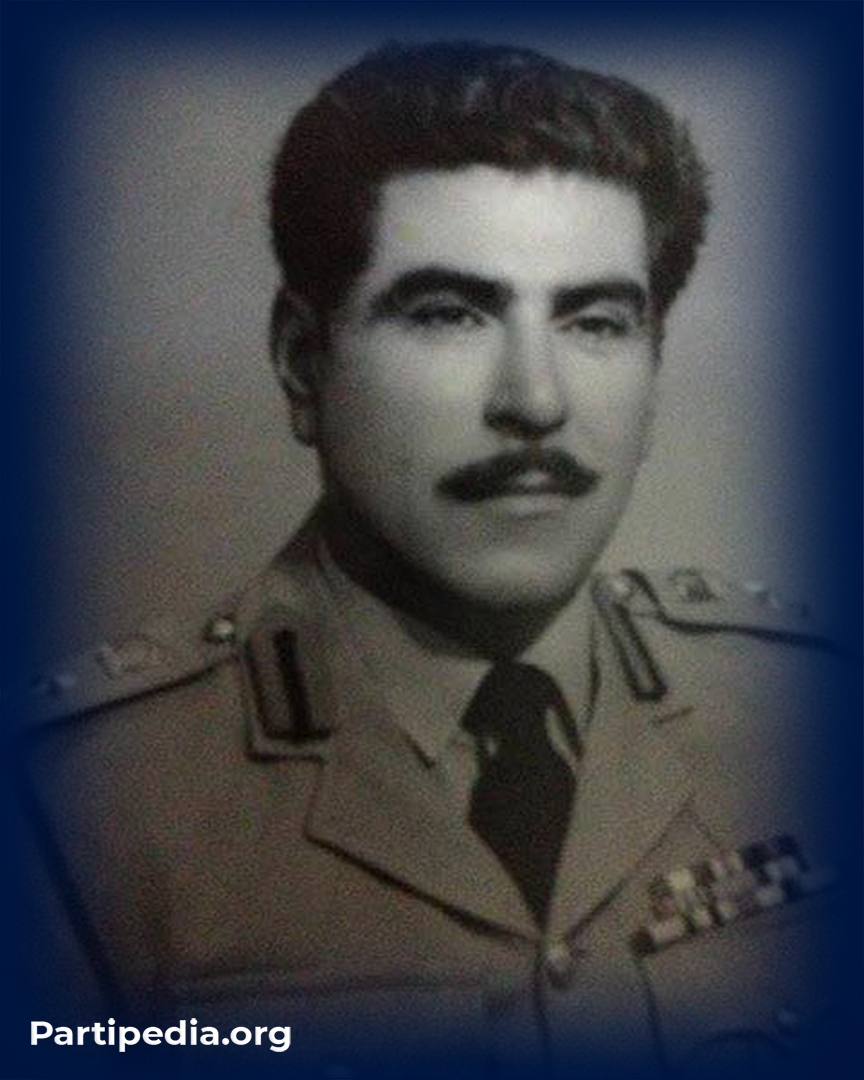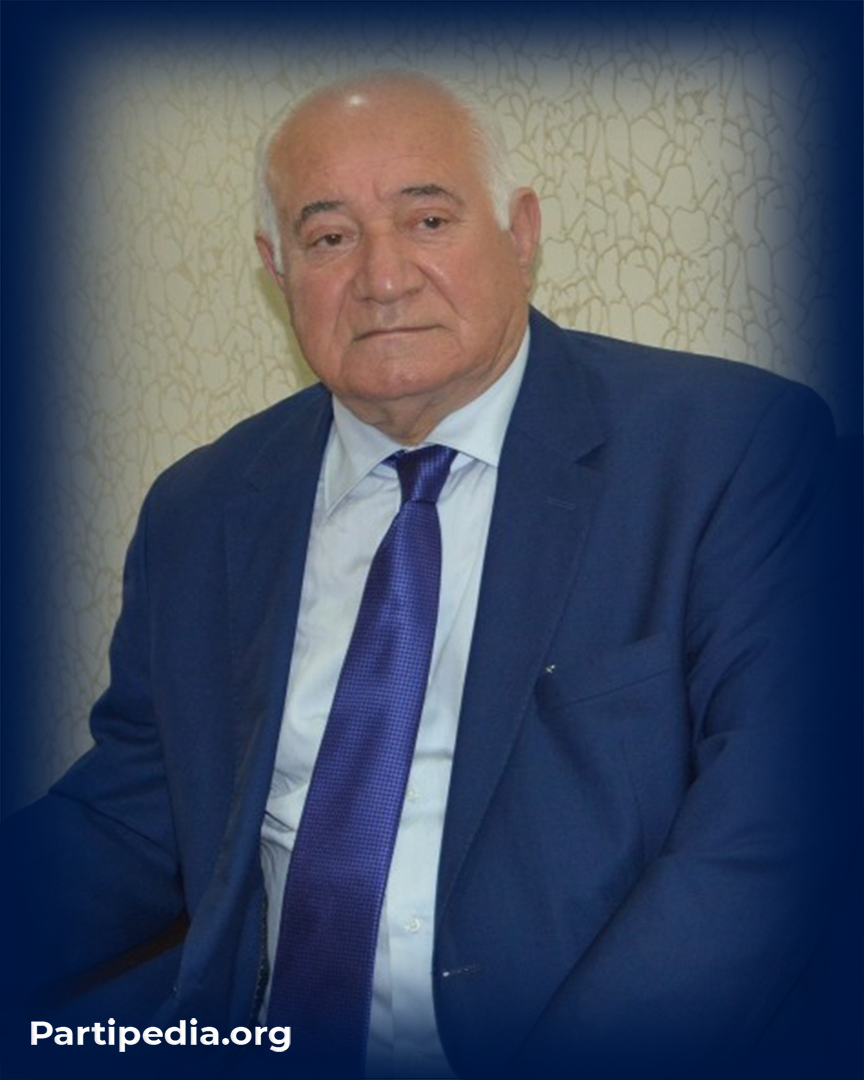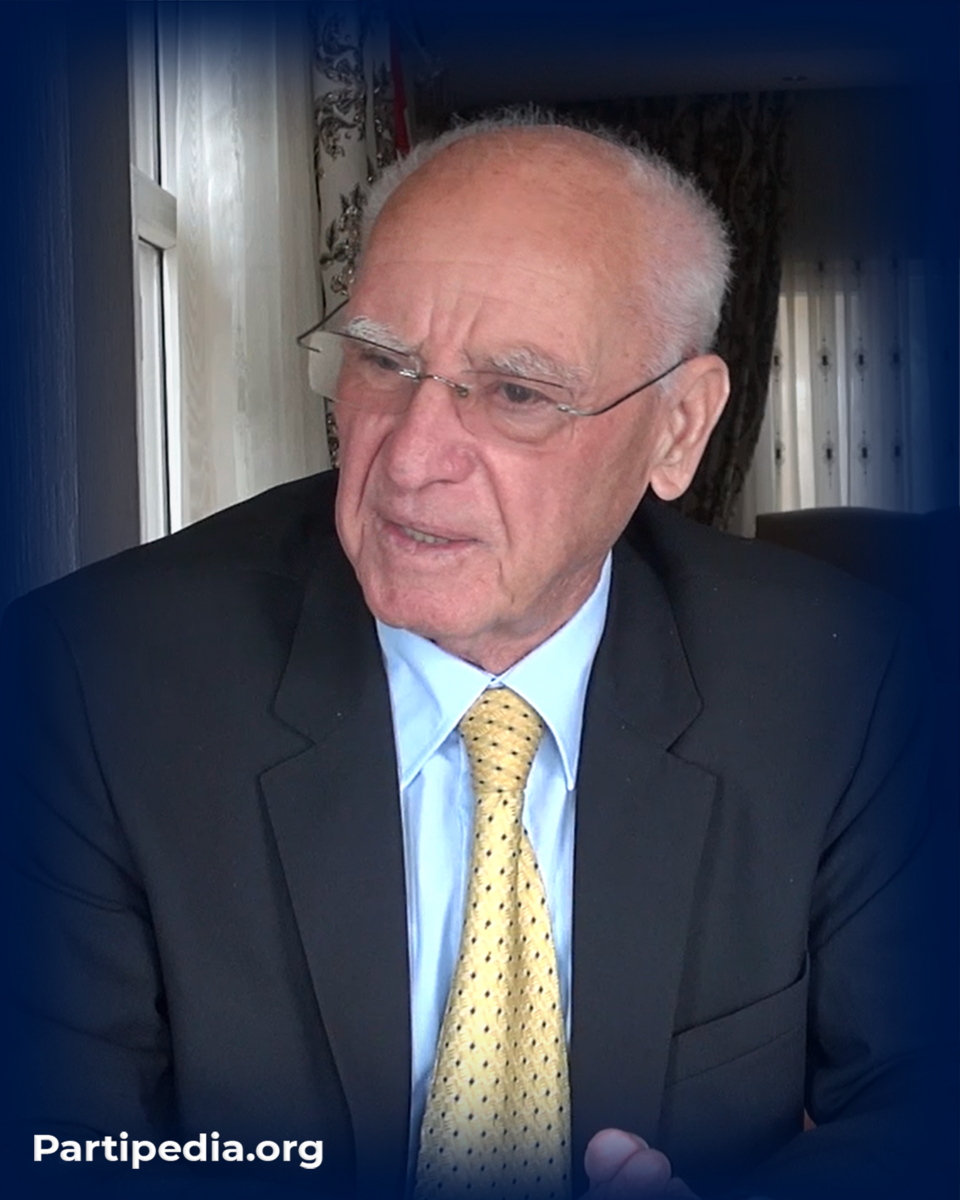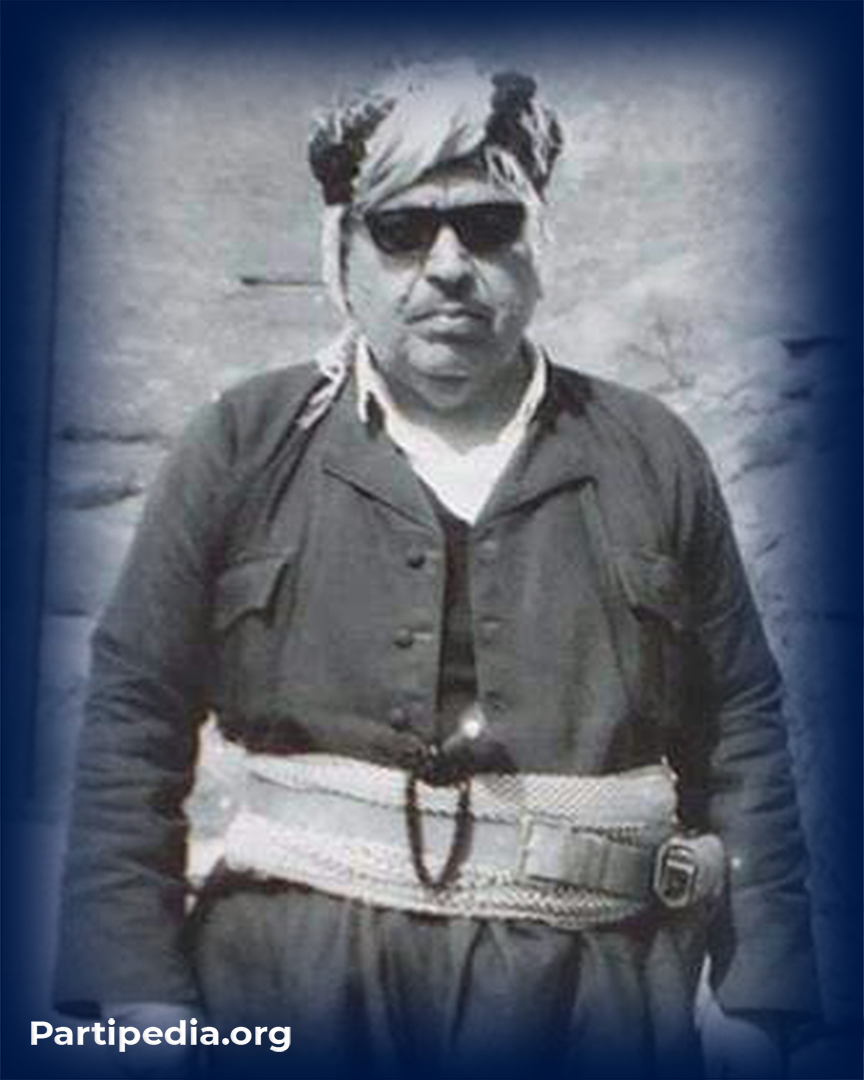


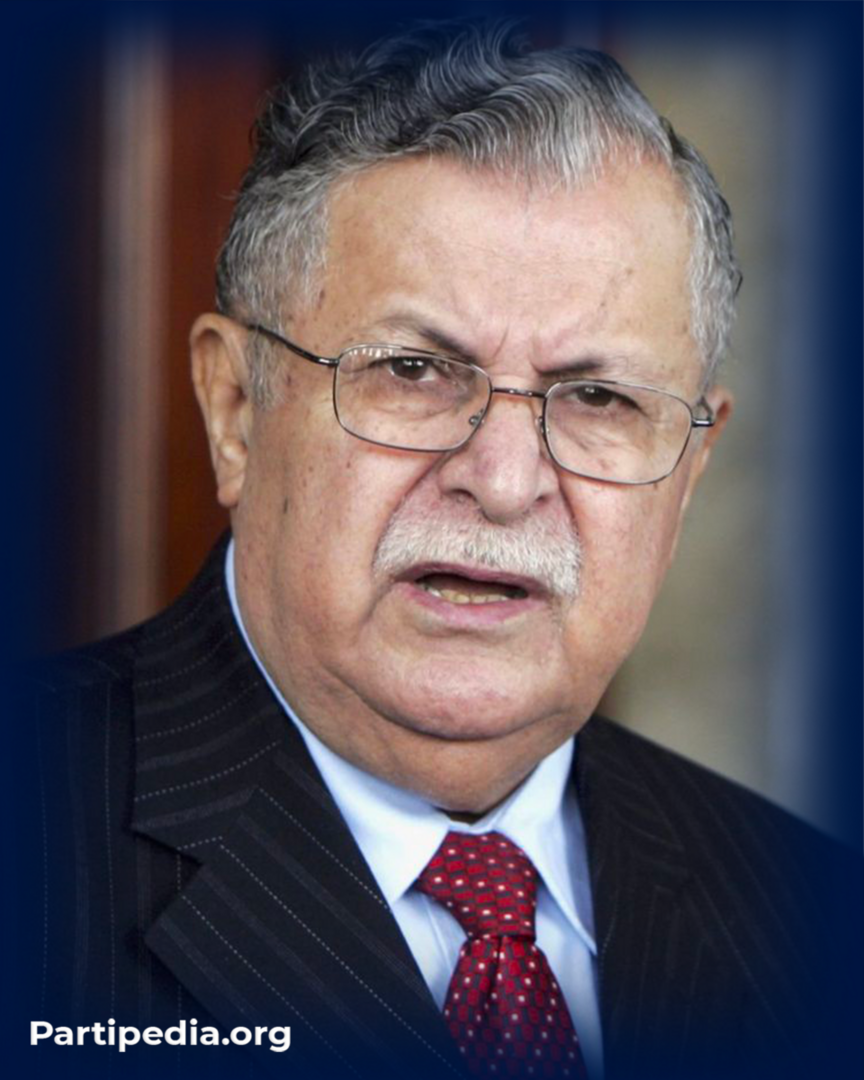
Jalal Husameddin Nureddin Ghafur, known as (Mam Jalal), joined the Party in 1947, became a member of the Party's Central Committee in 1953, became a member of the founding board of the Kurdistan Students' Union in 1953, became a member of the Preparatory Committee of the First Congress of the Kurdistan Students' Union in Baghdad in 1953, became the Secretary of that Union in the same year, joined the Peshmerga forces in 1961, and was elected President of Iraq by the Iraqi Parliament in 2004.
Biography
Jalal Husameddin Nureddin Khafur, known as (Mam Jalal), was born in 1933 in the city of Koy, in the Erbil province. He comes from a family of Sheikhs of the Qadiri Talabani order and is from the Zanganeh tribe of Fayli, whose ancestors migrated from Kermanshah in Eastern Kurdistan to Southern Kurdistan at the end of the Safavid era. He completed his primary and secondary education in the Koy district of Erbil province and his preparatory education in Kirkuk city. He started his first grade of secondary education in the Koy district in 1948. He completed his secondary education in the city of Koy in 1950. In 1951, he was accepted to a preparatory school in Erbil in the fourth grade. In 1952, he completed his fifth grade of secondary education in the science department in Kirkuk city. In 1952, he was accepted to the Faculty of Law at the University of Baghdad in the Faculty of Law. After dropping out of school due to political work, he graduated from the Faculty of Law at the University of Baghdad in 1959. He worked as a lawyer in Kirkuk province in 1960. In 1967, he married Hero Ibrahim Ahmed and they got married in 1970.
On December 17, 2012, he suddenly fell ill and was sent to the Charité hospital in Berlin. On September 24, 2012, he signed a memorandum of understanding with Nawshirwan Mustafa (1944-2017), the general organizer of the Gorran Movement, with the aim of stopping the vote on the Kurdistan Region Constitution. On July 19, 2014, he returned to Sulaymaniyah and withdrew from all administrative and political activities. On September 29, 2015, he was awarded an Honorary Doctorate in Law by the University of Koyeh. On Tuesday, October 3, 2017, he passed away due to illness in a hospital in Berlin. On this occasion, President Masoud Barzani, the President of the Kurdistan Region, announced a week of official mourning in the Kurdistan Region. On October 6, 2017, he was buried at the Kurdistan Regional Government (KRG) via the Kurdistan Regional Government (KRG) airport. His body arrived in Sulaymaniyah with the presence of the President of the Kurdistan Region, Masoud Barzani, and the flag of Kurdistan. He was buried at the Debashana Hill in Sulaymaniyah. The funeral was held in Kurdish, Arabic, Persian, and English.
Worksheet
In 1946, he became one of the favorites of the Iraqi Communist Party and was known as Omer Debabe through lawyer Omer Mustafa Mihemed Amin (1923-1992). He was invited to the ranks of the Kurdish Democratic Party and organized an organizational cell in his home. In 1947, with the encouragement and support of the Kurdish Democratic Party, he was one of the founders of the Education Development Association (K.P.X). In 1947, he won first place in the primary stage at the Erbil provincial level. On March 21, 1947, he played the role of Kawa's son in the theater (Zuhak) in the Koy district. In 1947, he joined the ranks of the Kurdish Democratic Party and began political activity under the pseudonyms Agir and Polu. He also published short stories under the name Agir in the Rizgari newspaper, the organ of the Kurdish Democratic Party.
In 1949, he became a member of the Koy District Committee of the Kurdish Democratic Party. In 1950, he became a member of the Erbil District Committee of the Kurdish Democratic Party. In 1951, he was temporarily exiled to Mosul by the agents of the Iraqi Empire due to his political activity. In 1951, he was a representative of the Second Congress of the Kurdish Democratic Party in Baghdad. He participated in the demonstration of November 20, 1952 in Erbil and was arrested by the police a day later. In 1953, he was elected by the congress representatives as a member of the Central Committee of the Kurdistan Democratic Party - Iraq (Third Congress). In 1953, he was a member of the founding board of the Kurdistan Students' Union in Baghdad. In 1953, he was a member of the Preparatory Committee of the First Congress of the Kurdistan Students' Union in Baghdad. In 1953, he was elected Secretary of the Kurdistan Students' Union (First Congress) by the congress delegates. In 1953, he was a member of the founding board of the Kurdistan Democratic Youth Union. In 1953, he became the President of the Kurdistan Democratic Youth Union (First Congress). In 1953, under the leadership of lawyer Ibrahim Ahmed Fatah (1914 - 2000) and the companionship of Habib Muhammad Karim (1931 - 2013), he became a member of the Board of the Kurdistan Democratic Party - Iraq under the name Habib Fayli, in order to reconcile the three wings of the Iraqi Communist Party (Al-Qa'id - Raya Ash-Shuxila - Wahdatu Ash-Shuy'iyin) and unify them, which they succeeded in doing. In 1954, he was elected a member of the Politburo of the Kurdistan Democratic Party - Iraq. In 1954, he was briefly detained by the Secret Police of the Kingdom of Iraq. On March 20, 1954, he participated in the Newroz celebration in Erbil and read a speech to the public in Arabic on behalf of the students of the Law Department of the Baghdad Law College. In 1954, he was known as Nihênî Awla in the organizations of the Democratic Party of Kurdistan - Iraq in Ranya, Sulaymaniyah Province. In 1955, he was elected Secretary of the Kurdistan Students' Union (Second Congress). In 1955, he submitted a letter of protest against the actions of the Iraqi Communist Party to the British Communist Party, together with engineer Nuri Siddiq Ali (1922 - 1983), or Nuri Shawês, on behalf of the Democratic Party of Kurdistan - Iraq. On July 31, 1955, he was a representative of the Kurdistan Democratic Party - Iraq at the World Youth Congress in Warsaw, the capital of the Republic of Poland. In 1956, he was elected President of the Kurdistan Students' Union. In 1956, he became a member of the Politburo of the United Democratic Party of Kurdistan (Second Unification), in 1957 he became a member of the Politburo of the United Democratic Party of Kurdistan (Third Unification), in 1957 he participated in the World Youth and Students Festival in Moscow and met with General Mustafa Barzani (1903-1979). In 1957, he participated in the establishment of the Kurdish Democratic Party in Syria in Damascus and became their point of contact with the United Democratic Party of Kurdistan. In 1957, he met with Michel Aflaq, the leader of the Arab Ba'ath Party, Ekrem Hourani, one of the founders of the Arab Ba'ath Party, and Abdulhamid Al-Sarraj (1925 - 2013), Vice President of the United Arab Emirates, in Damascus, and talked about his meeting with President Mustafa Barzani in Moscow and his meeting with President Gamal Abdel Nasser (1918 - 1970). On November 3, 1958, he was the host of the welcome speech for General Mustafa Barzani's return from the Soviet Union to the homeland at the People's Hall in Baghdad. He was the editor-in-chief of the Rizgari magazine, which only published two issues in early 1959.
In 1959, he became a member of the Joint Committee of the United Democratic Party of Kurdistan and the Communist Party of Iraq for mutual coordination and cooperation. On March 21, 1959, he delivered a speech to the people on behalf of the United Democratic Party of Kurdistan at the Newroz celebration in the Khanaqin district of Diyala province. In 1959, he was the representative of the Democratic Party of Kurdistan - Iraq at the Congress of the Iraqi Journalists' Union. In 1959, he was elected by the congress representatives as a member of the Central Committee of the Democratic Party of Kurdistan - Iraq (Fourth Congress). In 1959, he wrote articles under the name Pirot for the newspaper Xebat, the organ of the Democratic Party of Kurdistan - Iraq. On February 16, 1960, he graduated from the fourteenth class of the Yedeg Military College in Baghdad with the rank of Second Class Officer and served in the fourth division of the infantry and tanks in the Iraqi Army. In 1960, he was elected as a member of the Central Committee of the Kurdistan Democratic Party (Fifth Congress) by the congress delegates. In 1960, he was elected as a member of the Politburo of the Kurdistan Democratic Party at the first meeting of the Central Committee. In 1960, he became the head of the Fourth Branch Committee of the Kurdistan Democratic Party. In 1960, he opened a political awareness session for the cadres of the Fourth Branch Committee. In 1961, he attended the leadership meeting of the Kurdistan Democratic Party to assess the latest situation and voted to start the revolution. In 1961, accompanied by lawyer Omar Mustafa Mihemed Amin (1923 - 1992), under the name Omar Debabe, he visited the village of Barzan in the province of Erbil and met with President Mustafa Barzani in order to learn his opinion on the start of the revolution. In September 1961, he visited the rebellious tribes of the Pishder region in order to prepare for a nationwide revolution. On September 6, 1961, he led the general strike in the city of Sulaymaniyah to demand Kurdish rights as stipulated in the interim constitution of the Republic of Iraq. In 1961, he joined the Peshmerga forces and became one of the commanders. From December 18 to 23, 1961, he attended the meeting of the Central Committee of the Kurdistan Democratic Party in the village of Awalana in the province of Sulaymaniyah to continue the September Revolution and gave his approval. On Newroz 1962, he took command of the liberation of the Sharbajer area on the border of Sulaymaniyah province. In 1962, he was appointed as the commander of the First Division of the Peshmerga Force of the September Revolution, whose headquarters were in the Rezan River in Sulaymaniyah province. In 1963, he became the commander of the Liberation Force. In mid-1963, his father's house in the Koy district was burned by (Al-Haras Al-Qawmi) affiliated with the Ba'ath Party. In 1963, he commanded the Battle of the Rezan River on the border of Sulaymaniyah province against the Iraqi Army Ground Forces and retreated under pressure from the Iraqi Army. At the end of December 1963, he participated in the extensive meeting to establish the Revolutionary Leadership Council in the Ranya district in Sulaymaniyah province, which was unsuccessful.
In 1963, he was appointed Vice President of the First People's Congress (Koye Congress) by President Mustafa Barzani. On February 18, 1963, he became the head of the negotiating delegation of the First People's Congress (Koye Congress) to Baghdad to discuss Kurdish rights with the Iraqi government. In 1963, he was nominated by President Mustafa Barzani for the post of Minister of State in Iraq.
He joined the Politburo branch in 1964 and was expelled from the party by all the delegates at the Sixth Congress of the Kurdistan Democratic Party. In 1964, he left for Iran and lived there until 1965. In April 1965, he gave an interview to the BBC, which was broadcast. In mid-July 1965, after the Politburo branch was pardoned by President Mustafa Barzani, he left Iran and settled in the liberated areas of the September Revolution. In December 1966, a delegation from the Iraqi Communist Party visited him and his friends from the Politburo wing of the Kurdistan Democratic Party in Doleraq, on the border of Sulaymaniyah province, and informed them that their secret relations with the Iraqi government were not secret and were harming the interests of the Kurds and the revolution, but they confessed and insisted on their relations.
On December 28, 1966, he left the liberated areas of Doleraq and headed for Baghdad and helped the Iraqi government against the September Revolution. In mid-May 1966, he led the armed forces of the Ibrahim Ahmed - Jalal Talabani group, which were armed by the Iraqi Army, and attacked the Peshmerga strongholds of the September Revolution on the border of Sulaymaniyah province, which was initially successful but later defeated. On Sunday, June 19, 1966, he met with Dr. Abdulrahman Bezaz (1914 - 1973), the Prime Minister of Iraq, in Baghdad, with the aim of cooperating with the Iraqi Army against the Peshmerga Forces of the September Revolution. On Sunday, June 19, 1966, he met with Lieutenant General Abdulrahman Muhammad Arif (1916 - 2007), the President of Iraq, in Baghdad, with the aim of cooperating with the Iraqi Army against the Peshmerga Forces of the September Revolution. On August 28, 1966, he participated in the first gathering of opponents of the Kurdistan Democratic Party in the village of Timar (Germiyan). In 1966, he met with Abdulxaliq Samarayi (1935 - 1979) in the village of Keloş.
On March 28, 1970, Iraqi President Ahmed Hassan Bakr (1914 - 1983) renounced his full support for the Ibrahim Ahmed - Jalal Talabani group and the arming of their supporters. On August 7, 1970, accompanied by Ismail Aziz Mustafa (1938 - 2017), Sheikh Ismail Mullah Aziz, deputy head of the fifth branch of the Kurdistan Democratic Party, visited President Mustafa Barzani at the resort in Haji Omaran, Erbil province, with the aim of reconnecting with the ranks of the Party, and accused Fakhr Hamed Salih (1937 - 1975), also known as Fakhr Margesori, of treason.
In 1970, he attended the funeral of Gamal Abdel Nasser (1918 - 1970) in January, represented by President Mustafa Barzani, and was received by Egyptian President Anwar Sadat (1918 - 1981). On February 10, 1971, he returned to the ranks of the Kurdistan Democratic Party. In 1972, he became the deputy head of relations for the Kurdistan Democratic Party in Beirut. In 1975, he met with Anwar Sadat.
On May 22, 1975, in collaboration with Dr. Fuad Masum and Adil Murad (1949 - 2018) under the name Adil Feyli and Abdulrezaq Aziz Mirza (1945 - 2018) under the name Abdulrezaq Feyli, he wrote and published the first declaration of the Patriotic Union of Kurdistan. On June 1, 1975, he founded the Patriotic Union of Kurdistan with Dr. Fuad Masum, Adil Feyli and Abdulrezaq Feyli. In 1975, after the defeat of the September Revolution, he secretly visited Moscow at the request of the Soviet Union authorities and discussed the start of the revolution. From August 27 to 31, 1975, he participated in the Eighteenth Congress of the Kurdish Students' Association in Europe in West Berlin and caused the division of this association.
In mid-December 1976, he met with Masoud Barzani in Damascus and agreed on coordination and cooperation. On July 20, 1977, he returned to Southern Kurdistan with the aim of developing armed activities. On August 31, 1977, he attended the first leadership meeting of the Patriotic Union of Kurdistan in Dolekost, at the international border triangle (Iraq - Turkey - Iran) with the province of Erbil, with the aim of distributing posts, and was elected as the Secretary General of the Patriotic Union of Kurdistan at that meeting. In 1978, with the cooperation of the Iranian intelligence agency (Savak) (National Intelligence and Security Agency), he moved his forces from Iranian territory to the border of the Republic of Turkey in preparation for the Battle of Hakkari against the forces of the provisional leadership of the Kurdistan Democratic Party in the Behdinan and Northern Kurdistan regions. In 1978, he participated in the Bexalisk meeting on the border of Sulaymaniyah province with the aim of evaluating the results of the Battle of Hakkari and the loss of most of the Patriotic Union of Kurdistan forces at the hands of the forces of the interim leadership of the Kurdistan Democratic Party. In 1978, he participated in the Derawî Gurgan meeting on the Qandil Mountain on the border of Sulaymaniyah province against negotiations with the Iraqi government. In 1979, he provided armed assistance to the Communist Party of Iraq. In 1979, he met with Ahmad Banîxelani, a member of the Politburo of the Communist Party of Iraq, in the village of Nawzengi on the border of Sulaymaniyah province, with the aim of resolving the problems between the Democratic Party of Kurdistan of Iran and the Patriotic Union of Kurdistan.
On October 13, 1982, in the village of Goreşir on the border of Sulaymaniyah province, he met with Aqid Rukin Khalil Muhammad Shakir, known as Abu Ahmed, the deputy head of the Iraqi Intelligence Service, for the purpose of negotiations. In 1982, he became the President and founder of the Kurdistan Revolutionary Union. In 1984, he began negotiations with the Iraqi regime and Saddam Hussein (1937 - 2006) and gave up armed activity for two years. In 1985, he wrote a letter to Grand Ayatollah Hussein Ali al-Muntezari, the deputy leader of the Islamic Republic of Iran, with the aim of mutual cooperation. On October 11, 1986, he assisted the Iranian Revolutionary Guard Corps in Operation (First Conquest) to attack Iraqi military bases and oil facilities in Kirkuk.
On November 8, 1986, in Tehran, the capital of the Islamic Republic of Iran, he signed a peace agreement with Idris Mustafa Sheikh Muhammad (1944 - 1987), also known as Idris Barzani, a member of the Politburo of the Kurdistan Democratic Party. In April 1986, he signed a joint agreement with the Iraqi Communist Party.
On June 19, 1992, he was elected as a member of the General Assembly of the Iraqi National Congress (Vienna Congress). In 1992, he was unsuccessful in the election of the leadership of the Kurdish Liberation Movement, coming in second place after President Masoud Barzani and with 441,057 votes. On Saturday, April 3, 1993, he met with Turkish President Turgut Ozal (1927 - 1993) at the Republic Palace in the company of President Masoud Barzani. On Sunday, April 4, 1993, he met with Prime Minister Süleyman Demirel.
On July 1, 1993, he participated in the graduation ceremony of the twelfth class of Salaheddine University in the city of Erbil, together with President Masoud Barzani. On Wednesday, October 6, 1993, at the Bashmakh border crossing on the border of Sulaymaniyah province, as the Secretary General of the Patriotic Union of Kurdistan, he welcomed the convoy of President Mustafa Barzani (1903 - 1979) and Idris Mustafa Sheikh Muhammad (1944 - 1987), known as Idris Barzani, who were being transported from the Islamic Republic of Iran to their final destination in the village of Barzan in the province of Erbil.
On February 17, 1994, under the auspices of President Masoud Barzani, he signed a peace agreement with the Islamic Movement in Iraqi Kurdistan. On June 13, 1994, in the city of Silopi (Republic of Turkey), under the auspices of the Turkish Government, he met with President Masoud Barzani with the aim of declaring peace in the Kurdistan Region. On Wednesday, November 9, 1994, he attended a joint meeting of the Politburo of the Kurdistan Democratic Party - United and the Patriotic Union of Kurdistan at the headquarters of his Secretariat in the city of Erbil with the aim of resolving the disputes between them.
He arrived in the United States on September 11, 1998, and on September 17, 1998, in Washington, D.C., in the presence of Madeleine Albright, the United States Secretary of State, signed the peace agreement with President Masoud Barzani, the leader of the Kurdistan Democratic Party. He was received by President Masoud Barzani in the town of Pirmam on Friday, December 8, 1999. On Thursday, September 23, 1999, he led a delegation from the Patriotic Union of Kurdistan and visited the United States Department of State together with Nechirvan Barzani, the leader of the Kurdistan Democratic Party. On December 3, 1999, he participated in the meeting of Iraqi opposition groups in New York City, United States, as a representative of the Patriotic Union of Kurdistan. On Monday, December 8, 2001, he met with President Masoud Barzani in the town of Pirmam in Erbil province with the aim of strengthening the deep relationship. On Monday, February 5, 2001, he was unanimously elected Secretary General by the delegates at the Second Congress of the Patriotic Union of Kurdistan in the city of Sulaymaniyah and on this occasion he presented a speech to the congress attendees. On his return to the Kurdistan Region, on Thursday, December 11, 2001, he met with President Masoud Barzani again at the Supreme Council and discussed the Turkish side's views on the developments in Kurdistan. On Sunday, March 31, 2002, he received Hoshyar Mahmud Muhammad, also known as Hoshyar Zebari, a member of the Politburo of the Kurdistan Democratic Party, and they spoke about his trip to Turkey and Syria. On Sunday, April 7, 2002, he received Hoshyar Zebari and Fazil Mirani, representatives of President Masoud Barzani. On Friday, May 30, 2002, he received Fazil Mirani, representative of President Masoud Barzani, in the town of Dukan. On Monday, July 29, 2002, he received Dr. Roj Nuri Shawis, representative of President Masoud Barzani, in the town of Dukan in the province of Sulaymaniyah. On Monday, August 26, 2002, he received Sami Abdulrahman and Hoshyar Zebari in the city of London. On Saturday, September 7, 2002, he was received at the Ibrahim Khalil border crossing point on the border of the Republic of Turkey and the Kurdistan Region by a delegation of the leadership of the Kurdistan Democratic Party, and on the same day, he was received by President Masoud Barzani in the town of Pirmam. On Tuesday, November 26, 2002, they were received by the President of the French Parliament, accompanied by President Masoud Barzani, and on Thursday, November 28, 2002, by Nicolas Sarkozy, the French Minister of the Interior.
On Thursday, December 19, 2002, he met with British Prime Minister Tony Blair at Downing Street, accompanied by President Masoud Barzani. In 2003, he was a representative of the Salaheddine Congress of Iraqi opposition parties with the aim of overthrowing the Saddam Hussein regime. On Monday, February 3, 2003, he was received by President Masoud Barzani in the city of Khalifa in Erbil province to assess the political situation in Kurdistan and Iraq. On July 13, 2003, he was appointed as a member of the Council of the Iraqi Authority's Intellectual Presidency (Anjumana Hukim Al-Intiqali Al-Iraqi). On March 26-27, 2003, he participated in the comprehensive National Reconciliation Congress in Erbil, which was held under the supervision of President Masoud Barzani for all components of Iraq. On Wednesday, April 2, 2003, he attended the Dukan meeting for the joint leadership of the Kurdistan Democratic Party and the Patriotic Union of Kurdistan with the aim of calling for the phase of Iraqi freedom. On Monday, September 15, 2003, he and President Masoud Barzani welcomed General Colin Powell, the Secretary of State of the United States of America, in the city of Halabja to lay a wreath at the cemetery of the martyrs of the chemical attack in Halabja. In 2003, he visited the United States of America with Zalmay Khalilzad.
On Saturday, May 15, 2004, he represented the Congress of Sovereignty and Democracy, which was held in the city of Erbil with the presence of 600 delegates. On November 18, 2004, he chaired the Congress of Iraqi Oppositionists in Dukan to discuss the electoral process and the implementation of security and the trial of Saddam Hussein. On Wednesday, December 1, 2004, in the town of Pirmam, he signed a strategic agreement between the Kurdistan Democratic Party and the Patriotic Union of Kurdistan for their national problems with President Masoud Barzani.
In 2005, he was a candidate for the Iraqi National Intellectual Council on the Kurdistan Alliance List 130, and was elected as a member of the National Intellectual Council on the Kurdistan Alliance list on December 30, 2005. On April 28, 2005, he was appointed as the President of the Federal Republic of Iraq for the intellectual phase. In 2005, he ran for the Iraqi National Council on the Kurdistan Alliance list with number 730 in Sulaymaniyah province. On Saturday, June 17, 2005, he received Massoud Barzani, President of the Kurdistan Region, at the Palace of the Federal Republic of Iraq, and they discussed the writing of the Iraqi Federal Constitution and the participation of all components, and on Friday, August 12, 2005, they discussed writing the constitution again. On November 15, 2005, he attended the Islamic Congress in the Multi-Diverse World (Al-Alam At-Taeddudi) in Vienna as the President of the Federal Republic of Iraq. On December 21, 2006, at the Kurdistan National Council, he signed with President Masoud Barzani the unification of the two governments of the Kurdistan Region in Erbil and the Sulaymaniyah administration with the aim of establishing a unified government of the Kurdistan Region. He served as the President of Iraq for two terms (2006-2014). On Saturday, October 23, 2010, he was received by President Masoud Barzani in Erbil with the aim of establishing the Federal Iraqi Government.
His works:
Jalal Talabani has a large number of published works, most of which are his articles and letters, which he wrote or gave articles for special and general occasions and which were later published. Some of them are:
1 - Why the Kurdistan Students' Union? - 1953.
2 - Kurdish National Liberation Movement of the People of Kurdistan - (First Edition -), (Third Edition - 1964).
3 - The Peshmerga of Kurdistan - Its Origin, Development and Experiences in Comrade Mam Celal's Report to the Kurdistan Democratic Party Conference - Timar 28, August 1966 - 1966.
4 - Kurdistan and the Kurdish National Movement - (First Edition - 1969), Kurdish translation by (H.A) under the title Kurdistan and the Kurdish National Movement, published in 2011.
5 - Why do Kurdistan students need a special organization? - 1973.
6 - Why the Patriotic Union of Kurdistan...? - 1976.
7 - Resistance against imperialism and fascism and their agents for independence, democracy and autonomy - 1980.
8 - The Call for Kurdishness - 1981.
9 - About the partisan war in the cities - 1985.
10 - About the Kurdish Question in Iraq - 1988.
11 - Tomorrow and Democracy and the freedom of the masses, even from the right to dream? - (First Edition - 1988), (Second Edition - 2014).
12 - Learning and Understanding and Using Marxism in Work - 1989.
13 - Doctor Etasi and the Kurdish Question - next year.
14 - For the development of the Patriotic Union of Kurdistan - 1992.
15 - We are not afraid of war, but we want peace - 1995.
16 - My Memories - 1996, this letter or leaflet was written in Arabic and translated into Kurdish by Amanc.
17 - Mam Celal's Message - 1997.
18 - Arab-Kurdish dialogue and the solution to the Kurdish question - 1998.
19 - Spring revival of memories and beliefs - 1999.
20 - Silver Jubilee reign and future duties - 2000.
21 - Iraq from dictatorship to democracy - 2003.
22 - A series of political articles about federalism, unity, and the Patriotic Union of Kurdistan - 2004.
23 - Kurdistan is a high federalism... there should be no conflict in it - 2004.
24 - A short article about Social Democracy - 2007.
25 - Part of Mam Celal's memoirs - 2009, translated from Arabic into Kurdish.
26 - Working duties in difficult conditions - 2011.
Source:
1 - Aram Karim, I Know Mam Celal, Part One, (Unpublished - 2000), pp. 5 - 6, 8, 10-11, 13, 15, 17, 20 - 22, 26.
2 - Prepared by: Salah Rashid, Didara Temen, Volume One, Second Edition, (Sulaymaniyah - Karo Press - 2017), pp. 21 - 24, 33, 35, 38, 41, 43, 65, 72, 82, 89 - 91, 183 - 184, 221, 321, 30.
3 - Prepared by: Kemal Mahmud, Album and Biography of Mam Jalal (George Washington of Iraq), (Sulaymaniyah - Awat Library - Karo Press - 2017), pp. 6 - 18, 21 - 23, 32, 36 - 37, 71 - 72, 79, 81 - 85, 88 - 91, 114 - 115.
4 - Prepared by: Mela Bakhtiyar, Erîf Sulêman, From the Grains to the Grains (Wheat Grains), Volume One, Second Edition, (Hewlêr - Hawser Press - 2007), pp. 47 - 48.
5 - Ehmed Banikhelani, My Memories, (Stockholm - 1997), pp. 188, 214 - 215, 250, 259 - 260, 339 - 341, 356 - 357, 385 - 387, 400, 407, 427 - 431, 444, 447, 471, 532, 542 - 543, 548.
6 - Ehmed Bawer, Contemporary History of Iraq 1914 - 1968, (Sulaymaniyah - Karo Press - 2018), pp. 382, 384.
7 - Ehmed Dilzar, Memories of My Days, (Hewlêr - Ministry of Culture and Youth - Shehab Press - 2019), pp. 82, 220, 122.
8 - Ehmed Şerîf Lek, Interpretation of Historical Events, Volume Two, (Hewlêr - Rojhilat Press - 2019), pp. 69, 94, 108, 119 - 121, 124, 137, 143, 145, 206.
9 - Ashraf Talabani, A Summary of the History of the Talabani Sheikhs, (Hewlêr - Koyê Research and Publishing Center - Shehab Press - 2012), pp. 98, 102 - 109, 112 - 117, 132.
10 - Ibrahim Al-Rawi, From the Great Arab Revolution to Modern Iraq, Second Edition, (Beirut - Dar Al-Kutub Press - 1978), p. 378.
11 - Edith and Wai, Ayf, Bizoz, Iraq: A Study in Its Foreign Relations and Internal Developments 1915 - 1975, Translated by Abdulmajid Hasib Al-Qaysi, Part Two, (Beirut - Dar Al-Arabiya Lil Mewsu'at - 1989), pp. 22, 97.
12 - Ardaşir Peşeng, Kurds in the Iran-Iraq War, (Tehran - Nashrî Merz ü Büm - 1394 h.), pp. 136, 138, 151, 153, 163, 191, 193, 201, 206, 219, 222, 227, 262, 264 - 265, 271 - 273, 277, 285, 314, 331, 340, 343 - 345, 347, 349 - 351.
13 - Arnold Wilson, The Iraqi Revolution, Translated and Commented by Jafar Al-Kheyyat, (Beirut - Dar Al-Kutub Press - 1971m), p. 67.
14 - Names of Candidates of the Kurdistan Alliance List for the Upcoming Elections, Teaxhi Newspaper, Teaxhi Publications for Printing and Publishing, No. 4641, Third Issue, Baghdad, Wednesday, December 7, 2005, p. 8.
15 - Emma Sky, Unshakable Hopes and Lost Opportunities in Iraq, Translated and Presented by Qays Qasim Al-Ajresh, (Beirut - Al-Rafideyn and Seklur - 2016), pp. 423, 476, 519.
16 - Bahaeddin Nuri, In Evaluating the Policy of the Iraqi Communist Party in the Years 1958 - 1983, Fourth Edition, (Iraq - December 1991), p. 33.
17 - Peter G. Lambert, The United States and the Kurds: A Case Study of United States Commitments, Translated by the Center for Kurdish Studies and Document Preservation / University of Duhok, (Duhok - University of Duhok - Xanî Press - 2008), pp. 62, 64, 97, 99, 111, 113, 117, 119.
18 - Peter W. Galbraith, The End of Iraq, Mamik Translation, (Hewlêr - Aras Printing and Publishing House - 2007), pp. 86, 211.
19 - Talib Moryasi, The Search for Truth, Volume One, (Hewlêr - 2004), pp. 116, 131-132.
20 - Jalal Al-Talabani, Doctor Etasi and the Kurdish Question, (Kurdistan - Patriotic Union of Kurdistan - Organization Office - no year), pp. 1, 40.
21 - Jalal Talabani, Kurdistan and the Kurdish National Movement, (Beirut - Dar El-Telî'a for Printing and Publishing - 1969), pp. 1, 7, 447.
22 - Jalal Talabani, Kurdistan and the Kurdish National Movement, Translated by H.E., (Sulaymaniyah - Cemal Ali Bapir Library - 2011), pp. 1, 275, 337.
23 - Hafiz Al-Qadi, Remembrance, Part One, (Duhok - Xanî Press - 2006), p. 270.
24 - Habib Muhammad Karim, History of the Democratic Party of Kurdistan - Iraq (in main stations) 1946 - 1993, (Duhok - Xebat Press - 1998), pp. 50, 56-57, 59, 61, 68, 85, 508.
25 - Habib Muhammad Karim, Kirkuk and the Holy September Revolution, Gulan Al-Arabi Magazine, Gulan Cultural Center, Issue 70, Sixth Year, Hewlêr, Ministry of Education Press, March 31, 2002, p. 38.
26 - The War on Iraq Newspapers - Documents - Reports 1990 - 2005, (Beirut - Arab Union Research Center - 2007), pp. 524, 1066, 1160, 1239.
27 - Hesen Erfe, Kurds and a Historical and Political Study, (No place - No date), pp. 133 - 134, 139 - 141.
28 - Hassan Latif Al-Zubaydi, Encyclopedia of Iraqi Parties, (Beirut - Muesseset Al-Arif lil Matbû'at - 2007), pp. 448 - 450, 492, 512, 514 - 516, 591.
29 - Heso Hurmi, Eggs from the Life of Mir Tahsin Said Ali Beg, (Hewlêr - Rojhilat Press - 2017), pp. 90, 152, 193.
30 - Hussein Ahmadi, Research on Political Events in the Kurdish-populated Areas of Iran 1320 - 1330, Second Edition, (Tehran - Muessesati Metaliati Tarikhi Mu'asir - 1394 AH), p. 25.