

Biography
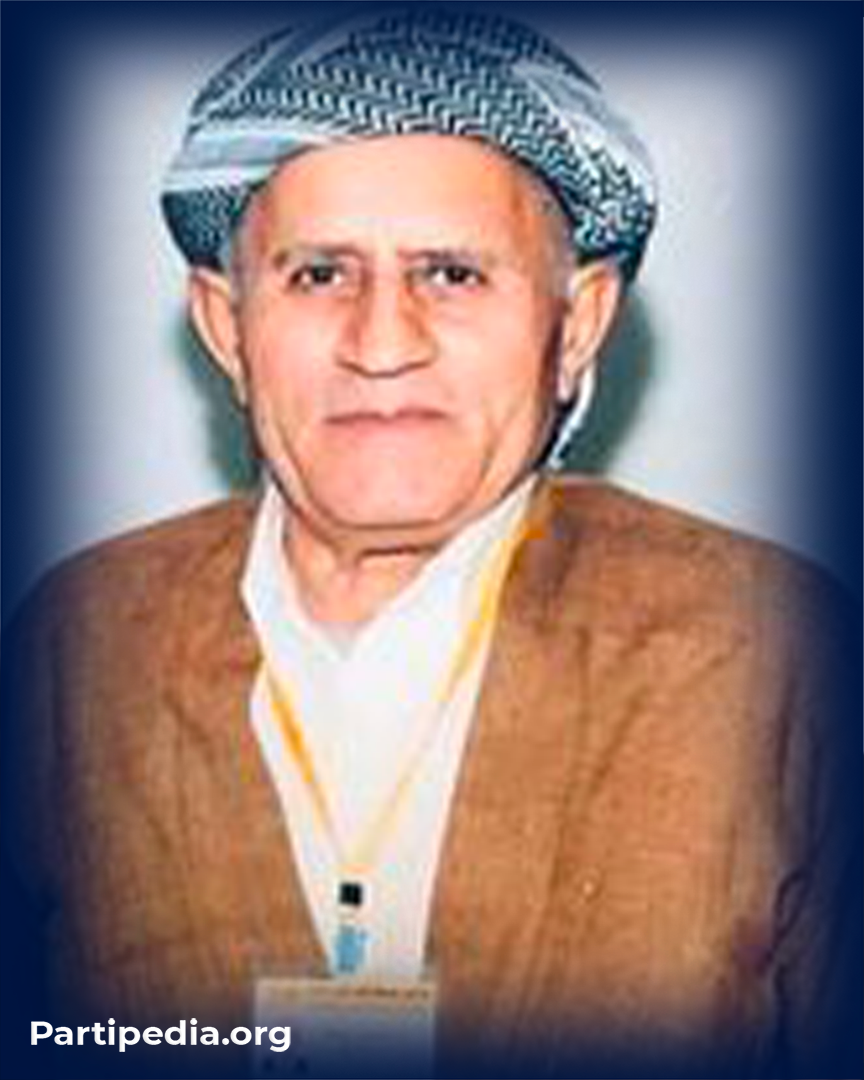
Omar Sharif Abdullah was born in 1941 in Kirkuk province, completed his primary and secondary education in Sulaymaniyah and his high school in Kirkuk. He graduated from high school and joined the Qutabi (Students) Union of Kurdistan in 1958.
Worksheet
Omar Sharif Abdullah joined the ranks of the KDP in 1958, became the head of the Kirkuk Workers' Union in 1959, joined the Peshmerga forces in 1961 and participated in the Battle of Xalobazi in Kirkuk province against the Iraqi army's ground forces in the same year, participated in the Kirkuk city operation in 1962, and in 1964 opposed the decisions of the Mawat general meetings organized by the Political School of the Kurdistan Democratic Party (KDP), supporting President Mustafa Barzani (1903-1979).
In early June 1964, as a member of the Preparatory Committee of The sixth congress of the Kurdistan Democratic Party was elected, in 1964 he became a member of the Central Committee of the Kurdistan Democratic Party (PDK) and was nominated as a candidate by President Mustafa Barzani, in 1964 he was appointed as the head of the fourth league committee of the Kurdistan Democratic Party (PDK) and in the same year he was appointed as the head of the third league committee of the Kurdistan Democratic Party (PDK), in 1964 he attended the funeral ceremony of the martyr Seyid Wali Payskilchi, a member of the third league committee of the Kurdistan Democratic Party (PDK), who was martyred by the racist Turkmen and with the help of the Kirkuk Security Administration of the Iraqi government, and read a poem at the martyr's grave, despite the fact that the Iraqi authorities had offered a reward of 10 thousand dinars for his capture, in 1964, he was a representative of the Qaladiz Congress (Second
People) and in the same year became a member of the Revolutionary Leadership Council in Iraqi Kurdistan.
He participated in the battles of Zanbur and the Zanganeh area of Kirkuk province against the ground forces of the Iraqi army. In 1965, he traveled on foot and without escort to all the districts of Sulaymaniyah and Kirkuk provinces to strengthen the organizations of the Kurdistan Democratic Party (KDP). In April 1966, he was captured by the Ibrahim Ahmed - Jalal Talabani group and with the plan of the Qaradakh force command of the third army, which was formed by September Revolution He had defected and joined the Iraqi regime and the Iraqi army. He was arrested with a group of his friends. On June 12, 1966, he was brutally executed by the fighters of the Ibrahim Ahmed - Jalal Talabani group in the village of Kirje, in the province of Sulaymaniyah. He was hanged and his grave is still missing. It is not known where he was martyred. On August 16, 2018, President Masoud Barzani awarded him the Barzani Medal of Nemir, and gave the medal to his daughter, Jiyan, instead. Omar SharifHe was a poet. He was fluent in Kurdish, Arabic, and Turkmen.
Source:
- Kurdistan Democratic Party Encyclopedia Committee Archives.
- Muhammad Abdulrahman Zengene, History of the Zengene Tribe, Second Edition, (Sulaymaniyah - Roon Publishing House - 2012), p. 7.
- Aqila Rwandzi, Yad û Afarin, (Hewlêr – Shawishka Center for Cultural Activities – Educational Press – 2005), p 43.
- Habib Muhammad Karim, Kirkuk and September Revolution Honorable Mention, Golan Al-Arabi Magazine, Golan Cultural Center, Issue 70, Sixth Year, Erbil, Ministry of Education Press, 31.03.2002, p.39.
- Muhammad Ali Soltani, The Îlat and Tawaîf of Kermashan, vol. 3, (Tehran - Chap Mawafaq - 1372 AH), pp. 641-642, 647-648, 650.
- David McDowell, New Kurdish History, (Beirut, Dar al-Farabi, 2004), p 484.
- Tofiq Mullah Sediq, Memories of the Partisan Days, the Peshmerga and My Expulsion, Second Edition, (Hewler, Shahab Press, 1996), p 92.
- Shakib Aqrawî, Years of Trouble in Kurdistan, The Most Important Political and Military Events in Kurdistan and Iraq from 1958 to 1980, second edition, (Hewlêr - Minare Press - 2007), p. 157.
- Martyr Omar Sharif Zengene, Xebat newspaper, organ of the Democratic Party of Kurdistan, issue 632, Hewlêr, Sunday, 16.08.1992, p 5.
- Martyr Kake Omar Sharif The leader, Brayati newspaper, organ of the Kurdistan Democratic Party (KDP)-United, issue 2334, Hewlêr, Wednesday, 21.05.1997, p. 6.