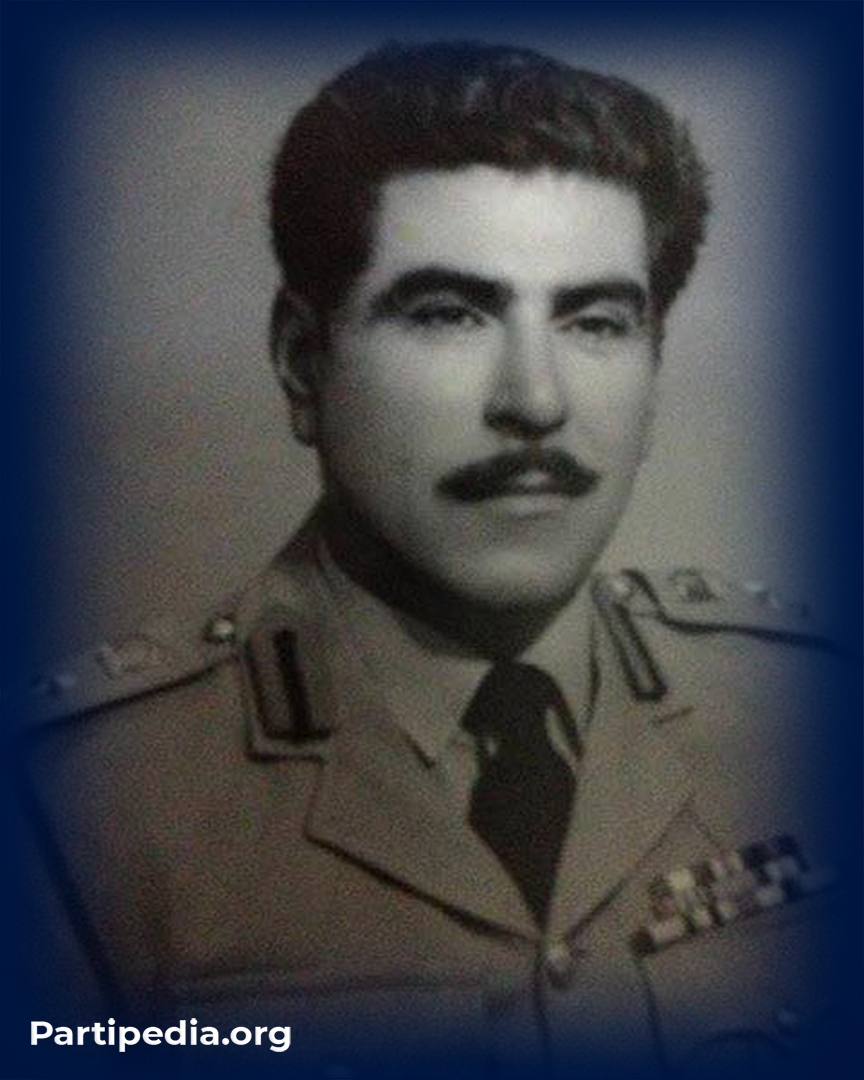


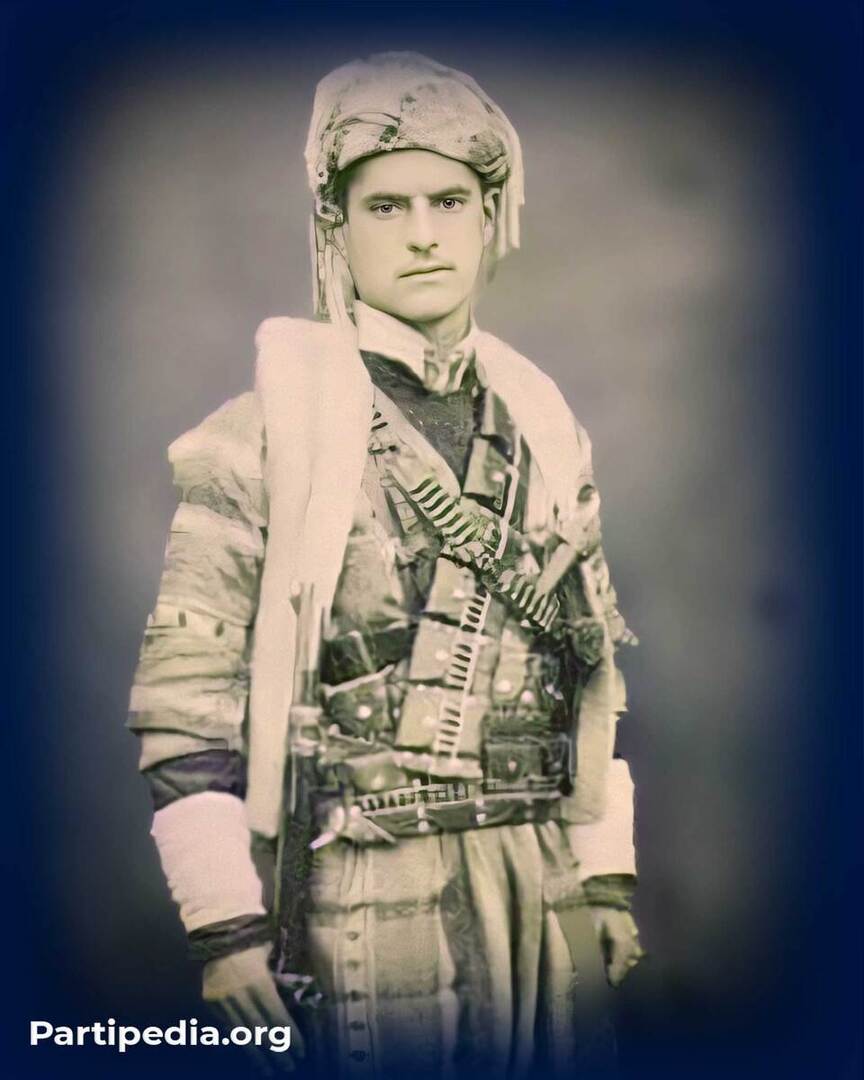
Muhammad Mahmud Muhammad Ahmed, known as (Muhammad Qudsi), was an officer and politician. He became a member of the Khoybun and the Brotherhood associations in 1938. He became a member of the Khiva Party in 1939, and in 1942 he became a Kurdish officer in the ranks of the Iraqi army with the rank of Sergeant (Mulazim). In 1944 he participated in the second Barzan revolution, and in 1945 he became a member of the Freedom Committee. In 1946 he was on the founding board of the Kurdish Democratic Party in the city of Mahabad. In 1947 he was executed by the Iraqi government in Baghdad for participating in the second Barzan revolution (1943-1945).
Biography
Muhammad Mahmud Muhammad Ahmed was born in the city of Quds, which is why he took the nickname of his city. His father, Mahmud Effendi (1894 - 1969), was an officer in the Ottoman army and later joined the Iraqi army. He was dismissed from the army due to his son's connections to the second Barzan revolution. His mother, Qeral Khan, was of Caucasian Circassian ethnicity. Muhammad Qudsii studied the first grade of primary school in the city of Mosul in 1927. He started the second grade in the city of Sulaymaniyah in 1928. He completed the primary stage at Khalidiyah Primary School and studied with Fayyiq Bekes to better learn the Sulaymaniyah dialect, where he received the nickname Qudsii. He completed the middle stage in the city of Sulaymaniyah and was known as the Star of Quds for his ability in sports. In 1930, he became a member of the Didewani Brigade of the first school in Sulaymaniyah. In 1932, he became the commander of the Didewani (Kishafiye) Department of the school in Sulaymaniyah. In 1937, he became one of the founders of the Yekîtî association in Sulaymaniyah. In 1938, he became affiliated with the ranks of the Xoybûn association and the Brirayetî association in Sulaymaniyah. In 1939, he became affiliated with the ranks of the Kurdish Hîwa Party. In 1940, he graduated as a deputy officer. In 1942, he graduated from the Baghdad Military College with the rank of Cîdar (Second Officer). In 1943, he became one of the active members of the Kurdish Hîwa Party in the town of Rawandiz (Hewlêr). In 1943, he worked as a theater director in the town of Rewandiz.
Worksheet
Muhammad Mahmud Muhammad Ahmed, born in 1943 Mustafa Barzani and visited the city of Baghdad. In 1944, he left the ranks of the Iraqi army and participated in the second Barzan revolution. On February 10, 1945, he became the letter carrier of the Kurdish Hiva Party and ran for President. Mustafa Barzani The commander of the Second Barzan Revolution and the head of the Azadî Committee in the second Barzan Revolution, he was a founding member of the Azadî Committee on December 15, 1945. In 1945, after the negotiations between the Azadî Committee and the Iraqi Government, he surrendered to the government with a part of the revolutionary officers. However, they were tortured in the Baghdad prison and later escaped to the liberated areas with Jalal Amin Beg. In 1945, he published articles in the magazine Gelawêj, and on March 25, 1945, he was a member of the delegation to the Azadî Committee negotiations under the presidency of Mustafa Barzani and held a meeting with Captain Stukes, the representative of the British Embassy, in the village of Shawraw on the border of Erbil province. In 1945, he met with President Mustafa Barzani He was on a trip to the Behdinan region with the aim of uniting the tribes and tribesmen against the Iraqi Pashayat army. On August 19, 1945, the Military Court of Appeal issued an order to seize all his transferred and non-transferred assets due to his participation in the second Barzan revolution. In 1945, after the defeat of the second Barzan revolution, he migrated to Eastern Kurdistan.
In 1946, he participated in the training and education of the Peshmerga of the Kurdistan Democratic Republic Army at the Military Academy in Mahabad. In 1946, he was promoted to the rank of Pesheng (Naqib, Captain) in the Kurdistan Democratic Republic Army. On March 21, 1946, he delivered a speech to the public on the occasion of Newroz in Mahabad, which was also published in the Kurdistan Newspaper, the organ of the Kurdistan Democratic Party. In 1946, with the consent of Sheikh Ahmed Sheikh Mihemed Sheikh Abdulsalam (1892 - 1969), known as Sheikh Ahmed Barzani and General Mustafa Barzani Collaborated with Celal Emin Beg and Ismail Ardalan to write the book The Secrets of Barzan. In 1946, he was on the founding board of the Kurdish Democratic Party in the city of Mahabad. In 1946, the first declaration of the establishment of the Kurdish Democratic Party, which was written by a lawyer, Hamza Abdullah Omer (1915 - 1998) translated the Arabic language into Kurdish (Kurmanciya Navin) and published it at the Kurdistan Printing House in the city of Mahabad. In 1946, he became the head of the Saqiz youth organization in Eastern Kurdistan. In 1946, he translated the first motto and program of the Kurdistan Democratic Party from Arabic to Kurdish. In 1946, he published a 16-page brochure and pamphlet on nationalism and national education at the Peshketin Library in the town of Rewandiz. On May 7, 1946, with the President Mustafa Barzani attended the opening of the Kurdistan Leaders' Sons' Academy in the city of Bokan and delivered a speech by the President Mustafa Barzani presented to those present.
In 1946, after the defeat of the Democratic Republic of Kurdistan under the command of General Mustafa Barzani He fought against the Iranian army. In 1947, after the defeat of the Democratic Republic of Kurdistan and the completion of the last defenses, he tried to free himself with a group of his friends, but they were unsuccessful and for this reason he was forced to surrender to the Iraqi police on April 10, 1947. Many Kurdish figures visit the city of Baghdad to talk to the authorities to try to prevent his execution. Because the Pashemil Military Court had already ordered his execution in 1945 and although they had decided not to execute him, they quickly ordered him to be hanged for the second time in 1947 in a fake trial, and the previous sentence was repeated. A large number of Kurdish figures living in Baghdad made a concerted effort to prevent the Iraqi authorities from ordering the execution, but their efforts were thwarted by the insistence of Salih Jabir (1895-1957), the Prime Minister of Iraq. Before his execution, he and three of his friends wrote a will for the people in which they reiterated their commitment to national freedom.
On June 19, 1947, during his execution, he was greeted with high morale, national pride, and a desire for hope for the future. Mustafa Barzani and his friends from the Aras River and their arrival in the Soviet Union were hanged. On June 19, 1947, he was hanged in the courtyard of the central prison in Baghdad in front of the imprisoned Kurds. On June 19, 1947, his body was received by Abdulsamad Bena, a member of the central committee of the Kurdish Democratic Party, and the Kurdish delegation and sent to the city of Sulaymaniyah. During the transfer of his body from the central prison in Baghdad to the city of Sulaymaniyah, thousands of Kurds stood at the gate of the prison. Fayiq (1905 - 1948), who was known as Fayiq to no one, the Kurdish poet, welcomed his body and the delegation of the martyrs, wrote a poem addressed to the Kurdish people, which was read as a hymn at the reception of their bodies. This poem of mourning for the martyrs of June 19, mentions all four martyrs. At the beginning of their execution, a large crowd of people from the city of Sulaymaniyah welcomed his body, and on this occasion, the great Kurdish poet Tofiq (1867 - 1950) Piremêrd wrote the poem Kostey Niwêy and was buried on Seywan Hill in the city of Sulaymaniyah. He announced the news of his execution on Baghdad radio. In 1959, Kamiran Mukri (1929 - 1986) published a 31-page book entitled Mihemed Qudsi yê Nemir in the city of Sulaymaniyah. Mihemed Qudsi was a master of Kurdish, Arabic and English.
His works:
1- What is Nationality and Patriotism? 1946
Source:
1- Archives of the Encyclopedia Committee of the Kurdistan Democratic Party.