

Situation and reason
In February 1965, the war between the Kurds and the Iraqi government resumed, and after the war began, the revolutionary leadership moved its headquarters from Pishder to Balek. The Iranian government, which had completely disappointed Ibrahim Ahmed and his supporters, tried to contact the revolutionary leadership and make an agreement with them, the result of these efforts was the widespread support of the Government of the Kingdom of Iran for the revolution against the ruling regime in Iraq. During the regime war, several Kurdish personalities and intellectuals inside and outside Kurdistan came between President Mustafa Barzani and the old Political School group that had fled to Iran and asked President Barzani to issue an amnesty for them. Barzani unconditionally pardoned them, and on July 6, 1965, they all returned to Kurdistan, except for Ibrahim Ahmed, who wanted to stay in Tehran. After the return of Ibrahim Ahmed's group, by order of President Mustafa Barzani, the Peshmerga joined the ranks of the revolution and their leaders were deployed in the Raqqa Valley under the supervision of Abbas Mamand Axa. After a while, they secretly contacted the Iraqi government from the Raqqa Valley. After the assassination of Iraqi President Abdulsalam Arif, his brother Abdulrahman Arif replaced him and contacted the revolutionary leadership directly and requested dialogue. In order to end the war, the government sent a delegation to Galala and met with the revolutionary leadership. However, the involvement of members of the old Political School group with the government disrupted the negotiations. As a result, the war resumed. The government, with the help of the Old Political School Group, planned a major offensive. On May 2, 1966, the government launched attacks. However, the government was defeated during that period of the war and finally lost all hope of victory. On June 15, 1966, a delegation was sent to the town of Galala, where President Barzani was based, to negotiate a ceasefire. On the 18th of the month, the two sides agreed that the revolutionary leadership would send a delegation to Baghdad to negotiate and reach an agreement. On June 22, the delegation of the leadership of the The revolution reached Baghdad and on June 29, the declaration of agreement was signed and announced. On October 28, 1966, President Abdulrahman Arif arrived in Baghdad and met with President Mustafa Barzani.
After the June 29 agreement and the normalization of the situation in Kurdistan, the KDP leadership decided to organize the party's ranks and prepare for a new party congress.
Organizing a congress
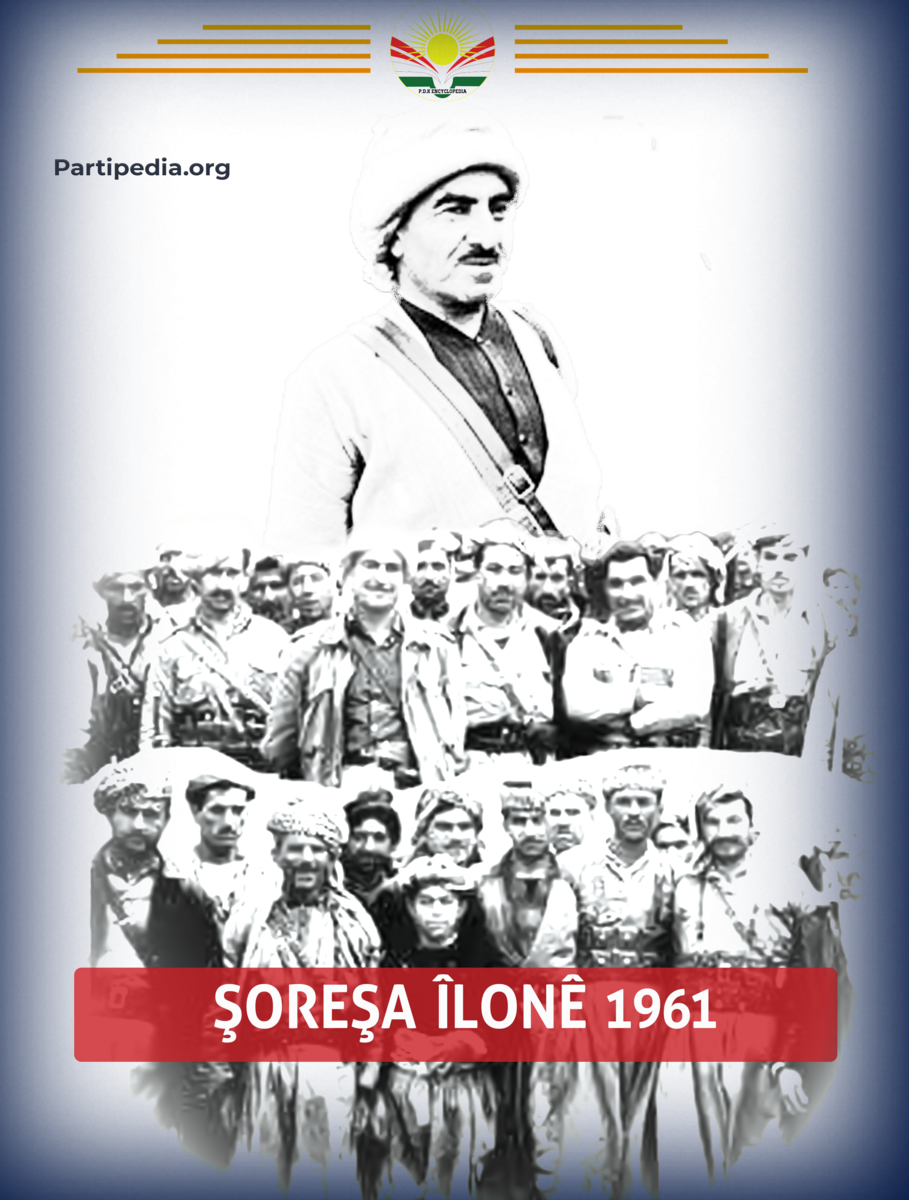
The seventh congress was held between November 15 and 21, 1966, with the participation of 425 delegates, representing 30,000 members of the Kurdistan Democratic Party, at the high school in the town of Gelale, Erbil province.
The Political School presented its political report to the delegates and shed light on all the events in Kurdistan, Iraq, and the region, especially the agricultural reform and insurance companies by the Baghdad government, and the economic collapse of Iraq.
At this congress, several important decisions were made regarding the organization and management of the liberated areas and a constitution for the Revolutionary Leadership Council was established. It was also decided at the congress to send a memorandum from President Mustafa Barzani to the Presidency of the Republic and the Presidency of the Council of Ministers in order to implement the June 29 statement.
At the congress, Ali Abdullah and Nouri Shawis each became members of the Political School of the Fifth Congress, who joined the supporters of the Mawet meeting and became members of the Political School for not supporting the Jalal Talabani-Ibrahim Ahmed group. In addition, the name of the KDP remained the same and President Mustafa Barzani was once again elected as the party leader, and for the first time, Idris Barzani and Masoud Barzani each attended the opening of the congress.
The leadership members elected at the seventh congress are:
1. Mustafa Barzani - President
2. Habib Muhammad Karim
3. Dr. Mehmud Osman
4. Salih Yusfi
5. Nouri Shawes
6. Ali Abdullah
7. Sami Abdulrahman
8. Shawkat Akreyi
9. Ahmed Atroshi
10. Yadullah Faily
11. Majid Atroshi
12. Aziz Akrey
13. Ismail Mela Aziz
14. Ali Shengali
15. Naaman Jesus.
Alternate members of the Central Committee:
1. Hashim Akrey
2. Shafiq Axa
3. Fatih Muhammad Amin.
The members of the Political School increased from five to seven and were elected by the members of the Central Committee as follows:
1. Habib Muhammad Karim, secretary
2. Dr. Mehmud Osman, Member
3. Saleh Yousfi, Member
4. Nuri Shawes, Member
5. Ali Abdullah, Member
6. Sami Abdulrahman, Member
7. Aziz Akrey, Member.
Seven members and two alternates were elected by the members of the congress to the Audit and Supervisory Committee:
1. Rashid Arif, president
2. Najmeddin Yusfi, Member
3. Mullah Heydar Muhammad Hussein, Member
4. Sabri Botani, Member
5. Mullah Salih Haji Hesen, Member.
After the end of the congress, President Mustafa Barzani assigned important duties to several members of the leadership, including Mahmoud Osman who was entrusted with foreign relations, Sami Abdulrahman was assigned several political and security tasks, Idris Barzani was appointed as the head of the Revolutionary Leadership Council's Military School, and Masoud Barzani was assigned to manage the Security School.
Another important achievement of the congress was the re-publication of the newspaper Xebat, which became the official mouthpiece of the party. After Massoud Barzani's visit to Baghdad, he took advantage of the opportunity and received an order to release the prisoners of 1965 and permission to operate the newspaper Xebat. The new issue of the newspaper Xebat was published on April 16, 1967, under the supervision of Salih Yusfi.
Source:
- Masoud Barzani, Barzani and the Kurdish Liberation Movement 1961-1975, Volume 3, Part 1, (Hewlêr, Ministry of Education Press, 2004).
- History of the Kurdistan Democratic Party, Congress and Conference (Program and Internal Regulations), Kurdistan Democratic Party Encyclopedia Committee, Volume 1, (Hewlêr - Roxana Press - 2021).
- Salah Al-Khirsan, Political Aviation in Kurdistan and Iraq, Readings in the Movements and Political Parties of the Kurds in Iraq 1946-2001, (Beirut - El-Belax Press - 2001).
- Shaqib Aqrawi, Sanawat Al-mihneh Fî Kurdistan, ehem Al-ehdas Al-siyasîyeh wa Al-eskariyeh Fî Kurdistan We Al-Iraq Min 1958- 1980, Al-tabe El-saniyeh, (Erbil- Matbet El-minareh- 2007).
- Habib Muhammad Karim, History of the Democratic Party of Kurdistan-Iraq (in the period of its leadership 1946 - 1993), (Dohuk - Xebat Press - 1998.
- Kurdistan Democratic Party, Central Committee, Final Statement of the Seventh Congress of the Kurdistan Democratic Party, 25.11.1996.
- Sherkoo Fethallah Omar, El-Hzib El-demokratî El-Kurdistanî We El-Hereke El-teheruriyeh El-qawmiyeh El-Kurdishîyeh Fî Kurdistan El-Iraq 1946-1975, (El-Sulaymaniyah- Ministry of Culture in the Government of the Kurdistan Region- Ron Press- 2004).
- (Tanwih, Journal of the Work of the El-hizb El-dimograti El-Kurdistan, El-Adat 671, Erbil, El-arbiaa, April 14, 1993).
- Al-Menahic and Al-Nizam Al-Daxli Lil-hizb Al-Dimoqrati Al-Kurdistan, Tedîlateho, Eqdehû Al-Mutemar Al-Sab' Lil-hizb, Senet 1966, (Bîdun Mekan- Metbeat Xebat).
- Hamud Gawheri, Get to know Idris Barzani and the Barzanis better, (Hewler - Shahab Press - 2014).