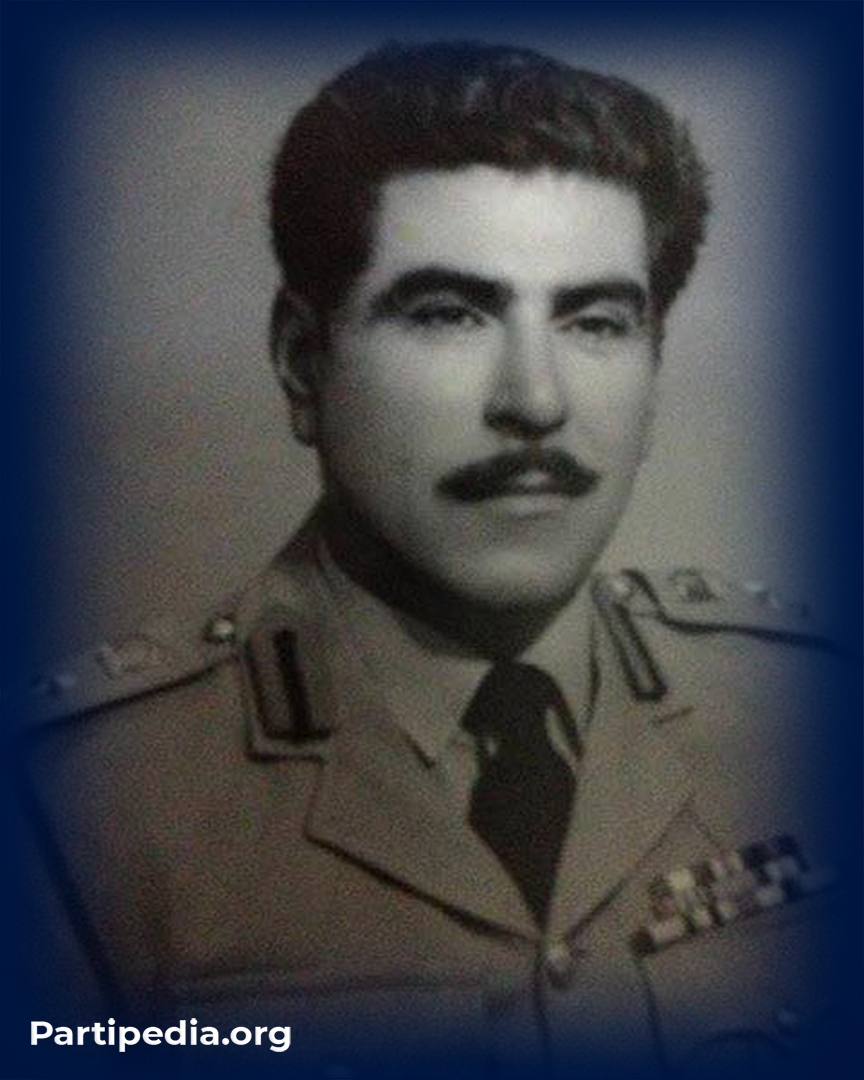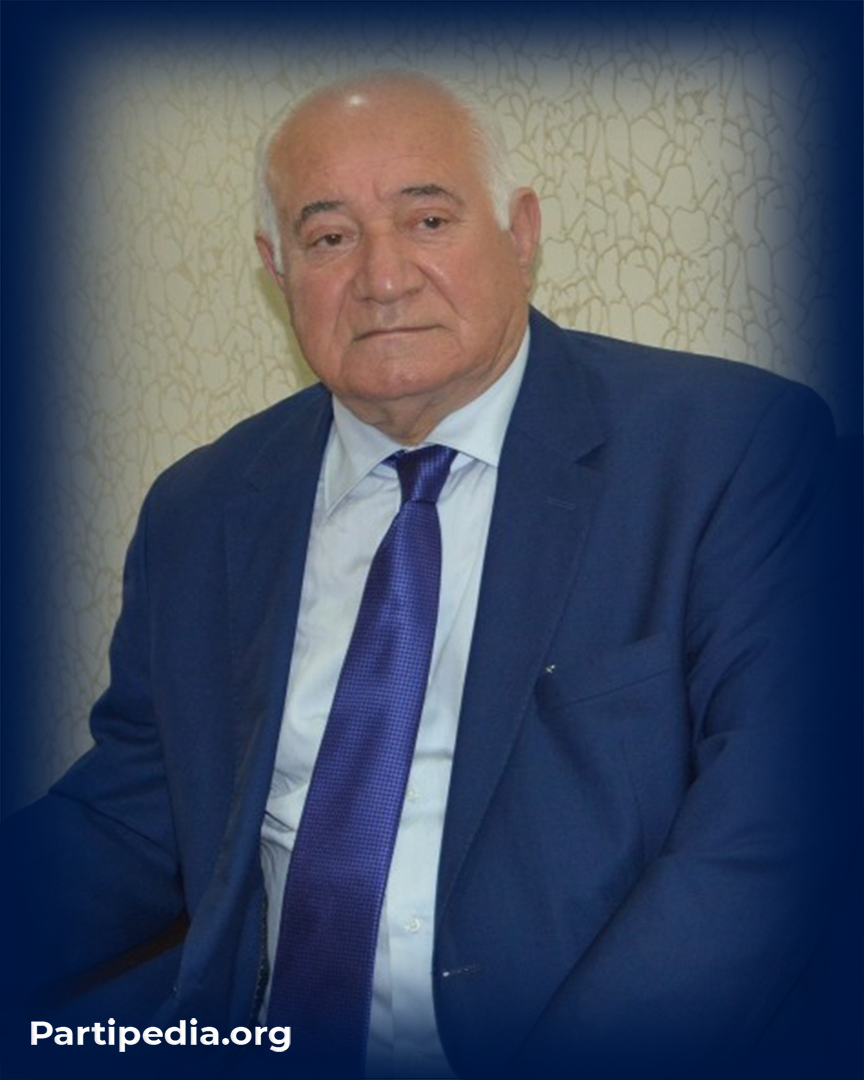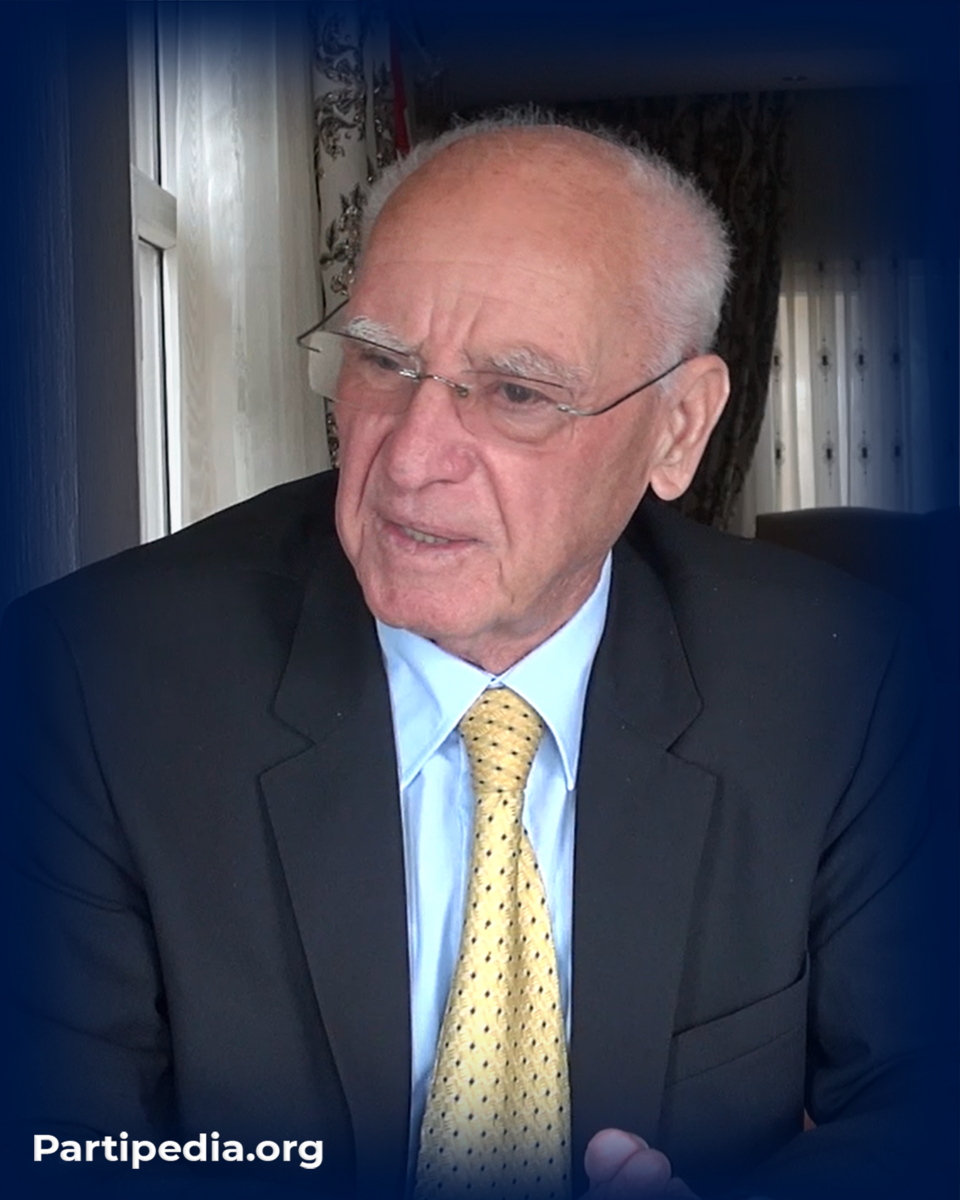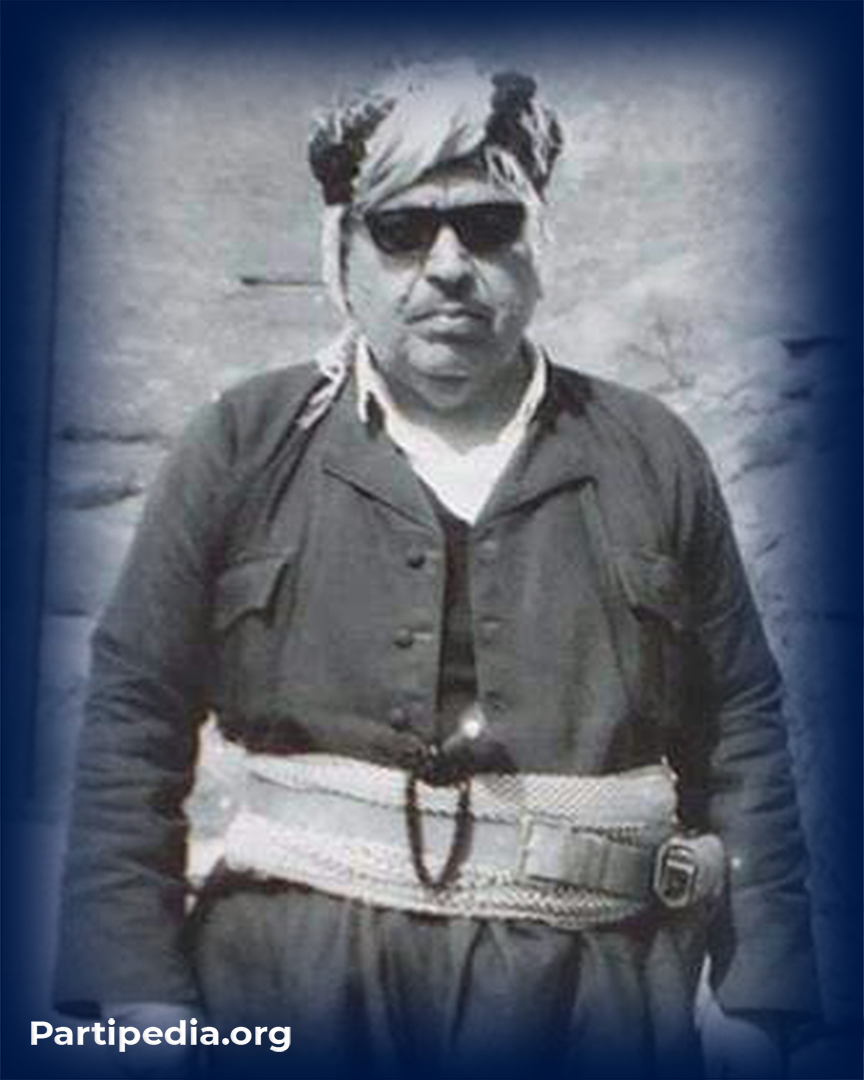


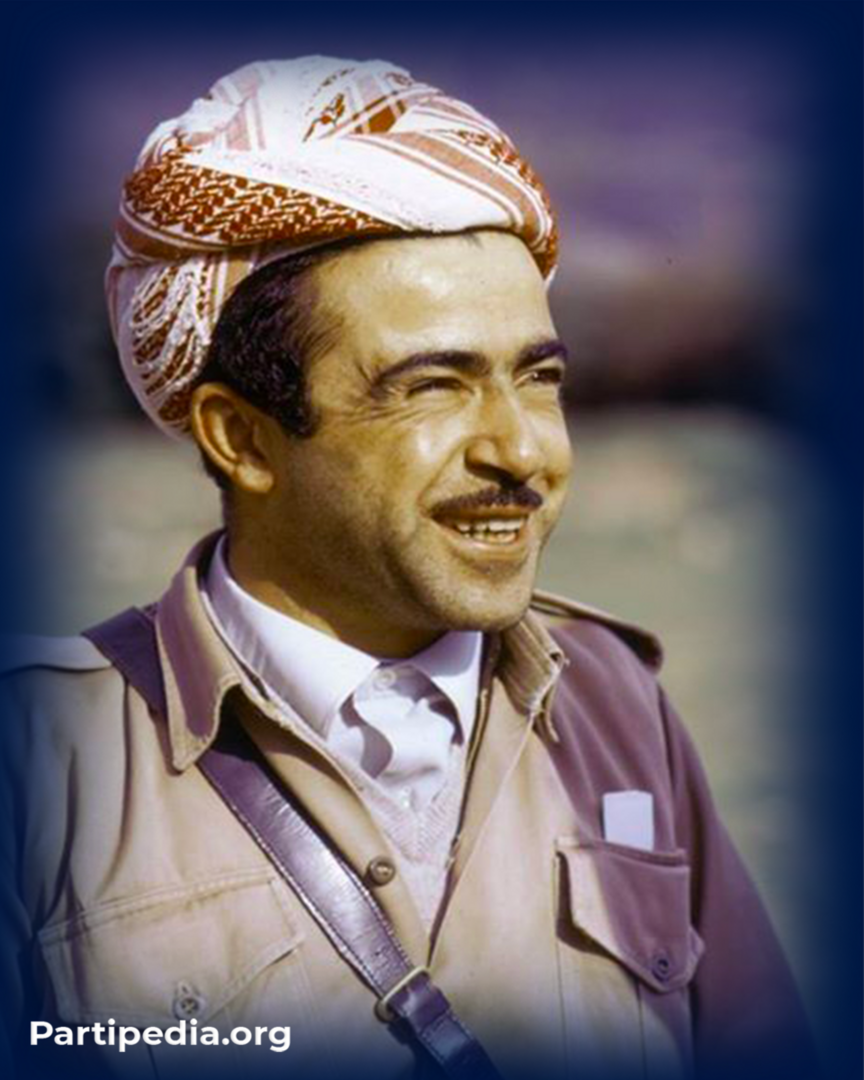
Politician Idris Mustafa Sheikh Muhammad Sheikh Abdulsalam Barzani, known as Idris Barzani and the engineer of peace, joined the ranks of the Peshmerga of the September Revolution in 1961, in 1962 he became the secretary of President Mullah Mustafa Barzani, in 1966 he became the head of the Military School of the Executive Office and a member of the Foreign Relations Committee of the Executive School of the Revolutionary Leadership Council in Iraqi Kurdistan, in May of the same year, during the September Revolution, he became the first head of Barzani's headquarters and commanded the Handirini Campaign against the Iraqi army, in 1970 he was the head of the military office of the Kurdistan Democratic Party (DK) and in the same year he was elected as a member of the KDP's central committee at the eighth congress, in 1975 he was one of the founders of the interim leadership of the Kurdistan Democratic Party (PDK) and in 1976 He played a prominent role in the May Revolution and the sending of the Peshmerga to Kurdistan, providing logistical support to the Peshmerga. He became a member of the Central Committee at the ninth congress and was later elected as a member of the Political School and responsible for relations with the Kurdistan Democratic Party (KDP).
Biography
Idris Mustafa Sheikh Muhammad Sheikh Abdulsalam Barzani was born on March 14, 1944 in the village of Barzan. He is from the family of the sheikhs of Takya Barzan and is the son of President Mustafa Barzani (1903-1979). In 1945, after the collapse of the Second Barzan Revolution, when he was less than two years old, he returned with his family to the village of Kekle in the Piran district and the Barazgar plain. On October 11 of the same year, he and most of the people of the Barzan region set off for Eastern Kurdistan via Keleshin and Dalamper. In 1947, after the collapse of the Democratic Republic of Kurdistan, he returned to Southern Kurdistan with his uncle Sheikh Ahmed Barzani (1892-1969).
Between 1947 and 1958, he lived in exile with his family in the cities of Basra, Mosul, and Baghdad. In 1952, despite the hardships of his family's life in exile and in Iraqi government prisons, he was sent to Basra to study and continued there until 1954. In the same year, the government moved his family to Mosul and he continued his studies there. In 1956, the government moved them again to Baghdad. The unstable situation of his family did not affect his continued education. Instead, he completed primary school and then continued his secondary education in Baghdad, while also studying religious studies.
After twelve years of being deprived of his father's love, he was happy to see his father again in 1958, and in 1964 he married Nazdar Xana, daughter of Hama Awrehman Axa. He was fluent in Kurdish, Arabic, Persian, and English.
Worksheet
Idris Mustafa Barzani joined the ranks of the Peshmerga of the September Revolution in 1961 and became the secretary of the leader, Mullah Mustafa Barzani, in 1963 he participated extensively in the Koyê, in 1964 he attended the 6th congress of the Kurdistan Democratic Party (KDP) in Qaladiz as a guest, in 1966 he was appointed as the head of the Military School of the Executive Office and a member of the Foreign Relations Committee of the Executive School of the Revolutionary Leadership Council in Iraqi Kurdistan, in early May 1966 he commanded the Hendrin Campaign against the Iraqi army, in the same year he became a representative of the Seventh Congress of the Kurdistan Democratic Party. In May of that year, during the September Revolution, he was appointed as the first head of Barzani's headquarters. In 1966, he received the Iraqi government's peace negotiation delegation in the Balakayeti area. A year later, he met with the President of Iraq, Colonel Abdulrahman Muhammad Arif (1916-2007), at the Green Palace in Baghdad, along with a delegation from the Kurdistan Democratic Party. In March 1967, he received Recep Abdulmajid, the Deputy Prime Minister of Iraq, in the town of Galala, along with President Mustafa Barzani, who had come to resolve the problems between the two sides.
In 1969, he led the Great Halaj-Daban War in the Germiyan region against the forces of the Ibrahim Ahmed-Jalal Talabani group. In the same year, under the command of President Mustafa Barzani, he prevented the advance of the Iraqi army on the Ranya-Sarkebkan front.
Idris Barzani has been the target of many assassination attempts and has been imprisoned. On December 6, 1970, his car was shot at in Baghdad by Ba'th Party spies, but he escaped unharmed and survived. Another attempt was made in early June 1972 to kill him, his father, and his brother Masoud Barzani with a TNT bomb. However, before the attempt could be carried out, the attempt was exposed and aborted. In 1978, he was briefly arrested by the Iranian SAVAK for political activities and interrogated in public.
On December 10, 1970, he was a member of the 9-member delegation of the Kurdistan Democratic Party (KDP) to negotiate the autonomy of Southern Kurdistan with Ba'ath Party officials in Baghdad and was a member of the delegation that signed the March 11 Agreement with the Iraqi government. He was later nominated by the Ba'ath Party for the post of vice president, but President Mustafa Barzani did not agree to this.
In 1970, he was elected as a member of the Central Committee of the Kurdistan Democratic Party (KDP) at its eighth congress. He participated in the Çoman Political-Military Conference from November 27 to 29, 1973.
On March 8, 1974, he held a final round of negotiations with Saddam Hussein (1937-2006) in Baghdad, before the Iraqi army invaded the areas liberated from the September Revolution, and proposed that the unification of the Kurdistan Autonomous Region law be postponed for another year to allow for further negotiations, but the other side refused.
On December 4, 1975, he became a member of the Military Planning Committee of the September Revolution and participated in the March 8 meeting in Haji Omaran to continue the resistance against the Algiers Agreement between Iran and Iraq, which aimed to prevent the September Revolution, and voted "yes" at the meeting and for the continuation of the revolution.
In 1975, after the defeat of the September Revolution, he emigrated to Iran and was responsible for refugee affairs in that country. In 1976, he was appointed as a member of the Political School of the Provisional Leadership of the Kurdistan Democratic Party (KDP) at the Berlin Conference.
In 1976, he played a prominent role in the May Revolution and sent Peshmerga to Kurdistan and provided logistical support for the Peshmerga. In mid-1977, a large meeting was organized in the city of Karaj under his leadership to assist the interim leadership of the Kurdistan Democratic Party (KDP) and to provide leadership for 150,000 refugees from Southern Kurdistan in Iran.
On March 5, 1979, he delivered a speech on behalf of the Barzani family at the grave of Mustafa Barzani in the city of Shino in the presence of 100,000 people. In the same year, he was a member of the Preparatory Committee of the Ninth Congress of the Kurdistan Democratic Party (KDP) and was elected as a member of the Central Committee of the Kurdistan Democratic Party, and later as a member of the Political School and responsible for communications at the first meeting of the Central Committee.
From September 1981 to the spring of 1982, he commanded the forces of the Kurdistan Democratic Party (KDP) in Southern Kurdistan, and his headquarters were in the Berazgir plain of Erbil province. In 1983, he was elected as a member of the Military Leadership Committee of the Front Forces (CUD), and in 1983 he signed a cooperation agreement with Abdullah Öcalan in Damascus.
On November 8, 1986, he headed a delegation from the Kurdistan Democratic Party (KDP) to Tehran, the capital of the Islamic Republic of Iran, and signed a peace agreement with Jalal Talabani (1933-2017), Secretary General of the Patriotic Union of Kurdistan.
He was the architect of the reconciliation of the political forces of Kurdistan and played a key role in the establishment of the Kurdistan Front, which was later established in May 1988.
He passed away on December 31, 1987, at his residence in the village of Silîvane in Eastern Kurdistan due to a heart attack and was buried next to the grave of Mustafa Barzani in the Halaj cemetery in Eastern Kurdistan.
On October 6, 1993, the remains of Idris Barzani and his father Mustafa Barzani crossed the Bashmakh border crossing in Sulaymaniyah province in two helicopters of the Islamic Republic of Iran and were welcomed by Jalal Talabani, Nechirvan Barzani, other leaders of the Kurdistan liberation movement, and a large crowd. On October 8, after two days of passing the coffin of the deceased through the villages, cities, and towns of Kurdistan, they were buried for the last time in the village of Barzan in the presence of many people and leaders.
Source:
-
27 Years of Struggle, Kurdistan News Bulletin, of the Kurdistan Democratic Party, Political School, Publishing and Communication Department, Issue 17, August 1973.
-
Kurdistan Democratic Party Encyclopedia Committee Archives.
-
Ali Mojani, Solmaz Sidqi..., The Culture of Contemporary Iraqi Men, (Tehran - Islamic Shura Council Documents Center - 1390 AH).
-
Aso Haji, Barzani, the Peshmerga of Independence, (Hewler - Rudaw Media Network - 2019).
-
Martyr Idris Barzani.. A Few Bright Pages of His Life and Struggle, Brirayeti Newspaper, Organ of the Kurdistan Democratic Party - Yekgirtu, Issue 1861, Hewlêr, Monday 31.12.1994.
-
Idris Barzani Martyr in a few lines, Xebat newspaper, organ of the Democratic Party of Kurdistan, issue 616, end of February 1992.
-
Bekir Barzencî, Kurdish Celebrities, Volume 5, (Beirut, Lebanese Cultural Center for Printing, Publishing, Translation and Distribution, 2012).
-
Bewar Abdulrahman, The School of a Martyr, (Hewlêr - Mukrianî Publishing House - Ministry of Education Press - 2004).
-
A brief biography of Mr. Idris Herdem zindi, Brayati newspaper, organ of the Kurdistan Democratic Party (PDK)-Yekgirtu, issue 2266, Hewlêr, Thursday 30/12/1997.
-
Habib Muhammad Karim, History of the Kurdistan Democratic Party - Iraq (Main Points) 1946 - 1993, (Duhok - Xebat Press - 1998m).
-
Sami Şuriş, Kurdistan and the Kurds, second edition, (Hewlêr - Rojehlat Press - 2019 AD).
-
Salute to the soul of the martyr Idris Barzani, Brayati newspaper, organ of the Kurdistan Democratic Party (KDP)-United, issue 1861, Hewlêr, Monday 31.12.1994.
-
Shakib Aqrawî, The Years of Trouble in Kurdistan, The Most Important Political and Military Events in Kurdistan and Iraq from 1958 to 1980, second edition, (Hewlêr - Manara Press - 2007).
-
Shaban Ali Shaban, Some Political and Historical Information, Third Edition, (Hewlêr - Rojhelat Press - 2013).
-
Ezzat Sulêman Beg, The story of the famous Kurdish war in 1966, part 1, Brayati newspaper, organ of the Kurdistan Democratic Party, issue 1643, Hewlêr, Thursday, 13.05.1993.
-
Eli Shengali, The Kurdish Question and the Arab Socialist Ba'th Party in Iraq, Part Three, Duhok - Xanî Press - 2012).
-
Eli Shengali, Pages from the well of my memory in the Kurdistan Democratic Party, (Duhok - Xanî Press - 2015).
-
Eli Kemal Berzi, Kurdish Celebrities in the Twentieth Century, Volume 1, (Hewlêr - Berzi Project - Zanko Press - 1999).
-
Felekedin Kakeyi, Memorial of Idris Barzani 1944-1987, Al-Taxi Newspaper, Dar Al-Taxi for Printing and Publishing, number 4180, Third Edition, Baghdad, Sunday, 29.02.2004.
-
Karwan Jewher Mihemed, Idris Barzani 1944-1987 Life and Political and Military Role in the Kurdish Liberation Movement, (Hewlêr - Hêvî Press - 2019).
-
Mihemed Mela Qadir, The Immortals' War, (Hewlêr - Hacî Hashim Publishing House - 2014).
-
Masoud Barzani, Barzani and the Kurdish Liberation Movement, Third Volume, (Hewlêr - Ministry of Education Press - 2002).