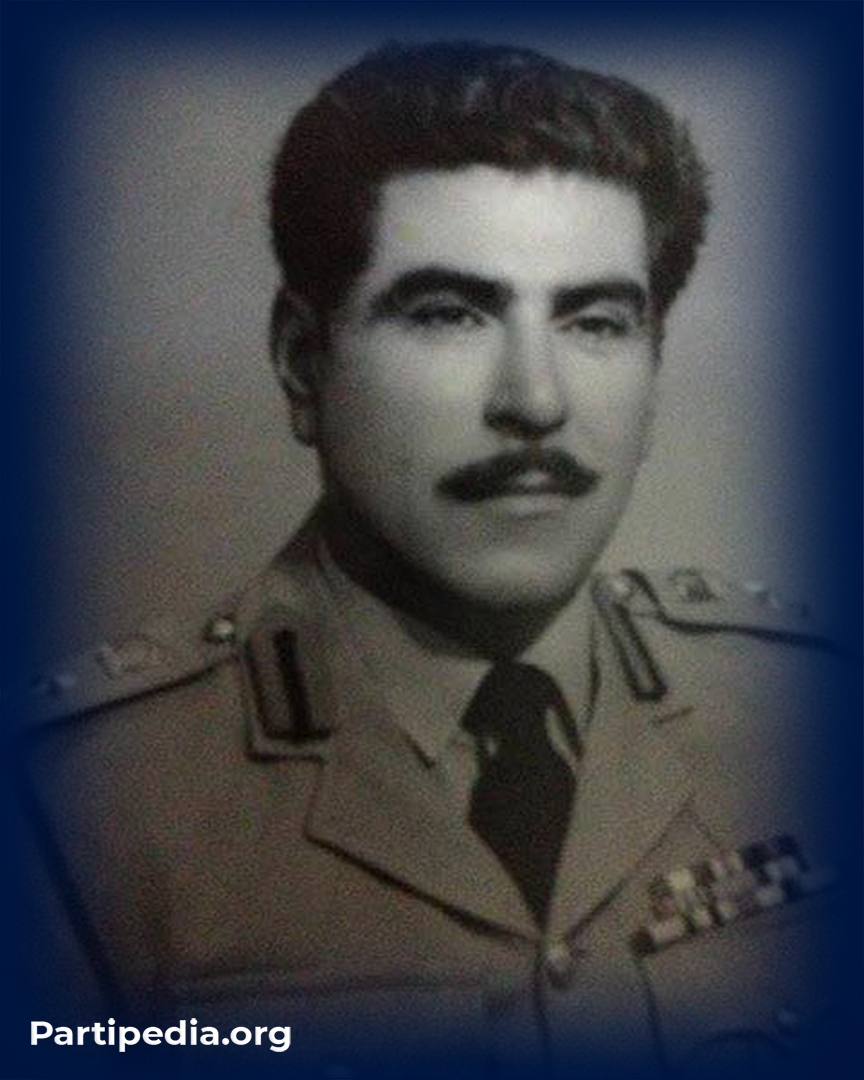


Mustafa Muhammad Abdulrahman Hussein Axa, known by the names (Mustafa Qaradaxi, Mustafa Hame Axa Evdirehman Axa, Salar, Salar Mustafa Qaradaxi, Miçe and Abu Çifne), is a writer and politician, who in 1962, at the request of President Mustafa Barzani, contacted the ranks of the Peshmerga forces. In 1963, he became the deputy commander of the first battalion in the Rezan River during the September Revolution. In 1964, he became a member of the central committee and political school of the Kurdistan Democratic Party at the sixth congress and was appointed by President Mustafa Barzani. In 1964, he became a member of the revolutionary leadership council and the first secretary of that council. In 1966, all his ranks were stripped from him by the central committee. He was expelled from the ranks of the Kurdistan Democratic Party at the seventh congress. He passed away on April 8, 2004, in Washington, D.C.
Biography
Mustafa Mihemed Abdurrahman Hussein Axa, known by the names Mustafa Qaradakhi, Mustafa Hame Axa Evdirehman Axa, Salar, Salar Mustafa Qaradakhi, Miçe and Abu Çifne. He was born in 1921 in the city of Sulaymaniyah. He is from a family of Shewekeli aghas of Sulaymaniyah who later moved to the city of Qalacholan, the capital of the Baban emirate, and was later granted the authority of the Qaradakh region by the Baban emirs and is known by his name. His father and uncles participated in the revolution of Sheikh Mahmud Hafid (1884 - 1956) against the British Empire. He completed the preparatory phase in the city of Sulaymaniyah in 1943. In 1944, he was established in the Sulaymaniyah agricultural command under the contract. He was admitted to the law department of the Baghdad Law College in 1945, but dropped out soon after. In 1946, he moved to Beirut, the capital of Lebanon, to study. In 1947, he moved to the United States of America to study.
In 1951, he received a master's degree in economics from Brooklyn College in San Francisco, California, USA. In 1952, he received a master's degree in sociology from the University of San Francisco, California, USA. On May 5, 1955, he was appointed as a teacher of the preparatory stage by a royal decree. From August 10 to 16, 1956, he participated in the first congress of the Kurdish Students' Association in Europe (K.S.S.E.) in Wiesbaden, Federal Republic of Germany. In 1956, he left the United States and returned to his homeland. In 1956, he was appointed as a teacher of the Baghdad Trade Preparatory School. In 1957, he was an English teacher at the Sulaymaniyah Preparatory School. In 1958, he published the book (How did the language come about?) under the name Salar and the play Awat under the name Salar Mustafa Qaradaxi. On January 16, 1959, he was elected as a member of the general board of the organization in the election of the Victory Party in Baghdad.
In 1959, he was established as the First Secretary and Director of the Foreign Relations Department at the Ministry of Foreign Affairs of the Republic of Iraq. In 1959, he became a member of the editorial board of the magazine Newroz. In 1960, two of his works were published in Baghdad under the title (Several Scientific Theories and Princes of the Maidens). In 1960, he began his career as the Second Secretary at the Embassy of the Republic of Iraq in Laos. In 1961, he became the Consul of the Republic of Iraq in Prague, the capital of the Czech Republic. In 1962, he became the First Secretary of the Embassy of the Republic of Iraq in Laos. In 1962, he became the First Secretary of the Embassy of the Republic of Iraq in Nigeria.
He passed away on April 8, 2004 in Washington, D.C., and his body was later transferred to the Kurdistan Region and, according to his will, was buried on April 16, 2004 in Girdi Gomezi, Qardax area, Sulaymaniyah province. He was fluent in Kurdish, Arabic, and English.
Worksheet
Mustafa Qaradaxi contacted the ranks of the Kurdish Life Association in 1945. In 1946, he contacted the ranks of the Kurdish Democratic Party. In 1960, he was a representative of the fifth congress of the Kurdistan Democratic Party. In 1953, he contacted the ranks of the Kurdistan Democratic Youth Union and the Kurdistan Qutb Union. In 1962, at the request of President Mustafa Barzani, he contacted the ranks of the Peshmerga forces. In 1962, he brought a radio station to Iran for the September Revolution. In 1963, he became the deputy commander of the first battalion on the Rezan River during the September Revolution. He was introduced to (Abu Cifna) by the Iraqi army. In 1963, he met with (David Adamson), a journalist from the British newspaper Sandy Telegraph. In 1963, he was a member of the Kurdish delegation to the visit of Gamal Abdel Nasser (1918 - 1970), President of the Republic of Egypt. In 1964, he became a member of the central committee and political school of the Kurdistan Democratic Party at the sixth congress and appointed Mustafa Barzani as President. In 1964, he became a member of the Revolutionary Leadership Council in Iraqi Kurdistan. In 1964, he became the first Secretary of the Revolutionary Leadership Council in Iraqi Kurdistan and in the same year, he became a member of the constitutional committee of the working office (al mekteb al tanfizi) and in 1965, he became the Secretary of the working office of the Revolutionary Leadership Council in Iraqi Kurdistan.
In 1965, he was accidentally and seriously wounded by the Peshmerga of the Communist Party of Iraq in Bawekhoshin in Derbendikhan, Sulaymaniyah province. In 1966, all his ranks were stripped from him by the central committee and he was expelled from the ranks of the Kurdistan Democratic Party, and his political career was postponed to the seventh congress. In 1967, he began working as the Chief of Staff at the Ministry of Trade of the Republic of Iraq. In 1970, he returned to serve at the Iraqi embassy in Jakarta, Indonesia, with the rank of (Qaem Bala'mal). On November 1, 1972, he was appointed Minister of Foreign Affairs (Wazir Mifuz) at the Iraqi embassy in Jakarta. In 1972, he was appointed Iraqi ambassador to Paris, but his order was soon revoked. In 1973, he settled in the Republic of Romania as a refugee. In the years (1975-1976), he was assassinated by the Iraqi government's intelligence agency and managed to escape. In 1978, he moved to the United States. In 1989, he was among the founders of the Kurdish human rights organization in the United States.
His works:
1- How language emerged - 1958.
2 - Awat - 1958.
3 - Prince Kichan - 1960 (Translator).
4 - Some scientific theories - 1960.
5 - Kurdistan Times 1990.
Source:
1 - Archives of the Encyclopedia Committee of the Kurdistan Democratic Party.