

Biography
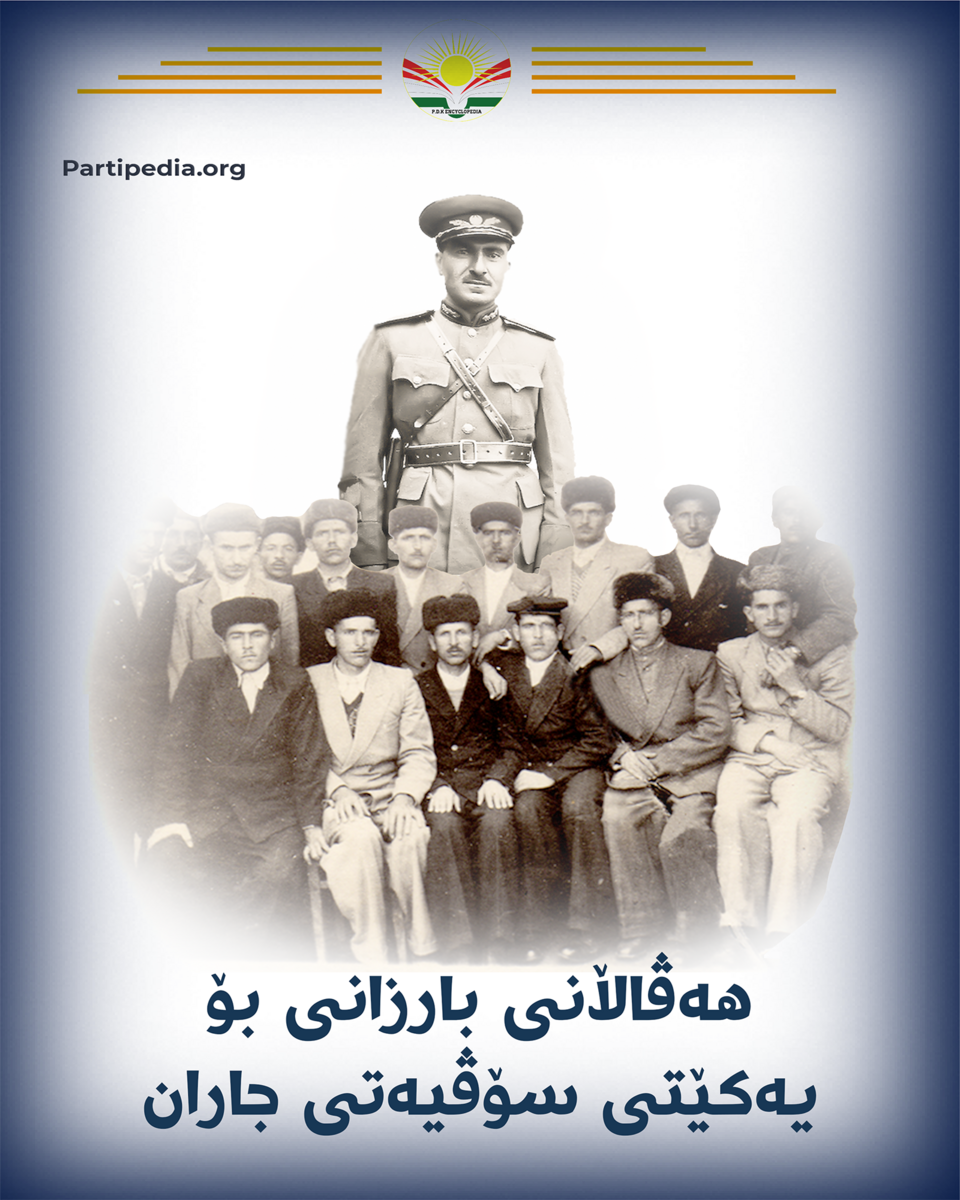
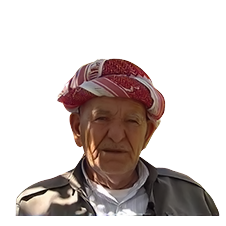
Taymaz Selki was born in 1924 in Selki village of Sherwan Mazen district of Mergasur district of Erbil province. Before going to the Soviet Union, he was married to Ruhan and had one child. He married Valentina Dachichka for the second time in the Soviet Union. When he returned from the Soviet Union, he did not bring her back He has three sons and five daughters. In 1960 he was employed as an employee in Ruandz. He knew Kurdish, Russian, Turkish and Persian. He died on August 5, 2014 and was buried in Selke village. . . .
The struggle
In 1942, he joined the army in Kirkuk. After the outbreak of the Second Barzan Revolution in 1943, he joined the ranks of the revolution and on October 2, 1943, he participated in the capture of the police station in Shanadar. On October 12, 1943, he participated in the capture of the police station of Kherazoki. On August 19, 1945, all his property was confiscated by order of the Military Customary Court.
On September 5, 1945, he participated in the capture of the Maidan Moriki police station and was wounded on September 14 in the Battle of Mount Pierce. His father, Arab Qatrani, was martyred in 1945 in the Battle of Biao Valley.
On October 11, 1945, after the collapse of the Second Barzan Revolution, he was arrested Mustafa Barzani and his comrades crossed to East Kurdistan. After the establishment of the Kurdistan Democratic Republic in Mahabad, on March 31, 1946, he defended the republic within the framework of the Barzan forces and played an active role.
After the collapse of the Kurdistan Democratic Republic, he participated in the Battle of Nalos on March 3, 1947, the Battle of Naghdeh and Shino on March 19, 1947, and the Battle of Qaraway in Saqiz region of East Kurdistan.
He was one of the Peshmergas who returned to Sherwan and Mazuri on April 19, 1947 via Khawkurk and Dashti Barazgar.
After their return, General Mustafa Barzani held a meeting with his comrades in Argosh village on May 6, 1947 and instructed them to stay or go to the Soviet Union Mustafa Barzani He crossed the Aras River on June 18, 1947, which is located on the border between Iran and the Soviet Union
After arriving in the Soviet Union, on June 19, 1947, he and all his comrades were detained in Nakhchevan, Azerbaijan, for forty days in an open community surrounded by barbed wire by a group of soldiers They were guarded and treated like prisoners of war in terms of food, clothing and transportation. They were later divided into Aghdam, Lachin, Ayulakh and Kalbajar regions of Azerbaijan by the decision of the Soviet government. On December 10, 1947, they were transferred to a military base on the Caspian Sea in Baku, the capital of the Republic of Azerbaijan They have been militarized. At the same time, they were taught Kurdish for four hours a day by some of their educated comrades.
After the mistreatment of his comrades, Jafar Bakirov decided to move his military camp from the Republic of Azerbaijan on August 29, 1948 to the community of Chirchuk near Tashkent, the capital of the Republic of Uzbekistan, where they continued military training.
In March 1949, he and his comrades were distributed by train to the villages of the Soviet Union and worked on the farms of the kolkhozes (land that people rented from the government and then paid back to the government).
After much effort and sending several letters by General Barzani to Stalin, Stalin finally received a letter in which Barzani talked about the suffering of his comrades and he immediately decided to form a committee to investigate the situation of Barzani's comrades In November 1951, he moved to Vrevisky, Soviet Union.
After the July 14, 1958 revolution in Iraq and the return of the general Mustafa BarzaniOn February 25, 1959, he and his comrades were granted a general amnesty under Articles 3 and 7, paragraph (a) of Article 10 and Article 11 of the 1959 Amended Law.
In 1958, the Iraqi Republic was established under the leadership of Abdulkarim Qasim. On April 16, 1959, he returned to Kurdistan with his comrades on the ship Georgia via the port of Basra in the south of the Iraqi Republic.
After ignition The Great September Revolution He participated in the Kurdistan Revolution in 1961 and was appointed as a battalion commander in Soran in 1963 and in Badinan in 1967. He participated in the battles of Dashtabil, Naliwan, Sharansh, Kani Mase, Zanta, Lomana, Maidanka Roviya, Duhok, Sar-e-Amedi, Matin Mountain, Bradost Mountain, Hawdian, Tahira, Miraw, Kani Spi and Kawper. In 1968, he was appointed battalion commander and in charge of Amedi region.
In 1975, after the collapse of the September Revolution, he moved to Iran as a refugee and settled in Zeveh community. He later moved to Faridoon Shahr in Mazandaran province, then to Jahrum and then to Kuhsang in Mashhad province Saveh Camp.
1979 Participation The May Revolutionand is a member 9th Congress of the Kurdistan Democratic Party He was a commander of the struggle force. In 1986, when the Peshmerga forces were reorganized, he was appointed commander of the PKK's elderly forces and was assigned to guard Barzani's shrine in Halaj village.
In 1993 he returned to South Kurdistan and settled in Pirmam township. In 1996 he retired. On August 16, 1996, in the framework of the Golden Jubilee celebrations for his struggle and resistance in the Second Barzan Revolution, the Kurdistan Democratic Republic, Barzani's path to the Soviet Union, The September Revolution and The May Revolution He was awarded the Immortal Barzani Medal by President Massoud Barzani. He died on August 5, 2014 and was buried in Selke village.
Sources:
-
Archive of the Kurdistan Democratic Party Encyclopedia Board
- Hamid Gawhari, Barzani Medal, Volume 1, (Erbil - Haji Hashim Printing House - 2015).
- Hamid Gardi, Summary of History, First Edition, (Erbil - Aras Publishing House - Ministry of Education Printing House - 2004).
- Haider Farooq al-Samarai, Zia Jaafar and the Political and Economic Role in Iraq, (London – Dar al-Hikma – 2016).
- In the memoir of the commander of martyr Hasso Mirkhan Zhazhoki, 62 days with Barzani, the Barzanis went to the Soviet Union, first edition, (Erbil – unknown place of publication – 1997).
- Massoud Barzani, Barzani and the Kurdish Liberation Movement 1931-1958, (Duhok - Khabat Printing House - 1998).
- Text of the resolution of the General Amnesty Committee with respect to the martyrs of the Barzan Revolution, Rzgari Magazine, No. 3, 2, Rabta Printing House, Baghdad, April 1,