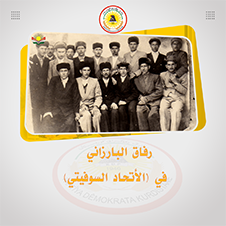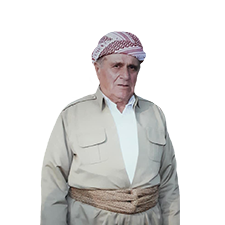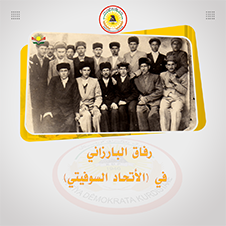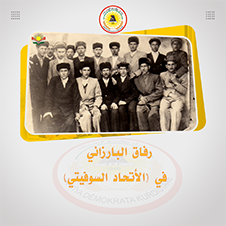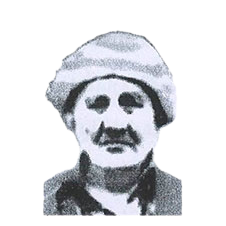


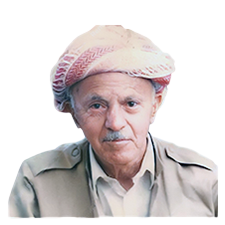
Babiker Mohammed Zubair Known as (Babaker Mohammed), a Peshmerga and Barzani's companion to the Soviet Union, he was born in 1920 in the village of Hasni. He fought in the second Barzan revolution and was a member of the Peshmerga in the Republic of Kurdistan in Mahabad. He participated in the September and Gulan revolutions. He held the position of (Sarpal - platoon commander) in the ranks of the Peshmerga. He died in 2003.
the biography
child Babiker Mohammed Zubair In 1920, in the village of Hasni, which belongs to the district of Mergasur in Erbil Governorate, he studied in the Soviet Union and obtained a certificate from the institute in the Department of Agriculture. He married Shukriya Yusuf in the Soviet Union, and they had their son Zubair Babakir in 1959 and their two daughters Hadiya. His wife was of the Tatar ethnicity in the Crimean Peninsula in the Ukrainian Republic. His wife Shukriya Yusuf and her children were arrested in 1963 and thrown into prison by the Ba'athist regime on charges of her husband accompanying Mustafa Barzani and being one of the Peshmerga. After their release from prison, they lived in the Iskan neighborhood and then in the Sidawa neighborhood under house arrest, then returned to the Soviet Union.
After returning from the Soviet Union, Babakir Muhammad was appointed in 1959 as an agricultural advisor in the Erbil Agriculture Department, but he was later dismissed from his post due to his involvement in September RevolutionHowever, he rejoined his job in 1971 after the March 11 Agreement, and in 1975 he was transferred to the Barzan Agriculture Department as an agricultural advisor. He was fluent in three languages (Kurdish, Russian and Persian). In 1998 he returned with his family to southern Kurdistan. He died in 2003 and was buried in the village of Hasni.
pages of struggle
Babakir Muhammad was a soldier in the Iraqi army before joining the revolution in 1943. He deserted from the military, like the majority of the people of Kurdistan who refused military service in the Iraqi army, and joined the ranks of the second Barzan revolution. As a result, on August 19, 1945, all his movable and immovable property was confiscated by order of the Iraqi military court.
On October 11, 1945, after the setback of the second Barzan revolution, he crossed with Mustafa Barzani and his companions to eastern Kurdistan. After the establishment of the Democratic Republic of Kurdistan in Mahabad on March 31, 1946, he defended the republic within the Barzan forces. He had a brother named Zubair Muhammad who died in 1945 in the Democratic Republic of Kurdistan.
After the collapse of the Republic of Kurdistan in Mahabad and Barzani’s return from eastern Kurdistan to southern Kurdistan, he participated in the battles of Naghdeh and Shino in eastern Kurdistan, and he was among his Peshmerga comrades, as he returned on 19/4/1947 via (Khakurk and the Barazgara Plain) through the lands of northern Kurdistan to the Shirwan and Mazuri regions.
Upon their return, General Mustafa Barzani held a meeting with his comrades in the village of Arkush on May 15, 1947, and gave them the choice of staying or going to the Soviet Union. There, all his comrades decided to continue and head to the Soviet Union. On May 23, 1947, they accompanied General Mustafa Barzani to the Soviet Union, participating in the battles of Qatur and the Maku Bridge. After great hardship and exhaustion, they crossed the Aras River on June 18, 1947, which lies on the border between Iran and the Soviet Union.
Upon their arrival in the Soviet Union on June 19, 1947, he and all his comrades were detained in the city of Nakhchivan, Azerbaijan, for forty days in an open compound surrounded by barbed wire and guarded by soldiers. They were treated as prisoners of war in terms of food, clothing, and transportation. By order of the Soviet government, they were later distributed to the Aghdam, Lachin, Ayulakh, and Kalbajar regions of Azerbaijan. On December 10, 1947, they were transferred to a camp on the Caspian Sea in Baku, the capital of Azerbaijan. On December 23, they received military uniforms and underwent eight hours of daily military training under the supervision of Azerbaijani officers. Simultaneously, they received four hours of daily Kurdish language instruction from some of their more educated comrades.
After Jafar Bakirov's mistreatment of his comrades, Barzani decided to move his military assembly from Azerbaijan on August 29, 1948, to the Girjuk complex near the Uzbek capital, Tashkent, where they continued their military training.
In March 1949, he and his comrades were distributed in groups by train to cooperative villages in the Soviet Union and worked on kolkhoz farms (land that people rented from the government and then paid a share of to the government).
After great efforts and sending several letters from General Barzani to Stalin, Stalin finally received a letter in which Barzani spoke about the suffering of his comrades, and he immediately decided to form a committee to investigate the situation of Barzani’s comrades. The committee’s final decision was that they should be gathered in the city of Frivsky, so in November 1951 he went to the Soviet city of Frivsky.
On February 25, 1959, he and his companions were included in the general amnesty according to Articles (3) and (7) and Paragraph (a) of Article (10) and the application of Article (11) pursuant to Law No. (19) amended for the year 1959.
Despite the establishment of the Republic of Iraq in 1958 under the leadership of Abdul Karim Qasim, due to his preoccupation with his studies, he returned with his companions on April 16, 1959 to Kurdistan on board the ship Crusia via the port of Basra in southern Iraq.
He participated in 1962 September Revolution He held the position of (Sarpal - platoon commander) and participated in all the battles, and in 1975, after the setback September Revolution As a refugee, he went to Iran and settled in (Naghdeh) in eastern Kurdistan.
In 1979 he participated in the Gulan Revolution and in the battles of Lolan and Alwatan. He retired in 1992 and in 1998 he returned with his family to southern Kurdistan.
Sources:
- Hamid Ghajerdi, Pakhteh Mezhou Nameh, Shabi Yahkim, (Holler - Dezghai Chap and Bukordaneh Aras - Chapkhana and Hazara of Iran - 2004).
- Haider Farouk Al-Samarrai, Diaa Jaafar and his political and economic role in Iraq, (London - Dar Al-Hikma - 2016).
- He has the best understanding of the Shahid Shahid Mirkhan Zajczyki, 62 years of Barzani’s dialect, this is how Barzani was born. This is the word, the name of the word (Holler - Chapkhana Rishnabiri - 1997).
- Masoud Barzani, Barzani and the people of Rezgarekhwazi Kurd 1931 - 1958, (Dehic - Chapkhana - Khabat - 1998).
- Text of the decision of the General Amnesty Committee to restore the honor of the martyrs of the Barzan Revolution, Rizgari Magazine, Issue 2, 3, Al-Rabita Press, Baghdad, April 1, 1959.
- Archive of the Encyclopedia Authority of the Kurdistan Democratic Party.
.