

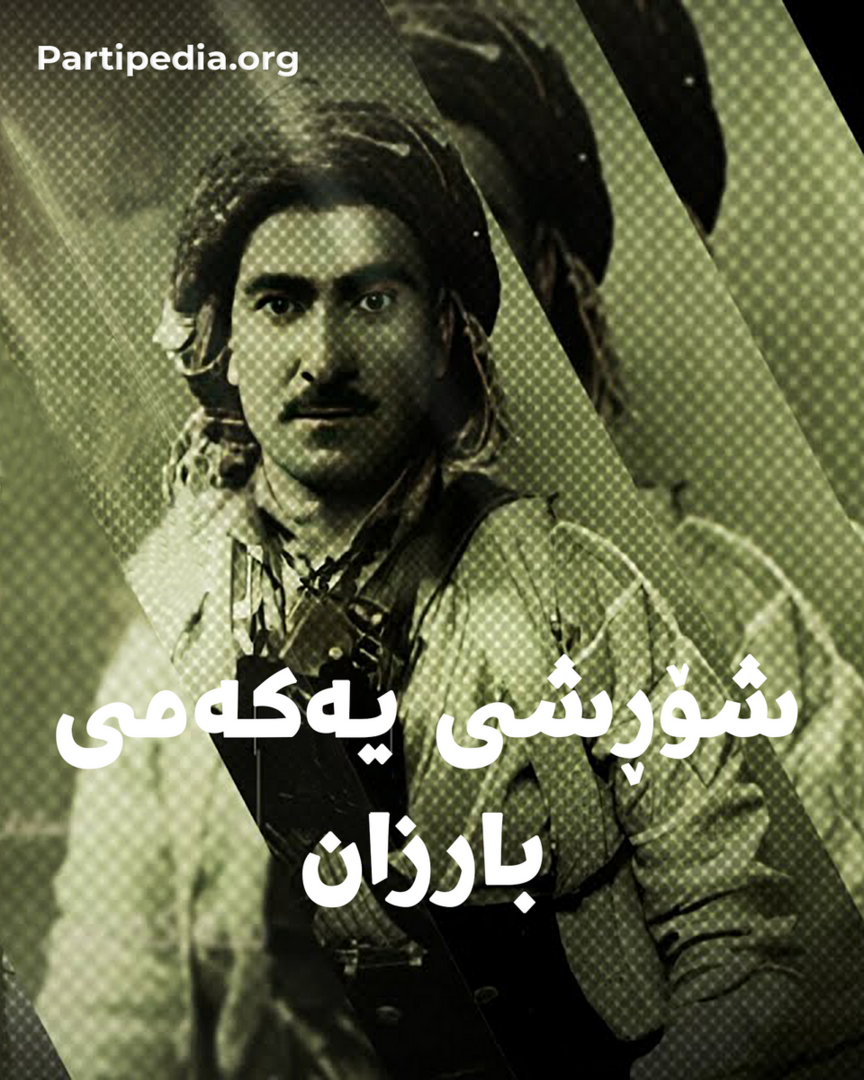
In 1931-1932, the first Barzan revolution led by Sheikh Ahmad Barzani was fought between the Barzan forces and the Iraqi government forces with the support of the British forces Government forces were able to take control of the Barzan region and forced the Barzan forces to retreat into Turkish territory.
After the First World War (1914-1918), the Kurdish issue was the subject of much regional and national debate. Barzani region, like all other regions of Kurdistan, was not exempt from the problems and conflicts. In late 1914, the British government realized that the Ottoman Empire, the British ally, was going to go to war After three years of war, the Ottoman army lost control of the war, Britain and Russia were able to occupy parts of Iraq and Iran, in the Treaty of Sykes-Picot in 1916, the province of Mosul fell to France, then Britain was able to convince France to exchange the province of Mosul for its share. On March 11, 1917, the British, led by Sir Stanley Maud, occupied Baghdad. On August 30, 1918, after the end of World War I, the Treaty of Modros allowed Britain to occupy parts of Mosul, Baghdad and Basra In November 1918, Sheikh Mahmoud Hafed became the civilian leader of the Sulaimani region by order of the British and was given the title of lieutenant Sulaimani region Sheikh Mahmoud's revolution broke out in May 1919 against the British occupation. Sheikh Ahmad commanded a Barzani force Mustafa Barzani He sent to help Sheikh Mahmud's revolution and asked the tribal chiefs to help the revolution.
When Sheikh Ahmad, commanded by his brother Mohammed Sadiq, sent a force to defend the attack on Acre, on November 4, 1919, Colonel Bill and Captain Scott were killed in an ambush They considered him a major enemy of Britain and began to instigate the Assyrians against the Barzanis, but to no avail. On March 3, 1920, the San Remo Congress declared Iraq under British rule, which led to the National Revolution in Iraq.
On 25 October 1920, in talks between Sir Percy Cox, the British Sami envoy, and Abdul Rahman Naqib, it was agreed to form the first Iraqi interim government, which consisted of eight ministers and twelve ministers without any ministers On August 23, 1921, King Faisal son of Hussein was appointed king of Iraq. In 1925, the Iraqi government established the first police station in Barzan as a first step to consolidate its power The government's efforts were aimed at providing services and attention to the region, but the government had another purpose.
In 1925, the Sheikh Saeed Piran Revolution broke out in North Kurdistan. Sheikh Ahmad sent a force led by Mustafa Barzani to help suppress the revolution. In 1927, the British Iraqi government launched a military offensive against Sheikh Ahmad by the Barzanis In the same year, the government established a military base in the Ble area. On February 31, 1928, the Sami envoy sent Major Wilson to Sheikh Ahmed to calm the situation.
In this situation, Sheikh Ahmad sent a letter to King Faisal I, calling for a united position of the Kurdish and Arab nations to expel the British from Iraq. Sheikh Ahmad sent his brother Mustafa Barzani to him The Mutasarif of Mosul agreed to exchange the British forces for an Iraqi regiment. An Iraqi regiment commanded by Mohammed Barqi replaced the British forces Sheikh Ahmed's work is stubborn and they start conspiring.
In April 1931, Sheikh Ahmad demanded the independence of the Kurdish people from the League of Nations This led to the Bradostis attacking the Sherwani tribe and the villages of Garkal, Kolak and Babke twice in 1931 at the instigation of the British. Barzan forces under the command of Sheikh Ahmad, first in the summer of 1931 under the leadership of Mustafa Barzani, on November 25, 1931, the second time under the command of Lee Beg, were able to defeat the Bradosti attack The governor of Zebar tried to mediate and on December 3, 1931, the governor of Zebar asked Sheikh Ahmad to send his representative to him. Sheikh Ahmad sent his brother Mohammed Sadiq with a force Mustafa Barzani He was outside Barzan for another purpose. The government knew that there were only a few people left in Barzan village, so it decided to attack Barzan.
On December 9, 1931, the Iraqi forces attacked Barzani village from three directions, but defeated the attacking forces by killing 126 soldiers and taking some prisoners This was the reason for the outbreak of the first Barzan revolution. After this battle, due to the arrival of winter and the engagement of part of their forces in the second revolution of Sheikh Mahmoud, the government agreed to Sheikh Ahmad's request to stop the fighting until the spring of He should make the nobles, Darabegs and tribal chiefs of the region his supporters against the Barzanis and gather more forces in Ruandz, Akre and Amedi. On December 12, 1932, the Council of Ministers decided to attack Barzan. On February 18, 1932, he sent a letter to the Turkish government to prevent the Barzanis from entering Turkish territory The government intends to reorganize and mobilize forces to attack Barzan.
On March 10, 1932, the government sent a message to Sheikh Ahmad asking him to appear before the governor of Zebar (Ble) and gave him only two days to appear and agree to establish an emir base in Barzan After the rejection, the government launched an infantry attack from three sides with the support of the British Air Force. In preparation for the defence, the Barzani forces were divided into three fronts: the Mergasur-Sherwan front The Balnda-Amedi Front, led by Mustafa Barzani, led by Mohammed Sadiq and his assistant Haji Taha Akreyi, and a force led by Sheikh Ahmad remained in Barzan. On March 18, 1932, the first clash between the two fronts took place in Korke, where the government forces were defeated and retreated to Mergasur. On April 3, 1932, the Battle of Dola Vazhe took place with the participation of the Dayi forces against the Barzan forces from the Mergasur side to the Vazhe Valley and Mamisk After the defeat of the Iraqi army, the British air forces bombed the Barzani area from all sides. On April 27, 1932, a British plane crashed after being wounded by the Barzanis. The pilot and his assistant were arrested in Sherwan Mazen. Sheikh Ahmed asked for a doctor to treat the prisoners. On May 3, 1932, Captain Holt, accompanied by a doctor and a linguist, arrived at Sheikh Ahmed and Captain Holt discuss the government's attack, agreeing to release the 25 Barzanis whom Sadiq Agha Oremari had handed over to the government on the Amedi front in exchange for the pilot and assistant.
In late May 1932, Sheikh Nuruddin Brifkani visited Sheikh Ahmed and conveyed the government's demand. The government's condition was that talks should be held in the village of Hostan near an Iraqi regiment The British, two days after the return of Sheikh Nuruddin Brifkani began intensive British air strikes, these attacks caused the villagers to take refuge in caves and evacuate the villages, these attacks led to the destruction of Villages and the burning and destruction of 1365 houses. After this unfavorable situation, Sheikh Ahmad on June 1, 1932, prominent men such as Li Beg, Khalil Khoshaw, Ahmad Nader, Abdullah Kirkamoyi, Hassan Mohammed On June 10, 1932, all the families gathered in the Zet Valley and surrounding villages and prepared to enter Turkish territory. Before leaving, however, Sheikh Ahmed held another meeting with prominent men and some decisions were made, including the minimum number of families to enter Turkey, those who were not in danger to return to their villages and some weapons to be handed over to the government About 200 to 300 people under the command of Khalil Khoshaw, Ahmed Nader, Abdullah Kirkmoyi and Hassan Mohammed Amin remained on the border between Gardian villages with additional weapons for the necessary time Give them to the armed movement and protect displaced families until they escape into Turkey.
On June 12, 1932, Pol's group, accompanied by the jashes of Kalhe Rekani, attacked the Mazuri area and was defeated. On June 15, 1932, the Iraqi army advanced to Sherwan Mazen and had 75 dead. On June 20, 1932, Mohammed Sadiq and Haji Taha Akreyi were sent to Grana village to negotiate with the Turkish government authorities to arrange for the Barzani families to enter Turkey Provided they surrender their weapons. On June 21, 1932, the Barzanis entered Turkish territory. On June 22, 1932, Sheikh Ahmed entered Turkish territory. Their retreat ended the First Barzan Revolution, but the armed movement continued after they entered Turkish territory Ahmed, Haji Taha Akreyi and Ali Mah Barzani were transferred to Ankara, while Mustafa Barzani and Mohammed Sadiq were transferred to Erzurum.
After the Barzanis went to Turkey, the Iraqi government established several police and military bases in the area. The clashes decreased until the spring of 1933, after a tripartite treaty between Turkey, Iraq and the British After the Barzanis returned to Barzan in late August 1933, the Iraqi government feared that the Barzanis would resume the revolution. So they released Sheikh Ahmad. In exchange for his release, he promised the government to send Mustafa Barzani to Mosul. In return, the government decided to grant a general amnesty to the Barzanis except Khalil Khoshaw.
Shortly afterwards, Sheikh Ahmad was summoned to Mosul. After his departure, Sheikh Ahmad sent an envoy from Mosul to Barzan to summon Mustafa Barzani after his departure Mustafa Barzani Both were arrested and Mohammed Sadiq, Babo, Sheikh Abdul Salam's children and all their families were summoned to Mosul. They were then transferred to southern Iraq Abdullah Kirkamoyi, as the activist of the Barzan armed movement, who remained in the region after the first Barzan revolution, took refuge in the highlands. The martyrdom of Khalil Khoshaw in February 1936 escalated as follows First Barzan Revolution It was suppressed until after the return of Mullah Mustafa Barzani in 1943.
Sources:
-
Mustafa Mohammed Karim, Political Developments of Barzan Region during the Years (1902-1932), (Erbil-Roxana Printing House-2022), pp. 136-1
-
Massoud Barzani, Barzani and the Kurdish Liberation Movement (1931-1958), Vol.
-
Abdulaziz al-Aqili, History of the First General Barzan Movements 1932, (Baghdad-Youth Printing House-1956).
-
Bahram Valad Beg, Barzan Sheikh Ahmad's Revolutions in Iranian Documents (1909-1970), Volume 1, (Tehran-Chap Ahmadi Printing House-2021), pp. 109-1