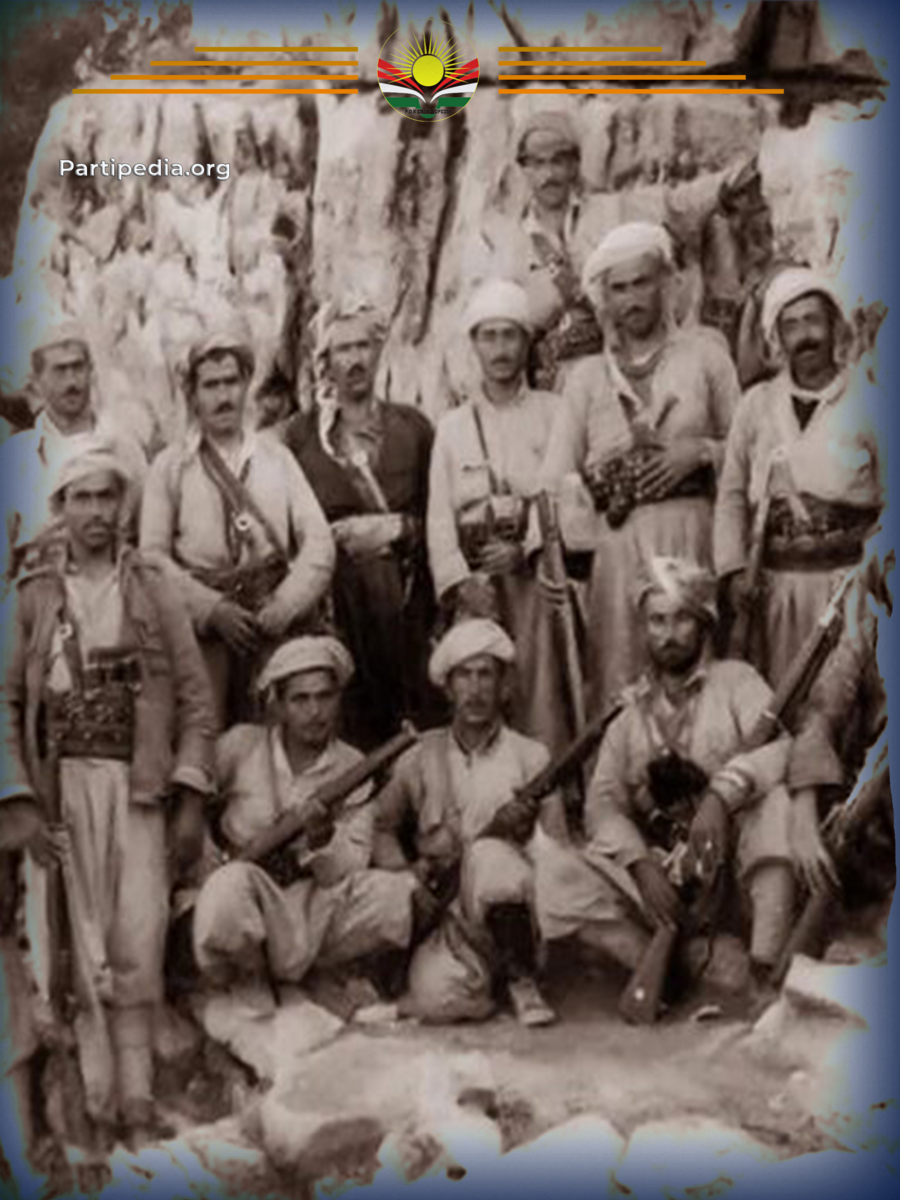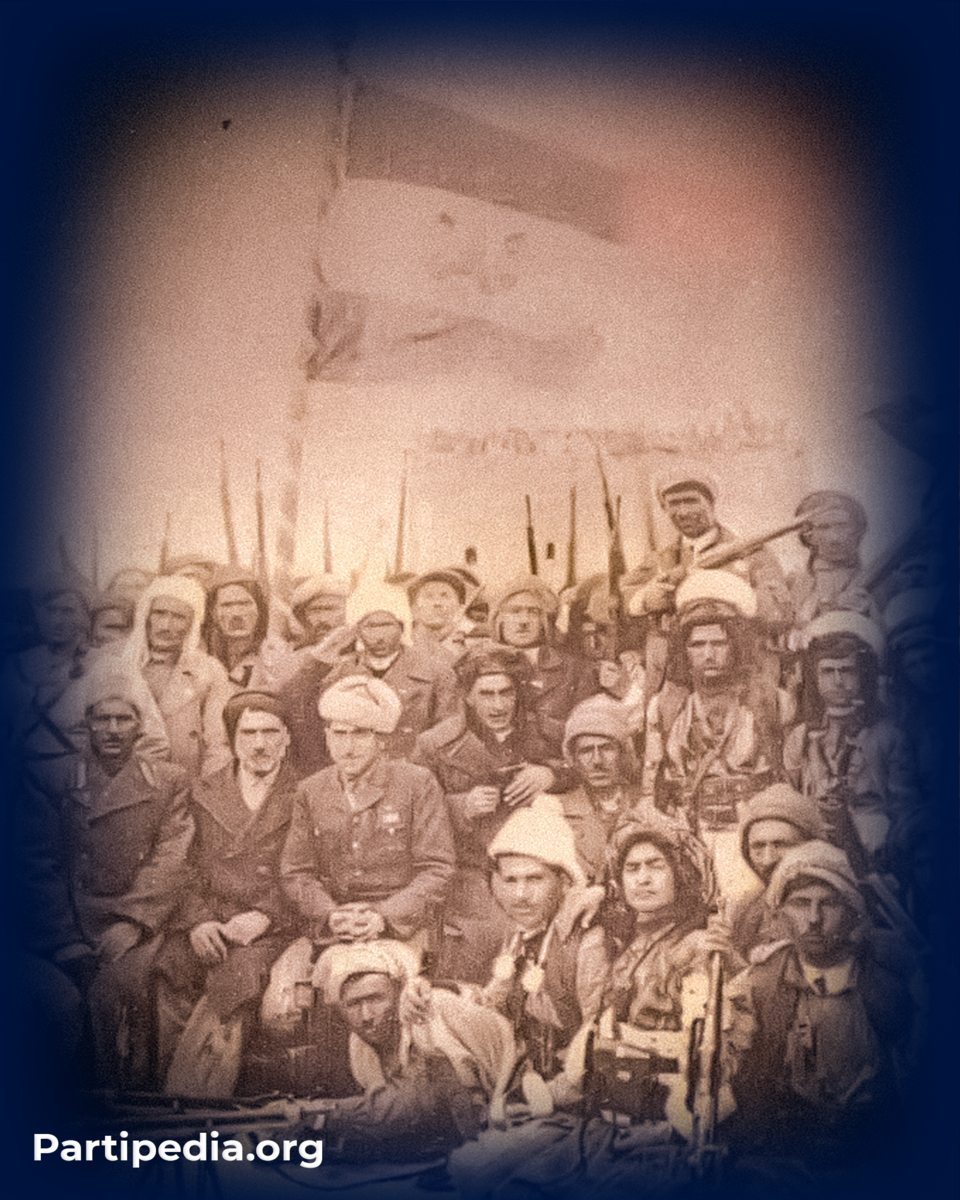


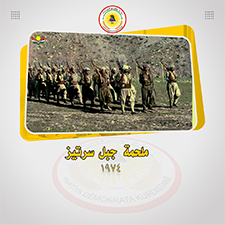
Mount Sertiz lies north of Mount Zozk and south of Mount Hassan Bek, at an altitude of 1850 meters above sea level. It is known as Mount Tatan on Iraqi military maps and overlooks the Bisha Gorge from the north. The leadership of the September Revolution consistently aimed to protect the mountain from falling into the hands of the Iraqi army, as the strategic road passing through the Bisha Gorge was a vital gateway connecting the Bradost and Barzan regions to the Balkayti area, which served as the revolution's headquarters.
At the beginning of the September Revolution, on May 29, 1962, Mullah Mustafa BarzaniThe leader of the Kurdish revolution, and more than 500 Peshmerga, went to the village of Bisha for the first time and stayed there for two nights. They were warmly received by the villagers, and then they stayed another night in the Bisha Gorge before leaving for other areas of the Balkayti region.
After the Iraqi army seized the slopes of Mount Korek, most areas, such as Rawanduz, the Diana Plain, and Badlian, were at risk of occupation. Therefore, the Revolutionary Military Bureau ordered the forces of Helgurd, Zimnako, Zakho, Kawa, Safin, and Azmar to send a battalion from each force to Mount Sirtiz to reinforce the Peshmerga positions in the strategic heights. This was intended to establish a defensive line and reduce the threat to the Revolutionary Command and other targets. These forces arrived at their designated location in August 1974.
When the Iraqi army succeeded in capturing Mount Zozak, it began preparing to seize Mount Sartiz, advancing as far as the village of Sitkan at the foot of the mountain. The Peshmerga forces, positioned defensively, informed their commanders that the Iraqi army was advancing toward their positions. Upon receiving this news, the Peshmerga commanders gathered in the village of Bisha to devise a plan to halt the Iraqi army's advance. To this end, the situation escalated to the point where... Hamid Effendi As infantry commander and Omar Othman as commander of theRevolutionary Artillery By attacking the Iraqi army to defeat their advance and expel them from the area.
It began The Epic of Mount Sertiz bombing Revolutionary Artillery The Iraqi army, which in turn had heavily bombarded the Omar Agha Pass southwest of Mount Sirtiz on October 7, 1974, launched a plan to attack Mount Sirtiz. The attack began with a massive bombardment of the entire mountain by army artillery and Grad rockets. Air Force planes then incinerated the mountain with napalm and phosphorus bombs before finally capturing it.
But a week later, after taking a break and preparing for a counterattack, the Kurdish Peshmerga forces, comprised of a battalion from the Khabat forces led by Hama Shamirani and a battalion from the Zamnako forces led by Nouri Hama Ali, attacked the Iraqi army, capturing the entire mountain and inflicting heavy losses on the Iraqi army, which suffered over 200 dead and a large number wounded. One Peshmerga fighter was killed and six others were wounded. The following day, the Iraqi army attacked the mountain again and regained control. After two months of fighting on Mount Sartiz, which held four strategic Iraqi military positions, the Peshmerga forces decided to withdraw from the mountain due to the disparity in military strength and weaponry. The mountain alternately fell to the Peshmerga and the Iraqi army.
Three days after the Peshmerga withdrew from Mount Sartiz, a message arrived from the military office of the revolution to the commander of the Peshmerga forces on the battlefront, to launch a counter-attack and seize the four strategic points where the Iraqi army soldiers were stationed.
More than 200 Peshmerga fighters from the Helgurd, Balak, and Azmar forces, comprising several battalions of 30 fighters each, participated in this attack under the command of Hamid Fendi. The Peshmerga attack began on November 15, 1974, at 5:00 PM with a heavy artillery bombardment of Iraqi army positions from 7:00 AM to 4:30 PM. Following this, the Kurdish Peshmerga forces launched a well-planned assault on Iraqi army positions. They managed to recapture Mount Sartiz within half an hour, inflicting heavy losses on the Iraqi army and killing and wounding many soldiers. The Peshmerga also captured significant spoils, including 45 Kalashnikov rifles, 140 hand grenades, 7 pistols, 2 radios, 38 light pistols, and 4 machine guns.
Mount Sertiz held immense strategic importance for the Iraqi army. Despite suffering repeated defeats at the hands of the Kurdish Peshmerga forces, the Iraqi army remained determined to capture it. The following day, November 16, 1974, a special Iraqi army battalion launched another attack on the four strategic locations, attempting to regain control. However, at sunset on November 20, 1974, the Peshmerga launched a counter-attack, retaking the positions. Due to Peshmerga exhaustion, the intensity of the repeated attacks, and the constant bombardment by the Iraqi army, the Peshmerga were unable to hold their ground. They withdrew that night, and the Iraqi army once again seized the mountain.
In all of the Iraqi army's attacks on Mount Sirtiz, they climbed the mountain from the village of Sitkan. On one of the northern heights of Mount Zozk, below Mount Sirtiz, there was a position called Kharomer, where a machine gun was stationed for the support force, which was supporting the Peshmerga operations on Mount Sirtiz.
Maintaining control of Mount Sertiz was of particular importance to the Kurdish Peshmerga forces. A message arrived from Barzani's headquarters, directing the commanders of this battlefront to seize Mount Sertiz. The message emphasized that the Helkurd forces should capture the mountain, and then the Sayyid Aboush Battalion from the Zakho forces should take their place. To carry out Barzani's orders, both the Helkurd and Azmar forces attacked the mountain's summit. Within a short time, the Iraqi army and its collaborators (Jash) were forced to abandon their positions, and Mount Sertiz was retaken. The Sayyid Aboush Battalion was then stationed there, as instructed in the message. However, this time, the Iraqi army suffered a crushing defeat at the hands of the Peshmerga. Left with no other recourse to retaliate against the Peshmerga for the losses inflicted upon them, the Iraqi army resorted to a heavy bombardment of Peshmerga positions on Mount Sertiz. This bombing caused serious damage to the Peshmerga forces and resulted in the martyrdom of 18 Peshmerga and 14 wounded in the Halkurd force, 11 martyrs and 4 wounded in the Zakho force, and one martyr and 2 wounded in the Zamnako force.
Due to the successive defeats it suffered in this region, and with the onset of the cold season and snowfall, the Iraqi army weakened and was unable to resist the Peshmerga and attack Mount Sartiz again.
Sources:
-
Mahsoud Barzani, Barzani and his wife, Khawazi Kurd, on the eve of 1961-1975, in the name of God, in the name of God.
-
Sahnagher Ibrahim Khishnaw, Rudawah Sahrbazeh Kani Shirshi Hailul 1970-1975, Shabi Yehikham, Haholer.
-
Ghazi Adel Ghardi, this is what you have in store for me... I'm going to do this, what's wrong with you, what's wrong with you? 2020.
-
Ismail Gondezhiri, Shirshi Hailul Lahi Balhaykati, Chapkhhaneh Reichhahat, 2018.
-
Dimanah: Girgis Hilda Taharkhan, Peshmerga Shisharshi E-Yilul, E-archive in Eclipedia.
-
Dimaneh, Qadir Hassan Sitkani, Peshmerga Shirshi Hailul, 12/31/2022.