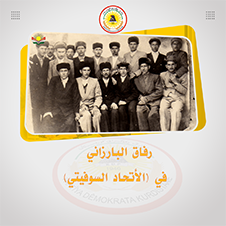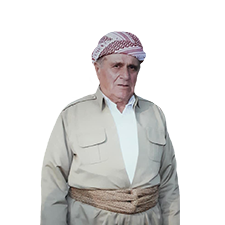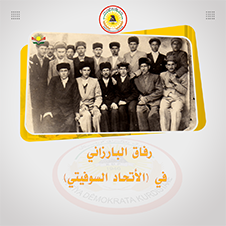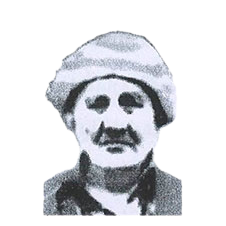


the biography
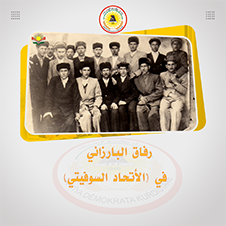
Jamil Tawfiq Hussein Known as Jamil Sur, he was born in 1912 in the Bamarni district of Amadiya, Dohuk Governorate. He joined the Hiwa Party in 1939. He was married to Maryam Mustafa Taha before going to the Soviet Union, with whom he had two sons (Izzat Jamil, 1936) and (Behzad Jamil, 1940) and a daughter (Kulizar Jamil, 1942). After arriving in the Soviet Union, he married Zulfiya Aghlib Safar, with whom he had a son (Abdullah Jamil, 1954) and two daughters (Asmar Jamil, 1952) and (Zuleikha Jamil, 1956). He was martyred on the night of October 4/5, 1963, in the Battle of Jabal Matin.
pages of struggle
He joined the ranks of the second Barzan revolution in 1945, participated in all the battles, and for this reason all his movable and immovable property was confiscated on August 19, 1945, by order of the Iraqi Military Court.
After the setback of the second Barzan revolution on October 11, 1945, he crossed with Mustafa Barzani and his companions towards eastern Kurdistan, and after the establishment of the Democratic Republic of Kurdistan in Mahabad, on March 31, 1946, he defended the republic within the framework of the Barzan force.
After the collapse of the Republic of Kurdistan in Mahabad and Barzani’s return from eastern Kurdistan to southern Kurdistan, he participated in the battles of Naghdeh and Shino in eastern Kurdistan, and he was among his Peshmerga comrades, as he returned on 19/4/1947 via (Khakurk and the Barazgara Plain) through the lands of northern Kurdistan to the Shirwan and Mazuri regions.
Upon their return, General Mustafa Barzani held a meeting with his comrades in the village of Arkush on May 15, 1947, and gave them the choice of staying or going to the Soviet Union. There, all his comrades decided to continue and head to the Soviet Union. On May 23, 1947, they accompanied General Mustafa Barzani to the Soviet Union, participating in the battles of Qatur and the Maku Bridge. After great hardship and exhaustion, they crossed the Aras River on June 18, 1947, which lies on the border between Iran and the Soviet Union.
Upon their arrival in the Soviet Union on June 19, 1947, he and all his comrades were detained in the city of Nakhchivan, Azerbaijan, for forty days in an open compound surrounded by barbed wire and guarded by soldiers. They were treated as prisoners of war in terms of food, clothing, and transportation. By order of the Soviet government, they were later distributed to the Aghdam, Lachin, Ayulakh, and Kalbajar regions of Azerbaijan. On December 10, 1947, they were transferred to a camp on the Caspian Sea in Baku, the capital of Azerbaijan. On December 23, they received military uniforms and underwent eight hours of daily military training under the supervision of Azerbaijani officers. Simultaneously, they received four hours of daily Kurdish language instruction from some of their more educated comrades.
After Jafar Bakirov's mistreatment of his comrades, Barzani decided to move his military assembly from Azerbaijan on August 29, 1948, to the Girjuk complex near the Uzbek capital, Tashkent, where they continued their military training.
In March 1949, he and his comrades were distributed in groups by train to the collective villages of the Soviet Union and worked on the farms of the kolkhoz (land that people rented from the government and then paid a share of in return to the government). After great efforts and sending several letters from General Barzani to Stalin, Stalin finally received a letter in which Barzani spoke about the suffering of his comrades, and he immediately decided to form a commission to investigate the situation of Barzani's comrades. The commission's final decision was that they should be gathered in the city of Frivsky, so in November 1951 he went to the Soviet city of Frivsky.
After the July 14, 1958 revolution and the return of General Mustafa Barzani on February 25, 1959, he and his companions were included in the general amnesty according to Articles (3) and (7) and Paragraph (a) of Article (10) and the application of Article (11) pursuant to Law No. (19) amended for the year 1959.
The Republic of Iraq was founded in 1958 under the leadership of Abdul Karim Qasim. He returned with his companions on April 16, 1959, to Kurdistan aboard the ship Croziah via the port of Basra in southern Iraq, and settled in Sarsang. In 1961, he participated in September Revolution He held the position of (Serleq - Company Commander), and was the local official for Sabna-Bamarni (Duhok). He participated during September Revolution In the epic of Kli Zawita, Kli Qantara, the Battle of Siyartika, Sarsank and the purification of Briker, he was martyred on the night of 4/5 October 1963 in the Battle of Mount Matin.
Sources:
- The Government of the Prime Minister of Kurdistan, the Ministry of Plan Danan, the Ministry of Foreign Affairs of Kurdistan, the Ministry of Khazanika and Danishtwan, Holler, 2009g.
- Hamid Ghardi, the name of the word, the name of the person, (Hawler - this is the name of the family and the people of Aras - Chakhani) Peruvian Ministry - 2004g).
- Haider Farouk Al-Samarrai, Diaa Jaafar and his political and economic role in Iraq, (London - Dar Al-Hikma - 2016 AD).
- Dana Adams Schmidt, Your Journey to Now Be in Azakani Kurdistan, and Abu Bakr Sah Ismail, (Dahic - New Year's Day) In Jordan and Mokryani - Chapkhani Khani - 2008g).
- Singer and Peshmerga, Jamil Tawfiq Hussein and Bernias B. Jamil Singer and Peshmerga, Iranian Party Democracy of Kurdistan, Holler, October 15, 2018.
- Omar Faruqi, Sardar Dana Zindagi and the duels of the late Mullah Mustafa Barzani, Chap Dom, (Holler - Chapkhani, Ministry of Foreign Affairs and Purchase - 2002g).
- Abdullah Hamman Mullah Habib Abu Bakr, My Barzan clan, from November 1931 to 1991, today, (Holler - Secretary of the Ministry of Foreign Affairs) Rushanberi - 2001g).
- Karwan Muhammad Majeed, Barzaniyakan La Mahabad y Bachfiyet, Jabiyekam, (Solemani - Saudi Arabia - 2011g).
- This is the story of the Shahid of Hassan Mirkhan, 62 of Barzani’s language, this is where Barzani was on your computer, Here you are (Holler - Russian Federation - 1997).
- Laith Abdul-Muhsin Jawad Al-Zubaidi, The July 14, 1958 Revolution in Iraq, (Baghdad - Dar Al-Rashid Publishing - 1979 AD).
- Mustafa Hussein Shaaban, the leader of the Kurdistan Democratic Party, March 2925, Holler, Ping Shim, September 16, 1999, pp. 4.
- Masoud Barzani, Barzani and his wife, and the people of the country, 1931-1958, (Dahik - Chapkhani Khabat - 1998).
- Masoud Barzani, Barzani and his wife, and the people of the Ministry of Foreign Affairs, 1961-1975, Barghi Seim, Bishkem, (Holler - Ministry of Foreign Affairs). Peruardah - 2004g).
- Najaf Qoli Basyan, to Mahabadi Khoinawiyya and Hita Liwarakani Aras, and. Shaukat Sheikh Yazdin, Your Honor, (Permam - People of the Democratic Party of Kurdistan - 1996).
- Archive of the Encyclopedia Authority of the Kurdistan Democratic Party.