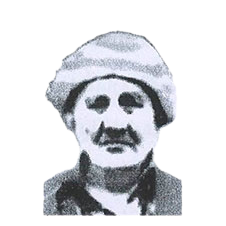


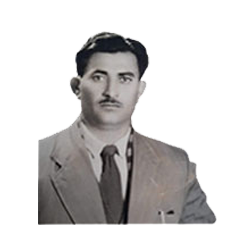
the biography
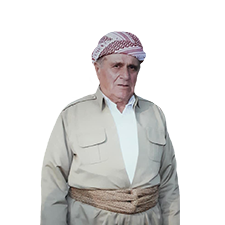
He was born in 1921 in the village of Che, which belongs to the Derlok district in the Amadiya region of Duhok Governorate. He studied in the Soviet Union. He married Khadija Ismail Lova, and they had two daughters (Rukhfaza and Laila). He died in 1983 in Tehran, the capital of the Islamic Republic of Iran.
pages of struggle
On October 11, 1945, after the setback of the Barzan revolution, he crossed with Mustafa Barzani and his companions to eastern Kurdistan. After the establishment of the Democratic Republic of Kurdistan in Mahabad on March 31, 1946, he defended the republic within the framework of the Barzan force.
After the collapse of the Republic of Kurdistan in Mahabad and Barzani’s return from eastern Kurdistan to southern Kurdistan, he participated in the battles of Naghdeh and Shino in eastern Kurdistan, and he was among his Peshmerga comrades, as he returned on 19/4/1947 via (Khakurk and the Barazgara Plain) through the lands of northern Kurdistan to the Shirwan and Mazuri regions.
Upon their return, General Mustafa Barzani held a meeting with his comrades in the village of Arkush on May 15, 1947, and gave them the choice of staying or going to the Soviet Union. There, all his comrades decided to continue and head to the Soviet Union. On May 23, 1947, they accompanied General Mustafa Barzani to the Soviet Union, participating in the battles of Qatur and the Maku Bridge. After great hardship and exhaustion, they crossed the Aras River, which lies on the border between Iran and the Soviet Union, on June 18, 1947.
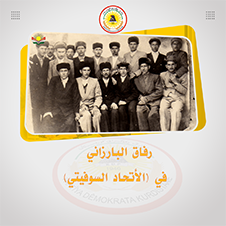
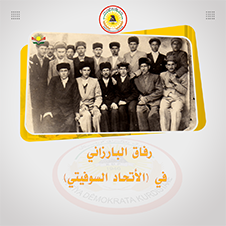
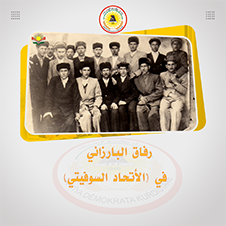
Upon their arrival in the Soviet Union on June 19, 1947, he and all his comrades were detained in the city of Nakhchivan, Azerbaijan, for forty days in an open compound surrounded by barbed wire and guarded by soldiers. They were treated as prisoners of war in terms of food, clothing, and transportation. By order of the Soviet government, they were later distributed to the Aghdam, Lachin, Ayulakh, and Kalbajar regions of Azerbaijan. On December 10, 1947, they were transferred to a camp on the Caspian Sea in Baku, the capital of Azerbaijan. On December 23, they received military uniforms and underwent eight hours of daily military training under the supervision of Azerbaijani officers. Simultaneously, they received four hours of daily Kurdish language instruction from some of their more educated comrades.
After Jafar Bakirov's mistreatment of his comrades, Barzani decided to move his military assembly from Azerbaijan on August 29, 1948, to the Girjuk complex near the Uzbek capital, Tashkent, where they continued their military training.
In March 1949, he and his comrades were distributed in groups by train to cooperative villages in the Soviet Union and worked on kolkhoz farms (land that people rented from the government and then paid a share of to the government).
After great efforts and sending several letters from General Barzani to Stalin, Stalin finally received a letter in which Barzani spoke about the suffering of his comrades, and he immediately decided to form a committee to investigate the situation of Barzani’s comrades. The committee’s final decision was that they should be gathered in the city of Frivsky, so in November 1951 he went to the Soviet city of Frivsky.
After the July 14, 1958 revolution in Iraq, and the return of General Mustafa Barzani, on February 25, 1959, he and his companions were included in the general amnesty according to Articles (3) and (7) and Paragraph (a) of Article (10) and the application of Article (11) pursuant to Law No. (19) amended for the year 1959.
In 1958, the Republic of Iraq was founded under the leadership of Abdul Karim Qasim. He returned with his companions on April 16, 1959, to Kurdistan on board the ship Crusia via the port of Basra in southern Iraq.
Participate in September Revolution In 1961, and in 1975, after the setback September RevolutionHe went as a refugee to the Kingdom of Iran, and in 1976 he participated in the Gulan Revolution.
Sources:
- The government of the Haririmi of Kurdistan, the Hazara of Plan Danan, and the Kargikani Parizkani of the Haririmi of Kurdistan and Jamara. Khazanehkan and Danishtwan, Höller, 2009g).
- Hamid Ghaherdi, the name of God, the name of God, (Holler - Dehzghai Chap and the name of Aras) - Chapkhana and Hazara of Iran - 2004g).
- Shah'aban Ali Shah'aban, this is a political and religious harlot, a handsome man, (Hol. 2013g).
- Shahoukat Sheikh Yehzadin, Bible Verse, (Permam - Chapkhana Khabat - 1996 AD).
- Omar Faruqi, Sardar Dana Zindagi and the duels of the late Mullah Mustafa Barzani, Chap Dom, (Holler - Chap Khaneh, Zarat Yamuzesh and Porrush - 2002g).
- Karwan Mohamed Mohamed Mohjid, Barzaniyah, had a career in the Soviet Union, the name of his family, (Solemani - Chakhana). India - 2011g).
- He has the best understanding of Shahid Hassiah Mirkhan Zajczyki, 62 years of Barzani’s language. This is the language of society, the name of God (Holler - Chapkhana, Richanperi - 1997).
- Laith Abdul-Muhsin Jawad Al-Zubaidi, The July 14, 1958 Revolution in Iraq, (Baghdad - Dar Al-Rashid Publishing - 1979 AD).
- Masoud Barzani, Barzani and his wife, Rezagari Khwazi Kurd 1931-1958, (Dehek - Chapkhaneh Khabat - 1998).
- Archive of the Encyclopedia Authority of the Kurdistan Democratic Party.