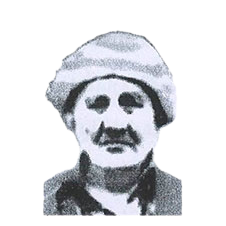


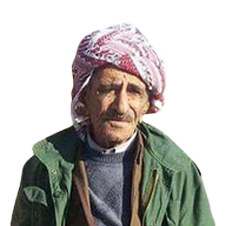
the biography
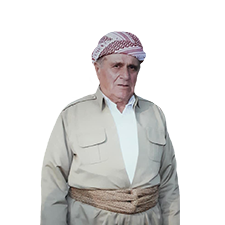
child Badro Lashkari Hussein In 1930, in the village of Bistri, in the Kurtu sub-district of Mergasur district, Erbil Governorate, he married Kurdistan Mohammed Hali, and they had four sons and one daughter: Sarkawt, Matin, Halkawt, Rikot, and Aisha. He studied in the Soviet Union and obtained a bachelor's degree in agriculture. He sought refuge in Iran in 1975 and returned to Kurdistan in 1995.
pages of struggle
In 1943, he joined the ranks of the Second Barzan Revolution. On November 6, 1943, he participated in the capture of the Kurtu police station. On September 5, 1945, he participated in the capture of the Maidan Murek police station. On August 19, 1945, all his movable and immovable property was confiscated by order of the Iraqi Military Court due to his participation in the revolution. September Revolution Second.
After October 11, 1945, and after the setback September Revolution Secondly, he headed to eastern Kurdistan. On March 31, 1946, he served as a Peshmerga with his brothers, Ahmed Lashkari and Sharif Lashkari, in the Barzan force of the Kurdistan Democratic Republic. They were part of Saleh Mustafa's force at the Saqqez front in the Kurdistan Democratic Republic.
On April 29, 1946, he participated in the Battle of Qarawa in the Saqqez region, and on May 3, 1946, he participated in the Battle of Malqarni. After the collapse of the Kurdistan Democratic Republic, he participated on March 3, 1947, in the Battle of Nilus, and in the battles of Naghda and Shino in eastern Kurdistan on March 19, 1947.
After the collapse of the Kurdistan Democratic Republic and Barzani's return from eastern Kurdistan to southern Kurdistan, he participated in the battles of Naghda and Shino in eastern Kurdistan, and was among the Peshmerga who returned on 19/4/1947 to the Shirwan and Mazuri regions via (Khwakurk and the Barazkara Plain) through the lands of northern Kurdistan.
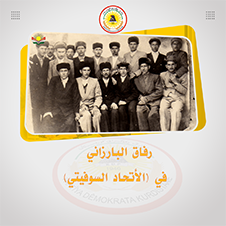
Upon their return, General Mustafa Barzani held a meeting with his comrades in the village of Arkush on May 15, 1947, and gave them the choice of staying or going to the Soviet Union. There, all his comrades decided to continue their journey to the Soviet Union. On May 23, 1947, they accompanied General Mustafa Barzani to the Soviet Union, participating in the battles of Wadi Qatur and the Maku Bridge. After great hardship and exhaustion, they crossed the Aras River on June 18, 1947, into the Soviet Union, which lies on the border between Iran and the Soviet Union.
On June 19, 1947, he and all his comrades were detained in the city of Nakhchivan, Azerbaijan, for forty days in an open compound surrounded by barbed wire and guarded by soldiers. They were treated as prisoners of war in terms of food, clothing, and transportation. By order of the Soviet government, they were later distributed to the Aghdam, Lachin, Ayvalakh, and Kalbajar regions of Azerbaijan. On December 10, 1947, they were transferred to a camp on the Caspian Sea in Baku, the capital of Azerbaijan. On December 23, 1947, they received military uniforms and underwent eight hours of daily military training under the supervision of Azerbaijani officers. Simultaneously, they received four hours of daily Kurdish language instruction from some of their more educated comrades.
After Jafar Bakirov's mistreatment of his comrades, Barzani decided to move his military assembly from Azerbaijan on August 29, 1948, to the Girjuk complex near the Uzbek capital, Chkend, where they continued their military training.
In March 1949, he and his comrades were distributed in groups by train to cooperative villages in the Soviet Union and worked on kolkhoz farms (land that people rented from the government and then paid a share of to the government).
After great efforts and sending several letters from General Barzani to Stalin, Stalin finally received a letter in which Barzani spoke about the suffering of his comrades, and he immediately decided to form a committee to investigate the situation of Barzani’s comrades. The committee’s final decision was that they should be gathered in the city of Frivsky, so in November 1951 he went to the Soviet city of Frivsky.
He returned with his companions on April 16, 1959 to Kurdistan aboard the ship Crozea via the port of Basra in southern Iraq.
In 1963 he participated in September Revolution He held the position of (Sarpal - Commander of the Platoon) and participated in the battles of Mount Pirs and Sari Akri. He went with Mulla Mustafa Barzani to the Soran region, and remained until 1975 in his brother Sharif Lashkari’s company.
In 1975, after the September setback, he sought refuge in Iran. He initially resided in the Zewa complex, then was transferred to Isfahan, and later to Toriz. In 1980, he participated in the Gulan Revolution and was a member of the Peshmerga in the office of President Masoud Barzani.
He returned to southern Kurdistan in 1995, and on December 11, 2010, during the 13th Congress of the Kurdistan Democratic Party, he was awarded the Barzani Medal by President Masoud Barzani in recognition of his struggle and sacrifices in the Second Barzan Revolution, in the Democratic Republic of Kurdistan, as well as his participation in the September and Gulan Revolutions and his accompanying General Mustafa Barzani to the Soviet Union.
Sources:
- Hamid Ghayohehri, Barzani’s Medal, Behreztrin Khazlinan, Barghi Hekham, (Holler - Haji Hashem’s Office) - 2015).
- Hamid Ghajerdi, Pakhteh Mezhou Nameh, Shabi Yahkim, (Holler - Dezghai Chap and Bukordaneh Aras - Chapkhana and Hazara of Iran - 2004).
- Haider Farouk Al-Samarrai, Diaa Jaafar and his political and economic role in Iraq, (London - Dar Al-Hikma - 2016).
- Bahdari Lah Shukri Hossein, Fermi Havalani Barzani (Bargay Barzani - Laygny Nawchi Barzan).
- Text of the decision of the General Amnesty Committee to restore the honor of the martyrs of the Barzan Revolution, Rizgari Magazine, Issue 3, 2, Al-Rabita Press, Baghdad, April 1, 1959.