


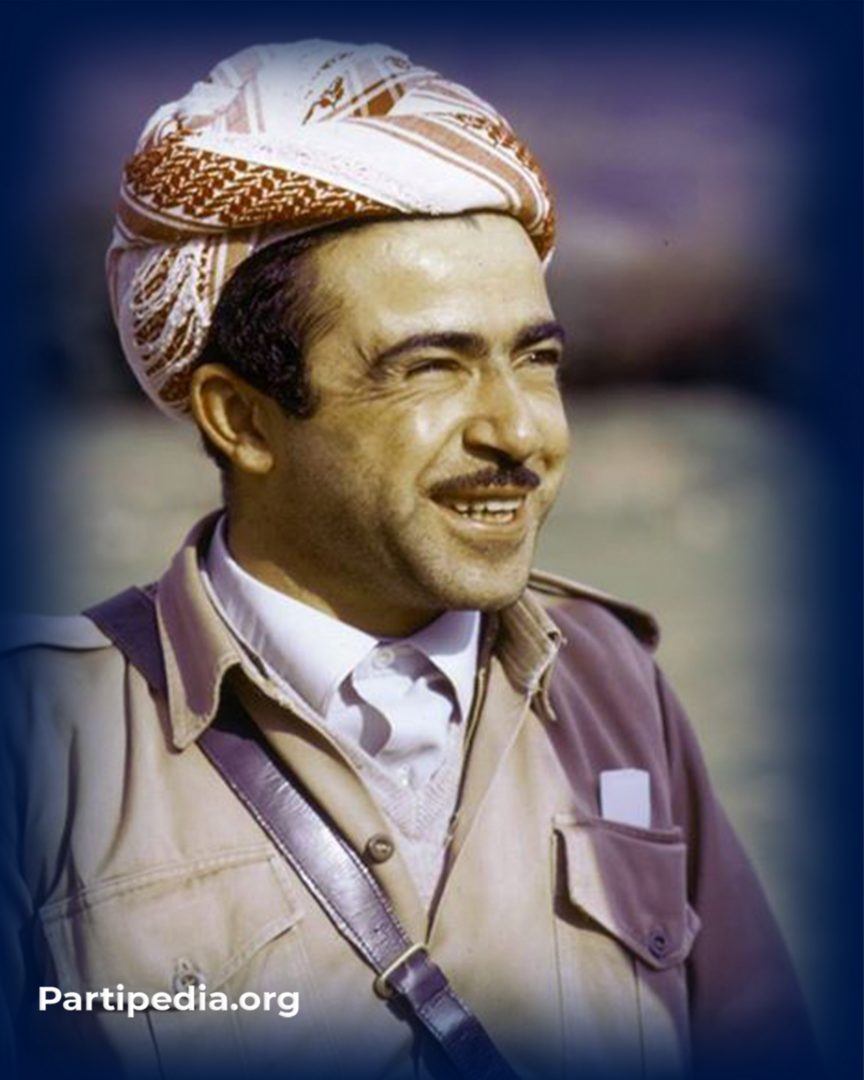
Idris Mustafa Barzani was one of the most prominent leaders of the Kurdistan Democratic Party (KDP) and the son of President Mustafa Barzani. After participating in the September Revolution and playing his role as assistant to President Mustafa Barzani for military and social affairs, friends are happy with the appearance of this capable leader and enemies are sad. Also after the Kurdish people's liberation movement led by General Mustafa BarzaniThe leader of the September Revolution entered into negotiations with the Iraqi government to bring about peace. The role of Idris Barzani in these negotiations was undeniable.
After the March 11 agreement, the Ba'ath Party leadership asked President Mustafa Barzani to appoint Idris as vice president of Iraq, but Barzani refused. Idris Barzani also visited the United States and met with senior officials. However, it is not known whether the Iraqi intelligence agency knew about it or not. These two steps prove that Idris Barzani not only had a role and influence in terms of social and military, but also politically became a name and relied on.
All this reputation and active role made the Ba'ath regime try to destroy him Idris Barzani and assassinate him. On December 1, 1970, to follow up and discuss how to implement the March 11, 1970 agreement, especially the fate of the Peshmerga and the formation of the Border Guard Force (Border Guard) from its Peshmergas The September RevolutionIdris Barzani visited Baghdad and met with Ahmad Hassan Bakr, the then Iraqi President and Saddam Hussein, the then Vice President, but was attempted to be assassinated there.
In order to implement the March 11 agreement, especially the issue of the composition of the border guards, on December 1, 1970, Idris Barzani and a number of Peshmerga leaders, including Hamid BarwariHe was supposed to stay in Baghdad for three days, but he sent a letter saying that the president asked him to stay for a few more days. But our uncle Sheikh Baba, who wanted to visit us in Haji Omeran, wanted to return to Barzan Barzan: On December 6, my uncle asked me if I could know Idris' decision about his return. I tried to talk to Idris on the phone, but the phone line was weak and I didn't understand anything. I called Erbil police director Sheikh Reza Gulani and told him to try to call Idris and tell him that my uncle was in a hurry to return to Barzan Otherwise, my uncle would return to Barzan alone. God wanted Sheikh Reza to understand that Idris' return was very important and he must return immediately.
Idris had sent the Mercedes car given to him by the Iraqi president to the garage to repair some defects, so he did not wait for the car to be repaired and returned to Erbil by taxi Hamid Barwari and Mohammed Aziz, who had come with him to Baghdad and stayed there to return, on the evening of the day Idris left Baghdad on December 6, each Hamid Barwari Some jashes, in collaboration with the Director of General Security, Nazim Gazar, had planned to kill Idris. I don't think it is unlikely that some senior Iraqi officials were involved in this plan They thought Idris was in the car. At 10 pm, the car was shot at Hamid Barwari Idris, because the shape of both of them was a little similar, Hamid Barwari He was seriously injured. More than 50 bullets hit the car, but Mohammad Aziz and his driver were unharmed. Their survival was a miracle. The driver, Hassan Kawani, was a quick and alert driver The location of the ambush. Thus, Idris was destined to escape the assassination plot, because the conspirator thought Idris was in the car given to him by the president, while Idris was on his way back home without anyone knowing.
The Iraqi government, as always, exonerated itself from the incident and asked the revolutionary leadership to provide them with information to find and punish the perpetrators.
Saddam sent a handwritten letter to President Mustafa Barzani assuring him that what had been done was against the March 11 agreement and that there were people who wanted it not to be implemented.
Those who attempted to assassinate Idris Barzani were exposed and punished by the Red Court, but those who decided to assassinate him remained secret until the 1973 coup d'etat, when the Iraqi government acknowledged that Nazim Gazar had done it.
reference:
1. Massoud Barzani, Barzani and the Kurdish Liberation Movement, Volume III, Part II, The September Revolution 1961- 1975, first edition (Erbil- Ministry of Peshmerga Printing House- 2004).