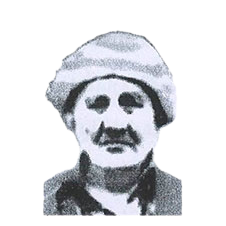


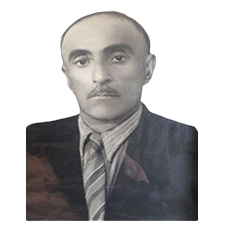
the biography
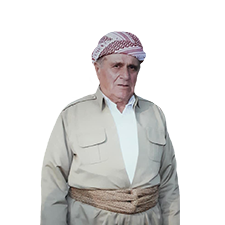
Suleiman Bek Darkali was born in 1898 in the village of Darkali, in the Warti sub-district of Rawanduz district, Erbil Governorate. Before emigrating to the Soviet Union, he had two families. His first wife was Aisha Fattah Hussein, with whom he had one son and three daughters: Mat Suleiman (1932), Saadat Suleiman (1936), Izzat Suleiman (1937), and Nazli Suleiman (1940). His second wife was Halim Wasouaziz, with whom he had three sons: Shawqi Suleiman (1936), Salah al-Din Suleiman (1939), and Sherzad Suleiman (1945). While in the Soviet Union, he married a woman named Nina. He was fluent in Kurdish, Arabic, Turkish, and Russian. He died in 1974 in the village of Darkali, where he was buried.
pages of struggle
Suleiman Bek Darkali was an officer in the Royal Iraqi Army who deserted from the military and joined the ranks of the Second Barzan Revolution in 1944 and participated in the battles. On August 19, 1945, all his movable and immovable property was confiscated by order of the Iraqi Military Court. On October 11, 1945, after the setback of the Second Barzan Revolution, he moved with his family to eastern Kurdistan.
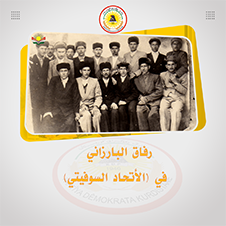
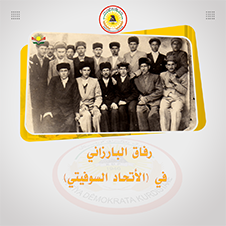
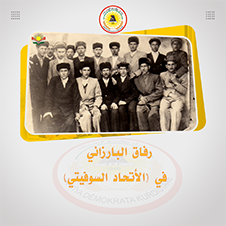
On March 31, 1946, he joined the Barzani forces of the Kurdistan Democratic Republic Army. On April 29, 1946, he participated in the Battle of Qarawa under the leadership of Khader Suleiman Bek in the Saqqez region of eastern Kurdistan. On April 15, 1947, he crossed the Kadar River with Sheikh Ahmed Barzani, located on the international border between the Iranian and Iraqi kingdoms, and was detained for several months in the Diana (Erbil) garrison. On April 19, 1947, he decided to continue the struggle under the leadership of General Mustafa Barzani. On May 23, 1947, after an expanded meeting in the village of Dari, he decided to join the force in the Soviet Union. On May 28, 1947, he attended a meeting in the village of Jerma at the request of Mirhaj Ahmad. On June 18, 1947, he crossed the Aras River on the Iranian border with the Soviet Union. On June 19, 1947, he and all his comrades were detained in Nakhchivan, in the Soviet Republic of Azerbaijan, for forty days in an open compound surrounded by barbed wire and guarded by soldiers. They were treated as prisoners of war in terms of food, clothing, and transportation. On June 23, by order of the Soviet government, they were gathered and housed in the Aghdam, Lachin, and Ayulakh regions of the Republic of Azerbaijan. On December 10, 1947, they were transferred to the Baku camp in the Soviet Republic of Azerbaijan. On December 23, 1947, they were given military uniforms and began receiving military training for eight hours a day under the supervision of officers from the Republic of Azerbaijan. They also received Kurdish language lessons for four hours a day from some educated refugees. On January 19, 1948, he became a member of the political leadership of Iraqi Kurdistan at the Baku General Conference, which was attended by delegates from all Iraqi and Iranian Kurds. On August 29, 1948, he and his comrades were transferred from the Soviet Republic of Azerbaijan to the Girchuk training complex near Tashkent, the capital of the Soviet Republic of Uzbekistan, where they continued their military training. On March 14, 1949, he and his comrades were divided into groups and transported by train to cooperative villages before being taken to Samarkand. In November 1951, he returned to Frisovsky in the Soviet Union, and on April 16, 1959, he and his comrades returned to Kurdistan aboard the ship Crusader via the port of Basra in southern Iraq. He participated in the September Revolution.
Sources
1. Interview with Matin Magazine, Comrade in struggle with Barzani Aziz Qazi recounts his memoirs, Part Two, Matin Magazine, First Branch of the Kurdistan Democratic Party - United, Issue 48, Third Round, Duhok, Hawar Press, December 2, 1996.
2. Hamid Gardi, Summary of the Historical Message, First Edition, (Erbil - Aras Foundation for Printing and Publishing - Ministry of Education Press - 2004 AD).
3. Haider Farouk Al-Samarrai, Diaa Jaafar and the Political and Economic Role in Iraq (London - Dar Al-Hikma - 2016).
4. Zarar Suleiman Bek Darkali, My Memories of the Years 1943-1977 (Sulaimaniyah - Rahand Press - 2002 AD).
5. Shaaban Ali Shaaban, Some Political and Historical Information, Third Edition, (Erbil - Rozhlat Press - 2013 AD).
6. Omar Faruqi, Sardar Dana Zindagi and the duels of the late Mullah Mustafa Barzani, Chap Dom, (Holler - Chap Khaneh and Zarat Amozesh and Parrush - 2002g).
7. Abdul Rahman Amla Habib Abu Bakr, The Barzan Clan between 1931 - 1991, First Edition, (Erbil - Ministry of Culture Press - 2001 AD).
8. Abdullah Ghafour, Erbil Geographical Dictionary, (Erbil - Kurdish Academy Publications - Haji Hashim Press - 2015) p. 215, p. 234
9. Karwan Muhammad Majid, The Barzanis from Mahabad to the Soviets, First Edition, (Sulaymaniyah - Baywand Press - 2011 AD).
10. Laith Abdul-Muhsin Jawad Al-Zubaidi, The July 14, 1958 Revolution in Iraq (Baghdad - Dar Al-Rasheed Publishing - 1979).
11. Masoud Barzani, Barzani and the Kurdish Liberation Movement 1931-1958, (Duhok, Khabat Press, 1998).
12. Najaf Qoli Basyan, From Bloody Mahabad to the Banks of Aras, translated by Shawkat Sheikh Yazdin, First Edition (Pirmam - The Golden Jubilee of the Kurdistan Democratic Party 1996).
13. Archive of the Encyclopedia Authority of the Kurdistan Democratic Party.