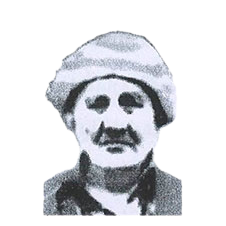



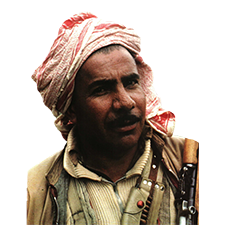
the biography
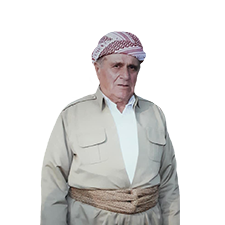
child Bijan Jundu Ali In 1926, in the village of Hoder in eastern Kurdistan, he studied in the Soviet Union. There, he married the Ukrainian woman, Rosa Alexandra, and they had two daughters (Erka and Asia). He obtained a bachelor's degree from Tashkent University - the Political Academy in the Soviet Union. He was a professor of Russian language at the University of Baghdad, and he gave lectures at Al-Mustansiriya and Alexandria Universities, as well as to Iraqi officers at the Military College in Baghdad. His wife, Rosa, was an employee. In 1963, Rosa was constantly targeted by the Ba'athist regime on charges of accompanying her husband to General Mustafa Barzani and being a Peshmerga, which forced her to return to the Soviet Union. In 1970, Bijan married for the second time to Mrs. Saadia Hussein Karim, who was from Erbil. He returned to Iran in 1974 and settled in Naghdeh. Bijan obtained a civil status identity and citizenship for himself and his family. He worked in agriculture in his village on the lands of the Agha, because he did not own agricultural land, and he continued to do so until his martyrdom.
pages of struggle
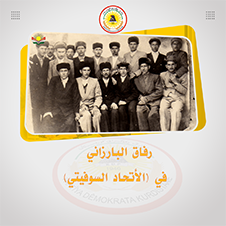
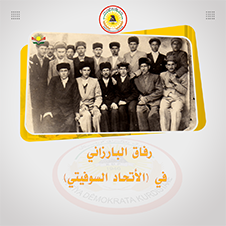
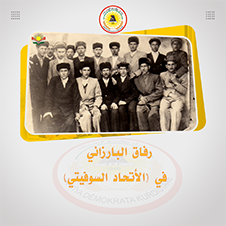
Bijan accompanied General Mustafa Barzani on June 3, 1947, on his march to the Soviet Union from the village of Smail Agha in eastern Kurdistan and participated in the battles of that march. After great hardship and extreme fatigue, he crossed the Aras River on June 18, 1947, which is located on the border between Iran and the Soviet Union.
Upon their arrival in the Soviet Union on June 19, 1947, he and all his comrades were detained in the city of Nakhchivan, Azerbaijan, for forty days in an open compound surrounded by barbed wire and guarded by soldiers. They were treated as prisoners of war in terms of food, clothing, and transportation. By order of the Soviet government, they were later distributed to the Aghdam, Lachin, Ayulakh, and Kalbajar regions of Azerbaijan. On December 10, 1947, they were transferred to a camp on the Caspian Sea in Baku, the capital of Azerbaijan. On December 23, they received military uniforms and underwent eight hours of daily military training under the supervision of Azerbaijani officers. Simultaneously, they received four hours of daily Kurdish language instruction from some of their more educated comrades.
After Jafar Bakirov's mistreatment of his comrades, Barzani decided to move his military assembly from Azerbaijan on August 29, 1948, to the Girjuk complex near the Uzbek capital, Tashkent, where they continued their military training.
In March 1949, he and his comrades were distributed in groups by train to cooperative villages in the Soviet Union and worked on kolkhoz farms (land that people rented from the government and then paid a share of to the government).
After great efforts and sending several letters from General Barzani to Stalin, Stalin finally received a letter in which Barzani spoke about the suffering of his comrades, and he immediately decided to form a committee to investigate the situation of Barzani’s comrades. The committee’s final decision was that they should be gathered in the city of Frivsky, so in November 1951 he went to the Soviet city of Frivsky.
In 1958, the Republic of Iraq was founded under the leadership of Abdul Karim Qasim. He returned with his companions on April 16, 1959, to Kurdistan on board the ship Crusia via the port of Basra in southern Iraq.
In 1962 he participated in September RevolutionHe held the position of wing commander. In 1974, he served for several months as commander of the 6th Regiment in the Balak Force, succeeding Mr. Asi Mr. Muhammad. He participated in the battles of Zarkali and Kurahz, and also completed an artillery course. He worked in meteorology during the time of September RevolutionHe also participated in the battles of the Erbil Plain, Koisinjaq, Ranya, Qaladiza, as well as in the battles of the Bahdinan region.
In 1979, he received a message from Dr. Qasimlu requesting him to join the Kurdistan Democratic Party of Iran due to the urgent need for him. Afterwards, he returned to the village of Hodari to meet his family. The Iranian government sensed Bijan's arrival in Hodari, and a battle broke out between the Kurdistan Democratic Party of Iran and the Islamic Republic of Iran, in which Bijan was martyred and buried in his village.
Sources:
-Archive of the Encyclopedia Authority of the Kurdistan Democratic Party.