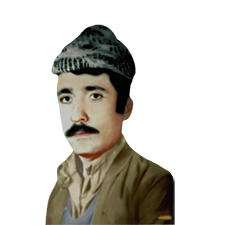


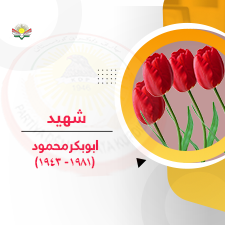
Abu Bakr Mahmoud Hama Sharif was born in 1943 in the village of Bani Banouk at the foot of Mount Surin, which belongs to the Khurmal district. He was a villager and completed his primary education. He sought refuge in Iran after the setback. September Revolution He resided in the city of Mariwan. He was married to Kafia Muhammad, and she shared the struggle with him in the ranks of the Peshmerga. She increased her activities after the martyrdom of Abu Bakr. On October 20, when Kafia and her Peshmerga comrades intended to enter Sayyid Sadiq, they fell into an ambush set up by the soldiers of the Ba'athist regime on the outskirts of Ahmad Awa. One of the Peshmerga, Muhammad Faraj, was martyred, and Anwar Haj Othman was seriously wounded. Abu Bakr was the father of four sons and one daughter (Fadil, Qadir, Shakhwan, Dilshad - who died in Iran - and Chenur).
In 1969, he became involved with the Darbandikhan local committee of the fourth branch of the Kurdistan Democratic Party. His brother, Mulla Omar Bani Banuki, was then in charge of the local committee. He participated in 1974 during the September Revolution In several battles, including the Battle of Sartiz, the Battle of Darbandikhan, and the Battle of Mount Zamnako, he became the deputy commander of the 4th Company in the (Bamo) Regiment within the Khabat Forces of the Kurdistan Democratic Party in 1974. Ahmed Chaqz was the company commander at that time, and Hama Sur was the regiment commander.
Abu Bakr Mahmoud did not abandon the armed struggle with his family after the setback September Revolution In 1975, he continued the struggle, participating in the Golan Revolution with guerrilla warfare activities in the Sharazur Plain, including activities inside the city of Sulaymaniyah, the Battle of Sharabazhir, the Battle of Qara Kulita, the Battle of Qainja Sharazur Village, the battles of Halabja and other heroic epics.
In 1979, Abu Bakr Mahmoud Hama Sharif and a group of his Peshmerga comrades entered the city of Sulaymaniyah to carry out an important operation. After carrying it out and returning, they fell into an ambush set up by a number of soldiers and mercenaries (Jahush) of the Ba'athist regime near the village of Qawila in the Sharazur plain, which led to the martyrdom of a number of them. Abu Bakr Mahmoud Hama Sharif and Othman Banishari were seriously wounded, but they were able to escape and get away from the area.
In 1979, he obtained the position of regiment commander in the Surin forces of the Kurdistan Democratic Party, and the rank of member of the Darbandikhan local committee affiliated with the fourth branch of the Kurdistan Democratic Party.
In 1981, a large force of soldiers and mercenaries (Jash) of the Baathist regime launched an extensive attack on the Peshmerga positions on the Iranian border, Kani Khayran and Dawla Naw. Abu Bakr Mahmoud was seriously wounded during the clashes between the two sides, but the enemy was unable to seize his position. The Baathist forces withdrew from the area, but the Baathist regime’s planes launched intensive air raids and bombed the Peshmerga positions with shells. Abu Bakr Mahmoud Hama Sharif was martyred after being hit by several shrapnel fragments fired by the planes. After his martyrdom, his Peshmerga comrades transported his body to the Iranian city of Marivan, where he was buried in the Dasivan cemetery next to his wife’s shrine.
Source:
Archive of the Encyclopedia Authority of the Kurdistan Democratic Party